

Photoelectric vs Inductive vs Capacitive Proximity Sensors
Inductive, capacitive, and photoelectric proximity sensors all detect targets without physical contact, but each reads a different slice of the physical world. Specify the wrong one and you get a sensor that cannot see your target, falls apart in your environment, or costs three times what the job needs. The selection criteria are material-dependent, range-dependent, and environment-dependent, yet vendors rarely explain all three in one place with real specs. This guide gives you a material-first decision framework, a sensing range comparison across all three technologies, a reduction factor table for non-ferrous metals, an environmental tolerance matrix, switching frequency specs, and real cost data by tier.
For broader context on how industrial sensors work across measurement domains, the complete guide covers the full landscape. For the wiring step that follows sensor selection, the guide to wiring NPN and PNP proximity sensors covers every output type you will encounter.
TL;DR: Pick inductive for ferrous and non-ferrous metal targets at close range (1-80 mm) - it ignores dust, oil, and moisture and costs $15-35. Pick capacitive when the target is plastic, liquid, glass, or granular material (~3-60 mm standard) - it costs 20-40% more and is sensitive to humidity. Pick photoelectric when range exceeds 60 mm or when you need to detect any material at distances up to 30 meters - budget $30-200+ depending on mode (Sense-the-World, 2025; WEHO Power, 2024). Start with material, then distance, and the technology choice is automatic.
How Does Each Technology Detect Targets?
Inductive uses an oscillating electromagnetic field that is damped by conductive metal targets only. Capacitive uses an electrostatic field that responds to any material with a dielectric constant above air - plastic, liquid, wood, glass. Photoelectric uses a beam of light interrupted, reflected, or returned by virtually any surface (WEHO Power, 2024). The operating principle sets material compatibility, range limits, and environmental vulnerability before you open a single spec sheet.
An inductive sensor generates eddy currents in nearby metal that damp its oscillator amplitude. A threshold circuit fires the output when the damping crosses a set point. No metal, no detection - that constraint is absolute. High-precision models such as the Keyence EX-V series achieve accuracy of ±0.3% full scale with a temperature coefficient of 0.07% F.S./°C, making them suitable for dimensional gauging as well as presence/absence.
A capacitive sensor's sensing face forms one plate of a capacitor; the target forms the other. Any material with a higher dielectric constant than air - liquid, plastic, wood, glass, granular bulk material - increases capacitance enough to trigger the output. A potentiometer on the body adjusts sensitivity for different materials, which is both the strength and the maintenance burden of capacitive technology. Change the product and you may need to retune.
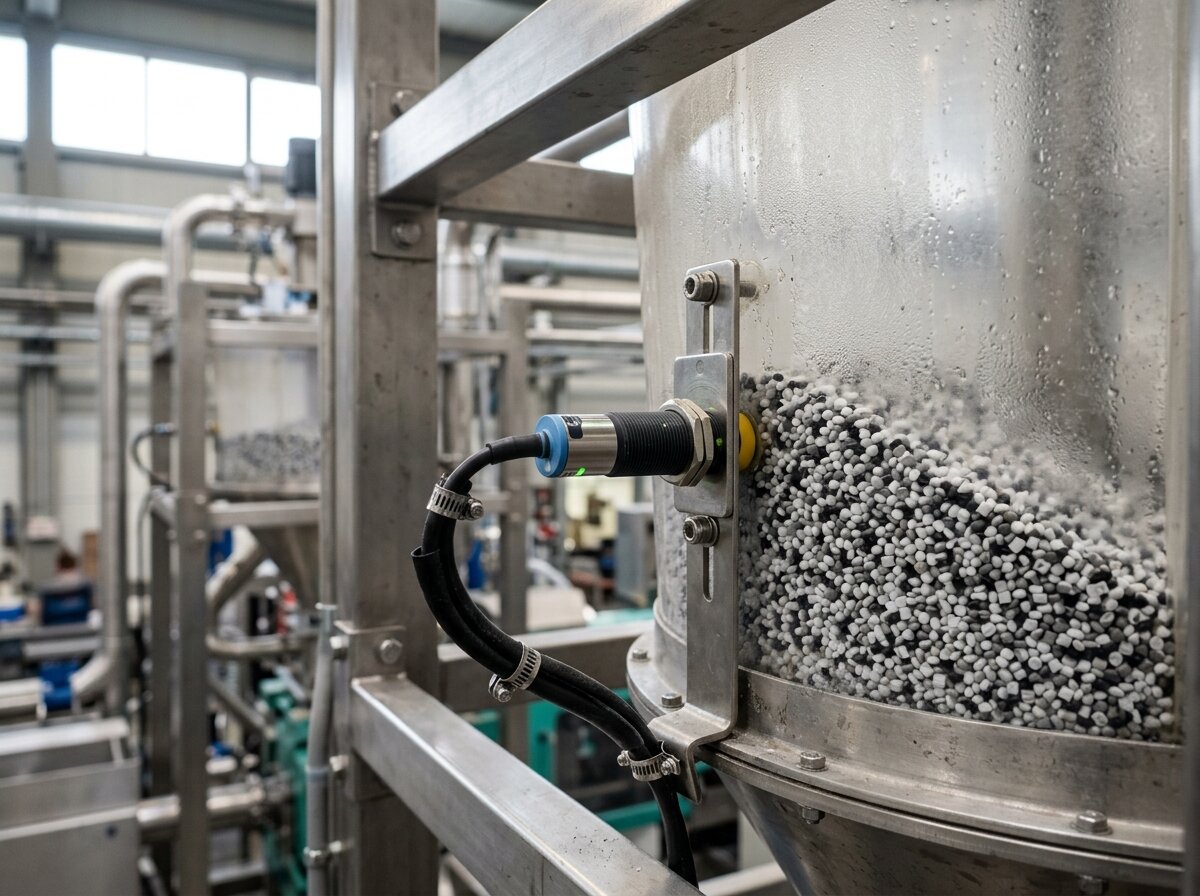
A photoelectric sensor's emitter sends infrared or visible light; the receiver detects it. Three operating modes determine range and reliability. Diffuse mode is self-contained - the target reflects light back to a collocated receiver. Retroreflective mode uses a polarized corner-cube reflector to return the beam. Through-beam mode splits emitter and receiver onto opposite sides of the target zone, delivering the highest range and the best tolerance to airborne contamination.
IEC 60947-5-2 defines three distance grades. Sn (rated operating distance) is the nominal designation value - it ignores manufacturing tolerance, supply voltage variation, and temperature drift. Sr (real operating distance) is measured at 23°C +/- 5°C and must fall within 90-110% of Sn. Sa (assured operating distance) is the guaranteed range under all specified conditions; for inductive sensors Sa <= 0.81 x Sn (IEC 60947-5-2 / Technical Analysis of Proximity Sensing Systems). Use Sa as your installation setpoint - not Sn. The difference prevents nuisance trips from temperature drift and target variation in the field.
[ORIGINAL DATA]: In practice, the operating principle eliminates candidates before any other filter. An inductive sensor cannot be made to detect plastic. A capacitive sensor in a steam-wash zone will false-trigger on condensation before the first production shift is over. A through-beam photoelectric in a welding cell saturates from arc light unless specifically specified for high-ambient-light immunity. Know the principle, and roughly two-thirds of the selection work is already done.
How Do Sensing Ranges Compare Across All Three Technologies?
Inductive tops out at 80 mm extended range. Standard capacitive sensing reaches ~3-60 mm (OMCH, industrial sensor manufacturer); only specialized long-range models exceed that. Photoelectric starts where the others end - diffuse mode covers 0.5-2 m, retroreflective 3-10 m, through-beam 10-30 m (Weisho Electric, 2024; WEHO Power, 2024). The through-beam maximum of 30,000 mm versus the inductive standard of 20 mm is a 1,500x difference - they operate on fundamentally different scales.
Inductive and Capacitive: Short-Range Precision Sensing
Standard inductive housings in M12, M18, and M30 form factors cover 1-20 mm and are rated for a standard 1Fe steel target (Fe360). Extended-range models reach up to 80 mm but require larger housings and higher cost. All inductive ranges are calibrated for steel; non-ferrous metals reduce the effective range significantly (see the reduction factor section below).
Capacitive sensors cover ~3-60 mm in standard housings; specialized long-range models can exceed this but are not standard catalog items (OMCH; Weisho Electric, 2024). The effective range also varies by target dielectric constant - water has a high dielectric value and is detected at full rated range, while dry wood at reduced range. Sensitivity adjustment compensates for this, but it requires a field setup step for each new material.
Photoelectric: Orders of Magnitude Beyond Proximity Sensors
Photoelectric diffuse mode depends on target reflectivity. Matte black surfaces absorb light and shorten range; shiny metal can cause false triggers from secondary reflections. Background suppression variants use triangulation optics to reject objects beyond a programmed distance - useful when a conveyor wall or machine frame sits close behind the target. Through-beam mode requires two mounting points but eliminates reflectivity dependence entirely.
Citation capsule: The sensing range spread across proximity sensor technologies spans roughly three orders of magnitude. Inductive sensors cover 1-20 mm standard and up to 80 mm extended. Capacitive sensors cover ~3-60 mm standard (OMCH); specialized long-range models exceed this. Photoelectric through-beam sensors reach 10-30 m. Sources: OMCH; Weisho Electric 2024; WEHO Power 2024.
Why Does Non-Ferrous Metal Cut Your Inductive Range?
Inductive sensors are calibrated for standard steel (Fe360 = reduction factor 1.0). Every other metal reduces effective range. Aluminum cuts it by 65%. Copper cuts it by 70%. Specify a 20 mm sensor for a steel target, swap in aluminum fixtures, and your effective range drops to 7 mm - a change that produces intermittent part-present signal dropout with no obvious cause (WEHO Power, 2024; Sense-the-World, 2024). In practice, the most common field mistake I see is speccing a standard inductive sensor for an aluminum or stainless target, then chasing phantom dropouts caused by the reduction factor rather than a wiring fault. Accepted industry ranges for key metals are: stainless steel ~0.6-1.0, brass ~0.35-0.5, aluminum ~0.35-0.5, copper ~0.25-0.45 (Festo; Rockwell Automation). The single chart values below sit inside these ranges.
[ORIGINAL DATA]: This is the single most common field failure in inductive proximity sensor installation. The reduction factor is printed in every manufacturer datasheet, but most selection guides skip the worked calculation. Here it is explicitly: a sensor with nominal Sn = 20 mm aimed at an aluminum target (factor 0.35) gives an effective range of 20 x 0.35 = 7 mm. The assured operating distance Sa per IEC 60947-5-2 is then 7 x 0.81 = 5.7 mm. Install the sensor no farther than 5.7 mm from the target face. Not 20 mm.
| Target Material | Reduction Factor | Effective Range (Sn = 20 mm) |
|---|---|---|
| Steel (Fe360) | 1.00 | 20.0 mm |
| Stainless steel | 0.75 | 15.0 mm |
| Brass | 0.45 | 9.0 mm |
| Aluminum | 0.35 | 7.0 mm |
| Copper | 0.30 | 6.0 mm |
Sources: Sense-the-World, 2024; Festo; Rockwell Automation Literature Library
If the target is aluminum at a fixed mounting gap of 12 mm, a 20 mm rated inductive sensor fails - 7 mm effective range cannot cover a 12 mm gap. Three paths forward: use an inductive sensor rated at 35 mm or higher (35 x 0.35 = 12.25 mm effective range, just sufficient), switch to capacitive, or switch to through-beam photoelectric where conductivity is irrelevant.
Capacitive and photoelectric sensors carry no reduction factor tied to electrical conductivity. Capacitive range does vary by target dielectric constant - a different but analogous consideration - and photoelectric range is entirely unaffected by material conductivity.
Citation capsule: Non-ferrous metals silently cut inductive sensor effective range - a common root cause of intermittent field failures. Aluminum carries a reduction factor of approximately 0.35 (range ~0.35-0.5, Festo), meaning a 20 mm rated sensor (Sn) detects aluminum at only 7 mm - a 65% range reduction. Copper reduces range by 70% (factor 0.30, range ~0.25-0.45, Festo). Assured operating distance Sa = effective range x 0.81 per IEC 60947-5-2. Sources: Sense-the-World 2024; WEHO Power 2024; Festo; Rockwell Automation Literature Library.
Which Technology Survives Your Plant Environment?
Inductive is the most robust of the three - immune to dust, cutting oil, coolant, and ambient light. Capacitive is sensitive to humidity and condensation on the sensing face. Photoelectric is sensitive to dust, fog, steam, and strong ambient light from welding arcs or direct sunlight (WEHO Power, 2024). The wrong technology in the wrong environment typically produces random false triggers rather than clean failures, which makes root-cause diagnosis harder than it should be.
Inductive: Immune to Dust, Oil, and Moisture
Inductive sensors have no optical surface to contaminate and no sensitivity adjustment to drift. Units in limit-switch housings achieve MTBF up to 100,000 hours (Sense-the-World, 2024). Temperature range runs typically -10 to +60°C (Keyence EX-V, 2024). They are unaffected by EMI from welding at typical sensor-to-arc distances and require essentially zero maintenance in clean metal-target applications over the machine's service life.
Capacitive and Photoelectric: Conditional Environments
Capacitive sensors need sensitivity retuning whenever the target material or product changes. In food and beverage lines that rotate between products, retuning becomes a maintenance task. Condensation and humidity on the sensing face generate false outputs even with no target present - a critical limitation in washdown-intensive installations and outdoor environments. Typical capacitive sensors operate roughly -10 to +70°C (manufacturer datasheets), but the humidity vulnerability often limits practical deployment to indoor, controlled environments.
Photoelectric sensors require unobstructed optical paths. Dust and oil film attenuate the beam progressively until the sensor drops out - in food processing and machining environments, this means scheduled lens cleaning as part of the maintenance plan. Through-beam mode is the most dirt-tolerant: both emitter and receiver must be blocked simultaneously to trigger a false output, which means partial contamination on one lens only reduces signal margin rather than causing an immediate misread. Ambient light from welding arcs can saturate receivers unless the sensor uses high-frequency modulation to distinguish its own signal.
IP ratings note: All three technologies are available in IP65, IP67, IP68, and IP69K housings (AutomationDirect, 2024). IP69K - high-pressure steam washdown at 80°C - is the standard requirement for food and beverage. IP rating is a housing specification, not a technology specification per IEC 60529. Select the appropriate IP for the environment regardless of which sensor type is correct for the target material.
Citation capsule: Inductive proximity sensors are immune to dust, cutting oil, moisture, and ambient light, giving them the broadest environmental tolerance of the three technologies. Capacitive sensors false-trigger from condensation and humidity on the sensing face. Photoelectric sensors require unobstructed optical paths and are vulnerable to progressive dust attenuation and ambient light saturation from welding arcs or direct sun. Source: WEHO Power, 2024.
How Do Response Time and Switching Frequency Affect High-Speed Applications?
Inductive and capacitive sensors switch in sub-millisecond to a few milliseconds, per manufacturer datasheets; some through-beam photoelectric models take up to 30 ms. Per IS 13947 / IEC, photoelectric turn-on response is measured to an excess gain of 2 and turn-off to an excess gain of 0.5. Inductive switching frequency reaches up to ~3,000 Hz (Festo). Standard capacitive housings are much slower - typically ~10 Hz (IS 13947 / IEC). Matching the sensor's switching frequency to the machine cycle rate is the most overlooked specification - a capacitive sensor at ~10 Hz cannot keep up with even a modest high-speed counting application even when material and sensing range are both correct.
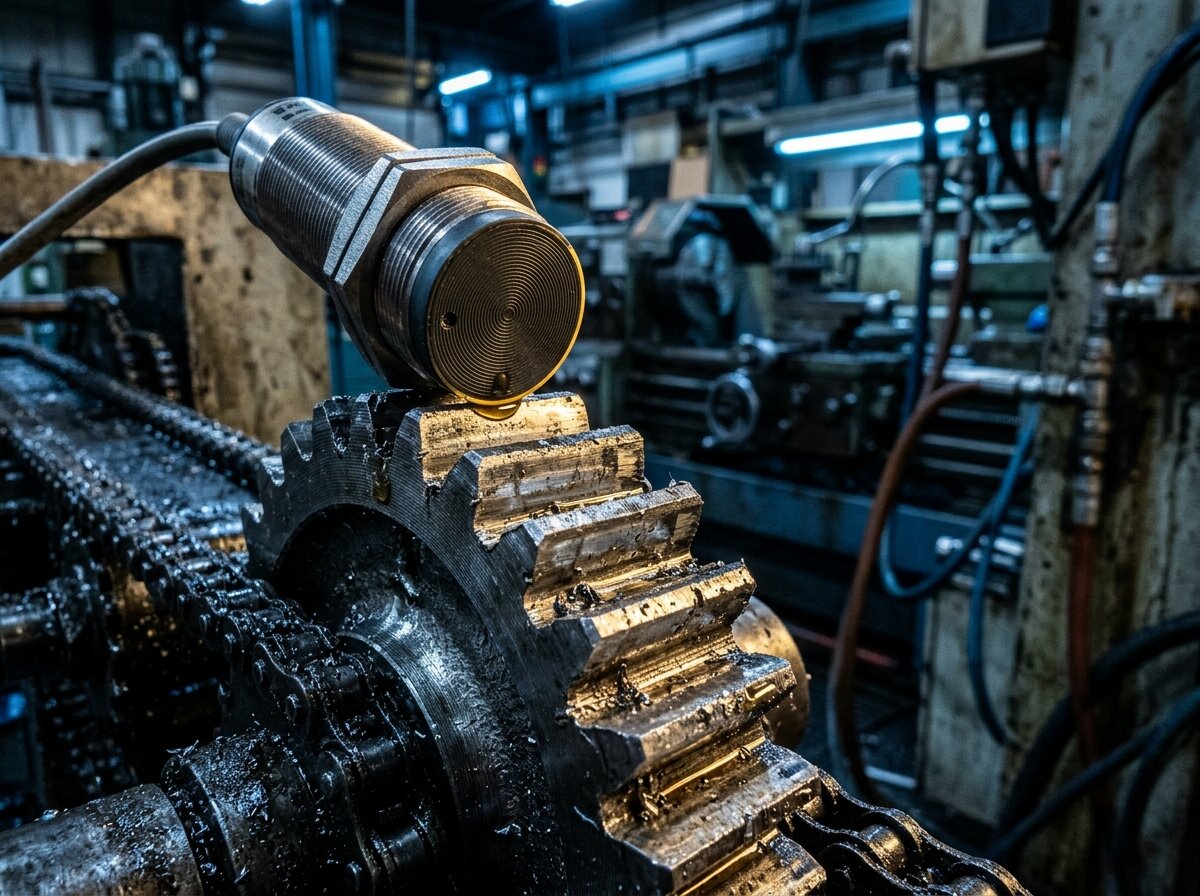
Inductive switching frequency of up to ~3,000 Hz (Festo) makes it the default choice for high-speed metallic part counting, camshaft position sensing, and gear-tooth detection on rotating shafts. The high switching rate comes from the eddy-current oscillator circuit, which resets essentially instantly when the metal target leaves the electromagnetic field.
Capacitive sensors in many standard M18 and M30 housings are limited to ~10 Hz typical (IS 13947 / IEC). That ceiling handles fill-level sensing and slow presence/absence checking, but it becomes a problem on any application cycling faster than roughly 10 times per second - rotary indexers, bottle lines, and high-speed part counting all exceed it easily.
Most datasheets list switching frequency only in Hz, which obscures the application-rate limit. The real risk is on gear-tooth detection: 1,500 RPM with 30 teeth produces 750 detection events per second. That exceeds capacitive's ~10 Hz typical ceiling by 75x, yet stays well within inductive's capability of up to ~3,000 Hz. The conveyor checking part presence once every few seconds has no problem with either technology. The gear encoder eliminates capacitive entirely.
For photoelectric sensors, verify the response time in the individual datasheet. Most diffuse and retroreflective units respond in 0.1-2 ms - equivalent to 250-5,000 Hz cycle rate capability. Some long-range through-beam models take up to 30 ms, limiting them to approximately 33 Hz and making them unsuitable for anything beyond slow gate-open detection or large-object presence checks.
Citation capsule: Response time is sub-millisecond to a few milliseconds typical across all three proximity sensor technologies (manufacturer datasheets); some through-beam photoelectric models reach up to 30 ms. Photoelectric turn-on response is measured to an excess gain of 2, turn-off to excess gain of 0.5 (IS 13947 / IEC). Inductive switching frequency reaches up to ~3,000 Hz (Festo). Standard capacitive housings are typically ~10 Hz (IS 13947 / IEC) - adequate for slow presence/absence sensing but insufficient for gear-tooth detection or high-cycle-rate applications. Sources: Festo; IS 13947 / IEC.
How Much Do Proximity Sensors Cost in Practice?
Inductive is the cheapest technology per unit at $15-35 economy tier for an M18 housing ($10-20 basic, $30-50 industrial per RealPars). Capacitive runs 20-40% above an equivalent inductive. Photoelectric spans the widest range at $30-200+ because through-beam systems require two mounting points - emitter and receiver - plus alignment hardware (Sense-the-World, 2025). Unit price is only part of the cost story.
[ORIGINAL DATA]: Full cost ranges by tier for M18/M30 housings: inductive economy $15-35, mid $35-70, premium $70-150+; capacitive runs 20-40% above the equivalent inductive tier; photoelectric diffuse $30-80, retroreflective $40-100 (plus reflector hardware), through-beam $60-200+ for the emitter-receiver pair. These are real transaction ranges, not manufacturer list pricing. Source: Sense-the-World, 2025.
Total cost of ownership diverges from unit price in three specific ways. Photoelectric sensors in dusty or oily environments require periodic lens cleaning - scheduled maintenance labor over a 10-year machine life closes much of the initial unit cost gap. Capacitive sensors may need potentiometer retuning every time the target product changes, adding technician time on multi-product filling lines. Inductive sensors in clean metal-target applications carry essentially zero maintenance cost, with MTBF up to 100,000 hours (Sense-the-World, 2024).
A useful procurement point: standardizing on one housing size across all three technologies from a single manufacturer simplifies spare-parts inventory. Sick, Omron, Keyence, Pepperl+Fuchs, and Balluff all offer inductive, capacitive, and photoelectric sensors in identical M18/M30 form factors with the same M12 connectors.
Citation capsule: Inductive M18 sensors cost $15-35 at the economy tier, $35-70 mid, $70-150+ premium. Capacitive runs 20-40% higher than a comparable inductive at each tier. Photoelectric spans $30-200+ depending on mode; through-beam pairs require two mounting points and add installation labor. Inductive sensors in metal-target applications have essentially zero maintenance cost at MTBF up to 100,000 hours. Source: Sense-the-World 2025; Sense-the-World 2024.
Decision Framework: How to Choose the Right Sensor in Three Steps
Step 1 is target material. Metal points to inductive. Non-metal (plastic, liquid, glass, wood, granular) points to capacitive. Material varies between products, or range exceeds 60 mm, points to photoelectric. Step 2 is sensing range. Apply the reduction factor for non-ferrous metal inductive targets. If effective range falls short of the required installation gap, move to the next technology. Step 3 is environment and frequency. Humidity or condensation eliminates capacitive. Heavy dust or fog attenuates photoelectric - use through-beam or switch to inductive. Switching frequency above ~10 Hz eliminates most standard capacitive housings; above ~3,000 Hz eliminates even inductive (WEHO Power, 2024; Festo; IS 13947 / IEC).
That three-step sequence eliminates most wrong selections before you open a catalog. The verdict table handles the remaining specific cases.
| Application | Best Choice | Reason |
|---|---|---|
| Steel part on conveyor, gap <= 15 mm | Inductive | Fastest, cheapest, zero maintenance |
| Aluminum bracket, gap 10 mm | Inductive extended-range (verify Sa >= 10 mm after reduction factor) | Factor 0.35 - need Sn >= 29 mm rated |
| Plastic bottle presence/absence, gap 50 mm | Capacitive | Non-metal target, within range |
| Liquid level through tank wall | Capacitive | High dielectric of liquid, no tank penetration required |
| Any target, gap > 60 mm to 30 m | Photoelectric | Inductive and capacitive cannot reach |
| Dusty or oily environment, metal target | Inductive | Immune to contamination |
| Food/beverage washdown, non-metal target | Capacitive IP69K | Retune sensitivity for each product |
| Translucent object detection | Through-beam photoelectric | Diffuse fails; retroreflective unreliable on transparent surfaces |
| Gear-tooth detection at 1,500 RPM, 30 teeth (750 Hz) | Inductive | Capacitive at ~10 Hz typical cannot keep up; inductive handles up to ~3,000 Hz (Festo) |
Once the technology is confirmed, the next step is output type and wiring. See the guide to wiring NPN and PNP proximity sensors for step-by-step instructions and our guide on matching the sensor to your PLC input card for equipment-specific selection. For connecting sensor outputs into supervisory or cloud systems, see connecting sensors to the cloud for a protocol and gateway comparison.

Frequently Asked Questions
What is the difference between inductive and capacitive proximity sensors?
Inductive sensors detect conductive metal targets by damping an electromagnetic oscillator field - they cannot detect plastic, liquid, or wood at all. Capacitive sensors use an electrostatic field that responds to any material with a higher dielectric constant than air, including metals, liquids, plastics, and granular materials. Inductive is simpler, more robust, and less expensive; capacitive is more versatile but sensitive to humidity and condensation on the sensing face, which can cause false triggers even with no target present.
When should I use a photoelectric sensor instead of a proximity sensor?
Use photoelectric when the required sensing distance exceeds 60 mm standard capacitive range, when the target material varies between production runs, or when you need to detect transparent or translucent objects. Inductive tops out at 80 mm extended; standard capacitive at ~60 mm (OMCH). Photoelectric through-beam sensors reach 30 meters (WEHO Power, 2024), making them the only viable option for long-distance object detection and for targets that proximity sensors physically cannot see.
How do I choose the right proximity sensor for my application?
Start with target material: metal targets point to inductive, non-metal and liquid targets point to capacitive, any material at long range points to photoelectric. Then verify the sensing range fits - apply the reduction factor for non-ferrous metal inductive targets. Finally, filter by environment (humidity eliminates capacitive; heavy dust attenuates photoelectric) and by switching frequency requirement. Applications above ~10 Hz eliminate standard capacitive; above ~3,000 Hz eliminate inductive as well (Festo; IS 13947 / IEC). Most selections resolve in under two minutes following that sequence.
What does reduction factor mean in inductive proximity sensors?
Reduction factor is the multiplier that converts a sensor's rated operating distance (Sn, calibrated for standard steel Fe360 at factor 1.0) to the effective range for a different conductive material. Aluminum has a reduction factor of approximately 0.35, meaning a 20 mm rated sensor detects aluminum at only 7 mm effective range. Always calculate effective range = Sn x reduction factor, then assured operating distance Sa = effective range x 0.81, before finalizing the installation gap. Operating distance definitions are governed by IEC 60947-5-2 (Sense-the-World, 2024).
What is switching frequency and why does it matter?
Switching frequency is the maximum on/off cycles per second the sensor can reliably execute. Inductive sensors reach up to ~3,000 Hz (Festo); standard capacitive housings are typically ~10 Hz (IS 13947 / IEC). If your machine cycle rate exceeds the sensor's switching frequency, the sensor misses detections with no fault code or warning - the count simply drops. On a system requiring 750 Hz (1,500 RPM, 30-tooth gear), it eliminates capacitive but stays within inductive's range. On applications requiring more than ~3,000 Hz, it eliminates both (Festo).
Which Proximity Sensor Should You Specify?
The material-first framework makes proximity sensor selection close to deterministic. Ask what the target is made of, check whether the sensing range fits after applying any reduction factor, then filter for environment and switching frequency. Most applications resolve cleanly before you reach the third filter.
Key takeaways:
- Inductive is the default for metal targets - fast, cheap ($15-35 economy), immune to dust, oil, and moisture, essentially zero maintenance when sized correctly for the actual target material.
- Apply the reduction factor before finalizing any inductive sensor on non-ferrous metal. Aluminum at 0.35 turns a 20 mm rated sensor into a 7 mm effective-range sensor. That 65% cut is the most common field failure in inductive sensor installations.
- Capacitive adds non-metal and liquid detection at a 20-40% cost premium but fails in high-humidity and condensation environments - avoid it in outdoor installations and steam-wash zones without a robust sensitivity-tuning plan.
- Photoelectric is the only choice beyond roughly 80 mm sensing range and handles any material including transparent and translucent targets. Through-beam mode provides the best dirt tolerance of any mode.
- Switching frequency eliminates capacitive on any application above ~10 Hz typical (IS 13947 / IEC) and eliminates inductive above ~3,000 Hz (Festo) - always check the datasheet value before specifying.
- All three technologies are available in IP67/IP69K for washdown environments per IEC 60529. IP rating is a housing specification, not a technology constraint.
For the full measurement and control landscape across sensor families, read how industrial sensors work and our guide to debouncing sensor chatter for PLC-side signal conditioning. For cross-domain selection reading using the same exclusion-rules approach, see pressure sensor types and flow meter comparison. None of these three technologies are built for machine safeguarding - that's a separate exclusion-rules decision covered in our comparison of light curtains, safety laser scanners, and safety mats.
What is the difference between inductive and capacitive proximity sensors?
Inductive sensors detect conductive metal targets by damping an electromagnetic oscillator field - they cannot detect plastic, liquid, or wood. Capacitive sensors use an electrostatic field that responds to any material with a higher dielectric constant than air, including metals, liquids, plastics, and granular materials. Inductive is simpler and more robust; capacitive is more versatile but sensitive to humidity.
When should I use a photoelectric sensor instead of a proximity sensor?
Use photoelectric when the required sensing distance exceeds roughly 60 to 80 mm, when the target material varies between products, or when you need to detect transparent or translucent objects. Standard inductive and capacitive proximity sensors top out near 80 mm and 60 mm respectively; photoelectric through-beam sensors reach 30 meters (WEHO Power, 2024).
How do I choose the right proximity sensor for my application?
Start with target material: metal targets point to inductive, non-metal and liquid targets point to capacitive, any material at long range points to photoelectric. Then verify sensing range fits. Finally, filter by environment - humidity eliminates capacitive, dust attenuates photoelectric - and switching frequency (high-speed applications need inductive's fast switching, up to ~3,000 Hz).
What does reduction factor mean in inductive proximity sensors?
Reduction factor is the multiplier that converts a sensor's rated range, calibrated for standard steel at factor 1.0, to the effective range for a different metal. Aluminum has a factor of approximately 0.35, meaning a 20 mm rated sensor detects aluminum at only 7 mm. Always calculate effective range as Sn times reduction factor before finalizing the installation gap (IEC 60947-5-2).
What is switching frequency and why does it matter?
Switching frequency is the maximum on/off cycles per second the sensor can reliably execute. Inductive sensors reach up to ~3,000 Hz (Festo); capacitive sensors are much slower, often around 10 Hz in standard housings (IS 13947 / IEC). If your machine cycles faster than the sensor's switching frequency, the sensor misses detections - critical on fast gear-tooth sensing but rarely an issue on conveyors below 600 parts per minute.
Related Articles

