
Is IO-Link a Fieldbus? Avoiding Protocol Vendor Lock-In
Ask five automation engineers whether IO-Link is a fieldbus and you'll probably get five different answers - which tells you the real question is hiding underneath. Vendors display IO-Link sensors right next to PROFIBUS, PROFINET, and EtherNet/IP cables at the same trade show booth, and that proximity blurs a distinction that affects your budget.
The confusion is about lock-in, not protocol taxonomy. If IO-Link is a competing fieldbus, picking it means picking a side, the same high-stakes commitment as choosing PROFINET over EtherNet/IP. If it's something else entirely, the calculus changes. This article settles that: what layer IO-Link occupies, how that separation keeps you out of a single sensor ecosystem, and where a smaller lock-in risk can still sit, one layer down. For the fuller connectivity picture, see our pillar guide to industrial sensors.
TL;DR: IO-Link is a point-to-point sensor interface (IEC 61131-9), not a fieldbus - it rides underneath PROFINET, EtherNet/IP, or whatever fieldbus you already run. That separation prevents vendor lock-in. The IO-Link market hit $13.51 billion in 2023 (IO-Link Masters notebook, 2023) and keeps expanding across every major fieldbus ecosystem.
Is IO-Link a Fieldbus or Something Else?
No - IO-Link is not a fieldbus. Defined by IEC 61131-9, it's a point-to-point, 3-wire interface that connects one sensor or actuator to one master port over a maximum 20 m cable (ifm IO-Link notebook, 2024). The master, not the sensor, talks to the fieldbus.
Point-to-point means exactly what it sounds like: one wire run, one device, one connection point. A fieldbus, by contrast, is a shared network where dozens or hundreds of devices talk to a controller over the same bus or star topology. IO-Link never touches that shared network directly. The master sits in between, translating.
Those speeds matter for context, not comparison. IO-Link runs three device-level rates: COM1 at 4.8 kbaud, COM2 at 38.4 kbaud, and COM3 at 230.4 kbaud (ifm IO-Link notebook, 2024). Stack that against fieldbus network speeds and IO-Link looks slow, because it moves data 20 meters from sensor to master, not across a plant floor.
Why does the confusion persist? Trade show booths and vendor catalogs list IO-Link right next to PROFINET and EtherNet/IP, as if they compete for the same job. They don't. One standardizes a sensor cable; the other standardizes a plant network. Conflating the two is where the lock-in anxiety starts.
What's the Difference Between IO-Link and Fieldbus Protocols?
IO-Link standardizes the sensor-to-master link at the device level; fieldbus protocols standardize master-to-controller communication at the network level, the layer where PROFIBUS's installed base alone reached 62 million nodes by 2019 (ifm notebook, 2019). They're two different jobs, stacked one on top of the other, not competing standards.
| Attribute | IO-Link | Fieldbus (PROFINET / EtherNet/IP / etc.) |
|---|---|---|
| Layer / scope | Device (sensor to master) | Network (master to controller) |
| Topology | Point-to-point | Bus or star, shared network |
| Max cable length | 20 m | Governed by fieldbus segment rules |
| Device description file | IODD | GSD / EDS |
| Primary role | Sensor parameterization and diagnostics | Controller networking and data transport |
Fieldbus ecosystems are already enormous, and that's why sensor-level neutrality matters. Ripping out an installed base that size and switching networks is a capital decision measured in years, not a weekend project - the kind of commitment IO-Link never asks a plant to make at the sensor level.
IO-Link's own installed base shows a similar growth pattern, moving independently of any single fieldbus's fortunes.
Point-to-Point vs Bus Topology
Picture the physical wiring difference. An IO-Link master port runs one cable to one device. A fieldbus segment daisy-chains or stars out to dozens of controllers, drives, and I/O blocks sharing the same backbone. Swap an IO-Link sensor and you touch one cable. Swap a fieldbus and you touch the whole segment.
How Does the Three-Layer Automation Stack Work?
Every IO-Link deployment sits inside three layers - enterprise (MES or cloud), network (the fieldbus: PROFINET, EtherNet/IP, EtherCAT, or Modbus TCP), and device (IO-Link sensors, point-to-point per IEC 61131-9, through a master) - and IO-Link touches only the bottom one. That containment is the mechanism behind the lock-in-free claim.
Data flows bottom to top. The device layer generates it, the network layer moves it, and the enterprise layer consumes it. Ever wonder why IO-Link marketing never names a specific fieldbus as a requirement? Swap the network layer's protocol and the device layer doesn't notice, because it was never wired to care.
 Enterprise systems consume data two layers up while IO-Link never touches anything above the device layer it lives in.
The same IO-Link master can present its data up through whichever fieldbus the network layer happens to run, without the sensor firmware caring at all. Buy the sensor once. Change the master's uplink card later, if you ever need to - the sensor never knows the difference.
Device-Level Growth Behind the Stack
IO-Link's device count has scaled independently of any single fieldbus decision. Nodes nearly doubled from 2013 to 2014, reaching 2.2 million (ifm notebook, 2014), passed 3 million by 2015 (ifm notebook, 2015), and hit 16 million compatible devices by 2019 (ifm notebook, 2019). That's the device layer growing on its own, not tied to one network's adoption curve.
The dollar figures show the same trend from a different angle. The IO-Link market was valued at $13.51 billion in 2023 and is forecast to reach $16.94 billion in 2024. From there, it's projected to climb to $48.57 billion by 2030, a 19.2% compound annual growth rate (IO-Link Masters notebook, 2023-2024).
That growth rides on top of every major fieldbus at once, not on one network winning - which is the point a lock-in-anxious buyer should take from the chart below.
How Does IO-Link Avoid the Vendor Lock-In Fieldbus Selection Creates?
Because IO-Link sensors talk to a master, not directly to a fieldbus, the same sensor works behind a PROFINET master today and an EtherNet/IP master tomorrow. A standardized, vendor-independent IODD file, searchable through the public IODDfinder database, makes that swap possible (ifm notebook, 2024). The lock-in decision moves from "which sensor ecosystem" to "which master."
I once specified an IO-Link master gateway for a customer whose whole plant had already committed to PROFINET years earlier. The sensor family we picked, mostly photoelectric and pressure, would have dropped onto an EtherNet/IP or Modbus TCP line with zero changes at the sensor. Only the master's uplink card would've been different. That's the device layer being protocol-agnostic in practice, not just on a datasheet.
IODD - The Vendor-Neutral Mechanism
IODD stands for IO Device Description, and it's the file format doing the work behind that swap. Any compliant master can read any compliant sensor's IODD file and auto-parameterize it on the spot - no manual mapping, no vendor-specific translation layer in between (ifm notebook, 2024).
Importing a current IODD into a master's web config takes minutes, auto-populating parameter names, units, and value ranges straight from the sensor's own memory. When the IODD is missing or outdated, though, the master falls back to raw index and subindex values with no labels attached, and you're reading a hex table instead of a parameter name. That gap is the single most common commissioning delay I see in the field.
IO-Link also removes a quieter dependency point: the digital-to-analog and analog-to-digital converters that traditional 4-20 mA integration requires (ifm notebook, 2024). Every converter in a signal chain is one more component tied to a specific vendor's catalog. IO-Link sensors skip that hardware, communicating digitally end to end.
What would it cost to reverse a real fieldbus-level commitment? Ask anyone who's lived through a controller platform migration. Choosing PROFIBUS, PROFINET, or EtherNet/IP at the plant-network level means rewiring, controller replacement, and re-certifying safety loops. Swapping an IO-Link master is a gateway-box replacement. One is a capital project. The other is an afternoon.
See our IIoT protocol comparison for how that network-layer decision plays out across PROFINET, EtherNet/IP, and the rest.
What Does Migrating From 4-20mA Wiring to IO-Link Cost?
IO-Link's unshielded 3-wire cable delivers a 15-25% wiring cost saving over shielded analog cabling. A 4-port PROFINET master like the ifm AL1100 runs $533-$627 USD (ifm notebook, 2024; IO-Link Masters notebook, 2024). That's a modest gateway investment against what the wiring and converter savings return.
Shielded analog cable costs more to buy, more to install correctly, and more to troubleshoot when a ground loop shows up years later. IO-Link's unshielded 3-wire cable skips the shielding requirement, which is most of where that 15-25% comes from (ifm notebook, 2024). Add in the D/A and A/D converters IO-Link eliminates, and the hardware savings compound before configuration time even enters the picture.
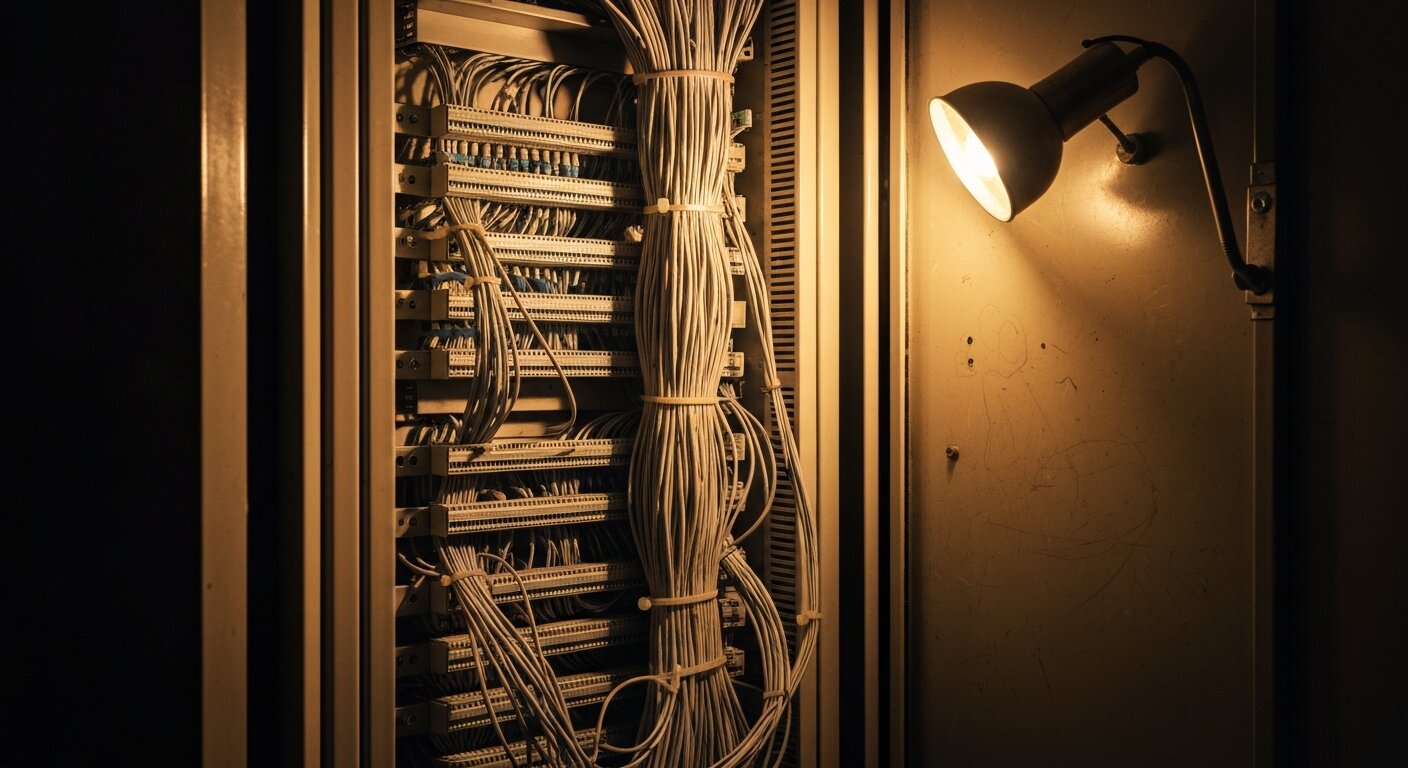 Unshielded 3-wire IO-Link cable cuts wiring costs 15-25% versus shielded analog cabling, before converters and labor are even counted.
Ground loops and induced noise are already the most common failure mode behind 4-20mA analog loop troubleshooting calls. IO-Link costs less to install and removes an entire category of the wiring problems that generate those service calls in the first place.
The Gateway Investment
$533-$627 buys a 4-port master that can replace four separate discrete or analog connections at once (IO-Link Masters notebook, 2024). Set that against the wiring savings and converter elimination above, and the payback math favors IO-Link on most multi-sensor retrofits. The gateway price doesn't include a labor-hour estimate for IODD auto-parameterization versus manual analog setup - that figure isn't in the data we have, so we won't guess at one here.
Migration doesn't have to happen all at once. Plants can replace existing 4-20 mA loops sensor by sensor, behind an IO-Link master. The fieldbus and controller layer stay untouched. Swap one transmitter this quarter, another next quarter, and the fieldbus never notices the difference. The same logic covers discrete sensor wiring IO-Link replaces. NPN and PNP proximity sensors can move to IO-Link output on the same incremental schedule.
Is There a Lock-In Risk Hiding Inside IO-Link Itself?
IO-Link removes fieldbus-level lock-in, but a real risk still exists one level down: over-customizing your configuration around a single master vendor's proprietary tooling instead of the standardized IODD format everyone agreed on. No competitor page names this part.
Sound like a contradiction, a lock-in-free protocol carrying its own lock-in risk? It isn't, once you see where the risk sits. It happens gradually. A plant builds its commissioning workflow around one master vendor's configuration software, leans on that vendor's proprietary extensions instead of standard IODD parameters, and trains staff on that vendor's specific tooling quirks. None of that reads as "lock-in" until the vendor discontinues a product line or changes pricing.
The Master-Vendor Recovery Path
This risk is still recoverable, and nothing like a fieldbus-level trap. Because IODD is standardized and multiple vendors sell IO-Link masters, a plant can swap a discontinued or unsatisfactory master line for another vendor's hardware without re-selecting a single sensor (ifm notebook, 2024). Compare that to a fieldbus swap, which touches wiring, controllers, and safety certification all at once.
Two habits keep that recovery path open. Keep IODD files version-controlled outside any one vendor's software, the same way you'd version-control PLC logic. And where a standard IODD parameter already covers what you need, skip the master vendor's proprietary configuration extension - it's convenience today and a dependency tomorrow.
What Trade-offs Come With IO-Link Wireless and IO-Link Safety?
IO-Link Wireless and IO-Link Safety both extend the standard past a single wire, and each brings its own trade-off (ifm notebook, 2024):
- IO-Link Wireless runs on 2.4 GHz with a packet error rate of 10^-9, a 5 ms cycle time, and supports up to 40 devices per master.
- IO-Link Safety adds SIL 3/PLe certification through a Black Channel approach that integrates with PROFIsafe, CIP Safety, and FSoE.
IO-Link Wireless
Trading a cable for radio isn't free. IO-Link Wireless buys freedom from conduit runs on moving equipment or hard-to-reach locations, but it caps you at 40 devices per master and inherits whatever interference already crowds the 2.4 GHz band. Worth trading a cable for a fixed device-count ceiling? Only when running conduit to that point isn't practical - wired IO-Link stays the default.
 IO-Link Wireless buys freedom from conduit runs on moving equipment, but that freedom caps out at 40 devices per master.
IO-Link Safety
Black Channel is the part worth understanding. It means the safety protocol rides inside the existing fieldbus safety layer instead of demanding a separate safety network alongside it (ifm notebook, 2024). That's the same "rides on top" logic already established, extended one layer further, into safety-rated communication.
Neither extension turns IO-Link into a competing network protocol. Wireless still connects one device to one master; Safety still rides inside whatever fieldbus safety layer already exists. The scope never grows past the device layer. That device layer covers most of the sensor families available with IO-Link, from photoelectric to inductive to capacitive.
When Should You Choose IO-Link Plus Fieldbus Over Fieldbus Alone?
Choose IO-Link plus fieldbus when you need per-device diagnostics or standardized sensor replacement across multiple fieldbus-committed sites. Fieldbus choice alone still governs pure controller-to-controller network decisions, where IO-Link doesn't apply.
| Scenario | Recommendation | Why |
|---|---|---|
| Standardizing sensor replacement across multiple fieldbus-committed plants | IO-Link masters per site | Same sensor family works behind any master, regardless of the site's fieldbus |
| Per-device diagnostics and parameterization without touching the controller layer | IO-Link | IODD gives every sensor a standardized, remotely readable configuration |
| Pure network-level, controller-to-controller application | Fieldbus choice still governs | IO-Link doesn't operate at that layer at all |
Go back to the three-layer stack from earlier. If your decision lives in the bottom layer, IO-Link is the answer. If it lives in the middle layer, IO-Link doesn't have an opinion, because it was never designed to have one.
For the network-layer decision itself, our IIoT protocol comparison walks through PROFINET, EtherNet/IP, and the rest in detail.
Frequently Asked Questions
Is IO-Link a fieldbus or something else?
No. IO-Link, defined by IEC 61131-9, is a point-to-point, 3-wire sensor and actuator interface with a 20 m maximum cable length. It sits below the fieldbus layer, connecting individual devices to a master, which then talks to whatever fieldbus the plant runs (ifm IO-Link notebook, 2024).
How does IO-Link avoid vendor lock-in compared to fieldbus?
IO-Link sensors connect through a master, not directly to the network, so the same sensor works behind any compliant master. Standardized IODD files, searchable through the public IODDfinder database, make sensors vendor-independent at the device layer (ifm IO-Link notebook, 2024).
What is the difference between IO-Link and fieldbus protocols?
IO-Link standardizes the sensor-to-master link at the device level, using IODD files for auto-parameterization. Fieldbus protocols like PROFINET and EtherNet/IP standardize master-to-controller communication at the network level, using GSD or EDS files instead (ifm IO-Link notebook, 2024).
Can IO-Link work with any fieldbus system?
Yes. IO-Link masters act as gateways that translate device-level data to whichever fieldbus a plant runs, including PROFINET, EtherNet/IP, EtherCAT, or Modbus TCP. The sensor itself never has to change when the fieldbus does (ifm IO-Link notebook, 2024).
Why should I use IO-Link instead of traditional fieldbus wiring?
IO-Link's unshielded 3-wire cable cuts wiring costs 15-25% versus shielded analog cabling and eliminates D/A and A/D converters entirely. IODD auto-parameterization also removes most manual configuration steps a 4-20 mA retrofit still requires (ifm notebook, 2024).
Conclusion
IO-Link operates one layer below your fieldbus, not in competition with it - which is what keeps you from getting locked into a single sensor ecosystem when a fieldbus decision changes five years from now.
Three things worth keeping:
- IO-Link is point-to-point (IEC 61131-9), not a fieldbus.
- IODD standardization is the mechanism that prevents lock-in at the device layer.
- The real remaining risk is over-customizing around one master vendor's tooling, not the protocol itself.
Migration doesn't have to be a single cutover, either. It happens sensor by sensor, behind a master, without touching the fieldbus layer underneath. For the network-layer decision IO-Link sits on top of, read our IIoT protocol comparison. For the broader picture, start with the complete guide to industrial sensors.
Frequently Asked Questions
Is IO-Link a fieldbus or something else?
No. IO-Link, defined by IEC 61131-9, is a point-to-point, 3-wire sensor and actuator interface with a 20 m maximum cable length. It sits below the fieldbus layer, connecting individual devices to a master, which then talks to whatever fieldbus the plant runs (ifm IO-Link notebook, 2024).
How does IO-Link avoid vendor lock-in compared to fieldbus?
IO-Link sensors connect through a master, not directly to the network, so the same sensor works behind any compliant master. Standardized IODD files, searchable through the public IODDfinder database, make sensors vendor-independent at the device layer (ifm IO-Link notebook, 2024).
What is the difference between IO-Link and fieldbus protocols?
IO-Link standardizes the sensor-to-master link at the device level, using IODD files for auto-parameterization. Fieldbus protocols like PROFINET and EtherNet/IP standardize master-to-controller communication at the network level, using GSD or EDS files instead (ifm IO-Link notebook, 2024).
Can IO-Link work with any fieldbus system?
Yes. IO-Link masters act as gateways that translate device-level data to whichever fieldbus a plant runs, including PROFINET, EtherNet/IP, EtherCAT, or Modbus TCP. The sensor itself never has to change when the fieldbus does (ifm IO-Link notebook, 2024).
Why should I use IO-Link instead of traditional fieldbus wiring?
IO-Link's unshielded 3-wire cable cuts wiring costs 15-25% versus shielded analog cabling and eliminates D/A and A/D converters entirely. IODD auto-parameterization also removes most manual configuration steps a 4-20 mA retrofit still requires (ifm notebook, 2024).
