
TSN vs Standard Industrial Ethernet: A Qbv Guide
Read more...

Picture a pump station with a few dozen legacy 4-20mA transmitters wired to an older DCS input card. Every one of them is a smart HART device. The control room sees one number per loop. The diagnostics, device status and extra variables sit inside the transmitter, and nobody can read them without a handheld and a walk to the field.
A WirelessHART adapter can pull that data out without changing the marshalling rack wiring. It works only if the loop has voltage to spare, the power source and update rate fit the job, and wireless stays away from fast control and safety trips. The checks below follow the order you will meet them on site.
TL;DR: A WirelessHART adapter can pull stranded HART data off a legacy 4-20mA loop without changing the marshalling rack wiring. Check loop voltage headroom first: Emerson's 775 THUM quick start says the supply must give at least 2.5 V more than the wired device's minimum operating voltage. Keep wireless out of fast control and safety trips.
A 2010 Emerson/HART Communication Foundation document (HCF_LIT-134, March 2010) says over 24 million HART 4-20mA instruments had been installed over the past two decades, and approximately 90% were connected to analog-only I/O or a DCS with no HART communication capability (Emerson, WirelessHART Adaptor, 2010). Both figures are dated, so read them as context, not as a count of your plant.
A separate 2012 journal paper hosted in ABB's library estimated that 85% of installed HART devices were not being accessed for diagnostics, with only one process variable reaching the system over the 4-20mA signal (Integration of Wireless HART into DCS, 2012 paper, August 2012). The mechanism matters more than the percentages.
A device using the HART protocol carries a digital signal on top of its analog current. If the input card or DCS cannot read that digital layer, the information stays in the field. The 4-20mA signal itself keeps working. Our note on why 4-20mA is still used covers the reasons.
The Emerson document lists three ways to reach the data. The first is I/O cards with HART pass-through. The second is a HART multiplexer. The third is a WirelessHART network with wireless adaptors. The first two need some re-work of existing wiring and may need loops shut down. The document also notes a reluctance to modify an installation by placing a multiplexer in the 4-20mA control loop, which is the opening for the wireless option.
The Emerson/HCF document says a WirelessHART adaptor requires no change to marshalling rack wiring. It connects to the instrument the way a HART handheld configurator does, and it provides access to all the variables and parameters in the installed wired HART instrument (Emerson, WirelessHART Adaptor, 2010).
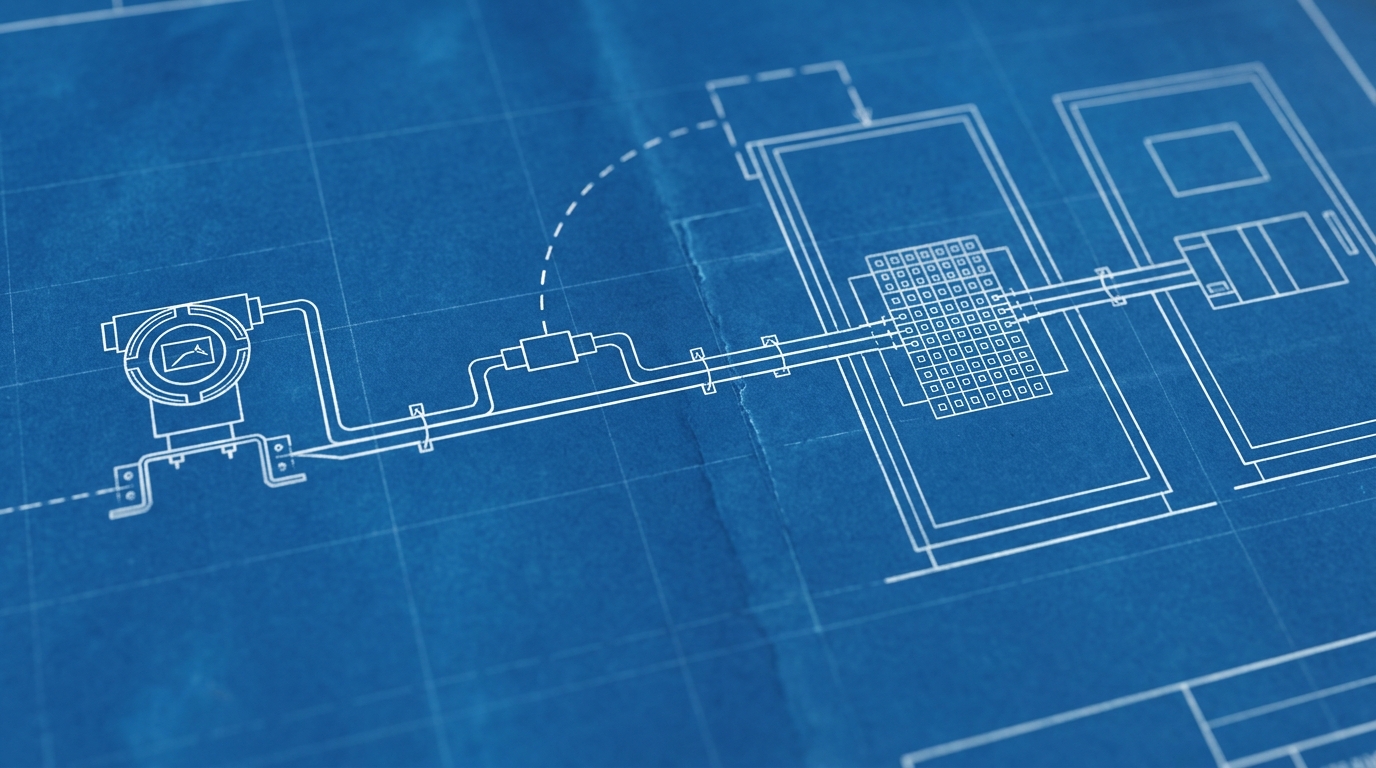 The adapter connects at the field device and leaves the marshalling rack wiring alone.
The 4-20mA signal path at the control room stays as it was. The adapter connects at the field device or anywhere else on the loop, talks HART to the transmitter the same way a handheld would, and, if it is loop-powered like the THUM, adds a voltage drop to the loop. It then sends what it reads over the radio. The data it can return includes process variables, diagnostic information and device status, per the same Emerson document.
HART is a frequency-shift signal riding on the loop current. One secondary explanation gives it as ±0.5 mA peak, which a 250 ohm resistance turns into about ±125 mV, the swing it says is needed for reliable demodulation (Industrial Monitor Direct). Treat that as background only. For a design rule, use Emerson's: the THUM adapter needs at least 250 ohms of resistance in the loop to function (Emerson 775 THUM quick start, Rev GM, March 2026).
The same quick start has wiring diagrams for a 2-wire device, a 4-wire passive device and a 4-wire active device. Phoenix Contact says its line-powered adapter can be added to a legacy instrument that outputs only 4-20mA, and the primary value returns to the gateway as a HART value (Phoenix Contact).
One caution from my own practice. The adapter is a new device on a loop that may already be marginal. If the loop has noise problems, fix them first; see troubleshooting 4-20mA loop noise.
Pick loop power when the loop has voltage to spare and you want no battery visits. Pick battery or external power when it does not. Emerson's quick start says the THUM adapter drops voltage linearly from 2.25 V at 3.5 mA to 1.2 V at 25 mA, and under fault conditions the maximum is 2.5 V (Emerson 775 THUM quick start, Rev GM, March 2026).
The quick start adds a rule you can apply directly. The supply must provide at least 2.5 V more than the minimum operating voltage of the wired device. It also says to limit the power supply to 0.5 A and 30 Vdc. A Control Associates product page describes the THUM as power scavenging (Control Associates). Phoenix Contact lists both loop-powered and line-powered (DC supply) versions.
This example is illustrative. Every input except the 250 ohm load and the 2.5 V adapter margin is my assumption, not a sourced figure.
The sum is 12 + 6.25 + 2.5 = 20.75 V. Leftover for cable: 24 - 20.75 = 3.25 V. At 25 mA, that allows 3.25 V / 0.025 A = 130 ohms of total loop cable resistance. If your measured cable resistance is higher, loop power fails this check. Our loop power budget guide walks through each term.
 Loop power costs voltage headroom; battery power costs a maintenance visit.
Endress+Hauser says the SWA70 can run from a battery pack, a wide-range power unit (24 to 230 V AC/DC), or a DC power unit (8 to 50 V DC, for example solar). Its battery life is up to 10 years, depending on the process-variable update rate, the field device type and environmental conditions (Endress+Hauser SWA70). Pepperl+Fuchs lists a battery-operated adapter with battery lifetimes up to 5 years, depending on parameterization. It also lists a loop supply for field devices of 8 to 23 V DC, adjustable in 0.1 V steps (Pepperl+Fuchs WHA-ADP2).
Update rate drives battery life. ABB says it has the largest impact, and that rates faster than four seconds prevent a device from entering deep sleep (ABB, Seven myths). ABB's own WirelessHART devices on a D-size primary cell could last up to 5 years at 8 s, 8 years at 16 s and 10 years at 32 s, under ABB's stated assumptions. Those figures describe ABB's transmitters, not adapters. Use them only to see the shape of the trade-off: slower updates, longer life.
WirelessHART was approved by the IEC in April 2010 as IEC 62591, which the 2012 paper describes as the first international wireless standard (Integration of Wireless HART into DCS, 2012 paper, 2012). The adapter is a radio node in a mesh, and a gateway connects that mesh to your host system.
 Every adapter is also a router, so coverage grows with each device you add.
Pepperl+Fuchs lists IEEE 802.15.4.2006 radios in the 2.4 GHz ISM band at 250 kbit/s, with a maximum of +10 dBm EIRP. Both Pepperl+Fuchs and Endress+Hauser state a range of up to 250 m outdoors and up to 50 m indoors; Pepperl+Fuchs says this is under reference conditions. As a planning habit, assume shorter distances around tanks, structures and pipe racks, and check the first hop with a site survey.
The band is shared. ABB says WirelessHART shares 2.4 GHz with WLAN and Bluetooth, which can cause collisions and retransmissions, and that the protocol counters this with channel hopping after each transmission (ABB, Seven myths). ABB also says security is built in, with a nonce counter that rejects replayed messages. Emerson describes a 128-bit join key that authenticates devices joining the network (Emerson, field device installation).
Capacity limits the update rate you can choose. The 2012 paper says a single WirelessHART network can contain up to 250 devices and could update all values about every 8 seconds (Integration of Wireless HART into DCS, 2012 paper, 2012). ABB's myths page says an update rate of 1 second could easily limit a gateway to 12 devices. Fast updates for many adapters need more gateways.
For the adapter itself, Control Associates lists the THUM update rate as user-selectable from 8 seconds to 60 minutes (Control Associates). That is one reseller page, so confirm the range in the vendor manual for your model.
Do not use a wireless adapter as the path for control signals or safety trips. Endress+Hauser states that the WirelessHART protocol may not be used to replace the wiring in the case of safety applications with a control function (Endress+Hauser SWA70). That is the vendor's wording, not a general rule from a regulator.
For regulatory closed-loop control, ABB gives a timing guide: the update rate should be 4 to 10 times faster than the process time constant. For condition monitoring and open-loop control, it says 3 to 4 times faster (ABB, Seven myths). ABB does not forbid closed-loop use, but those rates collide with the battery and capacity limits above.
Here is the decision rule I use. It is my engineering judgment, not a vendor requirement:
The 2012 paper also says WirelessHART complements rather than replaces wired instrumentation, and plants will often run both side by side. For trip loops, the 4-20mA and SIL guide explains why the wired path stays.
Run these seven checks before you open a junction box. The first four decide whether the adapter fits the loop; the rest decide how it behaves once fitted.
Back at the pump station, the transmitters feed a slow level and flow display, so a monitoring update interval fits. The two loops that drive trips stay wired and are left out of the adapter plan.
The pump station's stranded data is reachable without changing the marshalling rack wiring, provided each loop passes the same few checks in a fixed order.
Begin with one non-critical loop. Run the voltage budget with measured values, fit the adapter, and confirm the analog reading does not move. Then repeat on the next loop. The loop power budget guide covers the numbers behind step one.
Read more...