
How Do Industrial Sensors Work? The Complete 2026 Guide
The world's 500 largest companies lose $1.4 trillion annually to unplanned downtime — 11% of total revenues (Siemens/Senseye, 2024). That number doesn't have to be yours.
The problem isn't that engineers don't care about sensors. It's that sensor knowledge is scattered across vendor datasheets, IEC standards, and application notes that rarely talk to each other. You end up guessing at IP ratings, misreading accuracy specs, and retrofitting protocols that don't fit your architecture.
This guide fixes that. It covers every major sensor type — temperature, pressure, vibration, flow, level, proximity, vision — alongside selection criteria, communication protocols, IIoT integration, and maintenance practices. All vendor-neutral, all standards-referenced.
TL;DR: The global industrial sensor market reached $24.6 billion in 2025 and grows at 8.6% CAGR through 2030 (Research and Markets, 2026). Pressure sensors hold the largest share at 24.7%, but IO-Link smart sensors are growing fastest at 22.5% CAGR. This guide covers every major type — temperature, pressure, vibration, flow, level, proximity — with selection criteria, protocols, and IIoT architecture.
What Are Industrial Sensors and Why Do They Matter?
The global industrial sensor market hit $24.6 billion in 2025 and projects to $36.9 billion by 2030 at an 8.6% CAGR (Research and Markets, 2026). That growth reflects a simple reality: sensors are the first link in every automation chain. They convert physical measurements — temperature, pressure, position, flow — into electrical signals that control systems can act on.
Understanding how they work isn't optional if you're running automated processes.
Sensor vs. transducer vs. detector — what's the difference? A transducer converts energy from one form to another (a thermocouple turns heat into millivolts). A sensor is a transducer with signal conditioning built in — it outputs a standardized electrical signal. A detector is often a binary device: presence or absence, open or closed.
So what separates a $50 thermocouple from a $5,000 smart vibration sensor?
In the ISA-95 hierarchy, sensors sit at Level 0 — the physical process layer. Everything above them depends on data quality. A PLC running bad sensor data makes bad decisions. A SCADA system visualizing bad data misrepresents plant state.
Sensor outputs come in two flavors. Analog outputs (4–20 mA, 0–10 VDC) send a continuous signal proportional to the measured variable. Digital outputs (IO-Link, PROFINET, EtherNet/IP) send discrete packets containing measurement values, diagnostics, and configuration data. Modern plants use both.
The smart sensor sub-market tells the real story. Smart sensors — those with onboard processing and digital communication — are growing fast: the global smart sensor market reached $61.9 billion in 2024 and is projected to hit $136.3 billion by 2029 at a 17.1% CAGR (MarketsandMarkets, 2024). That's roughly twice the total industrial sensor market's growth rate. Intelligence is migrating to the device edge.
Citation capsule: The global industrial sensor market stood at $24.6 billion in 2025, growing at 8.6% CAGR to reach $36.9 billion by 2030 (Research and Markets, 2026). The global smart sensor market reached $61.9 billion in 2024 and is projected to hit $136.3 billion by 2029 at a 17.1% CAGR (MarketsandMarkets, 2024). Pressure sensors hold the largest single segment at 24.7% market share.
What Are the Main Types of Industrial Sensors?
 Sensors measure every variable that keeps modern processes alive — temperature, humidity, pressure, flow, light, and nutrient concentration
Pressure sensors command 24.7% of the industrial sensor market — the largest single segment. Temperature sensors rank second, followed by level, flow, proximity, vibration, and vision. Vision sensors hold the fastest growth at 10.3% CAGR (Mordor Intelligence, 2025). Each type handles a distinct measurement domain with its own physics, installation requirements, and failure modes.
Temperature Sensors
Temperature is the most measured variable in industry. RTDs (Resistance Temperature Detectors) offer high accuracy (±0.1°C) and long-term stability. Thermocouples measure across wider ranges (−200°C to +2,300°C) at lower cost but with lower accuracy. Thermistors provide high sensitivity in a narrow band, making them ideal for HVAC and lab equipment. The temperature sensor market reached $8.03 billion in 2025.
Which type shows up most on purchase orders? Pressure sensors, by a wide margin.
Pressure Sensors
Pressure sensors measure absolute, gauge, or differential pressure across applications from hydraulics to cleanrooms. Absolute pressure references a perfect vacuum. Gauge pressure references atmosphere. Differential pressure measures across two points — critical for filter monitoring and flow calculation. The pressure sensor market hit $21.54 billion globally, holding that 24.7% share.
Read more: Pressure Sensor Types Compared: Gauge, Absolute, and Differential
Vibration and Acceleration Sensors
Vibration sensors — predominantly piezoelectric accelerometers — sit at the heart of predictive maintenance programs. They detect bearing defects, imbalance, misalignment, and structural resonance. The vibration sensor market reached $7.05 billion in 2025. They're the primary driver of unplanned downtime reduction programs across heavy industry.
Read more: How to Select the Right Industrial Vibration Sensor
Flow Sensors
Flow measurement uses four primary technologies. Ultrasonic sensors clamp onto pipe exteriors — no process penetration required. Coriolis meters measure mass flow directly with exceptional accuracy (±0.1%). Magnetic flowmeters (magmeters) work only on conductive liquids but have no moving parts. Vortex meters count pressure oscillations shed by a bluff body inserted in the flow stream. Technology choice depends on fluid properties, required accuracy, and installation constraints.
Level Sensors
Level measurement monitors liquid or solid material height in tanks and silos. Ultrasonic sensors emit sound pulses and measure return time — non-contact and low maintenance. Radar sensors do the same with electromagnetic waves, handling foam, vapor, and extreme temperatures better. Capacitive probes measure dielectric changes as material level rises. Each has edge cases where the others fail.
Proximity Sensors
Proximity sensors detect object presence without contact. Inductive sensors detect metal targets within millimeters. Capacitive sensors detect any material — metal, plastic, liquid — through non-metallic walls. Photoelectric sensors use light beams to detect objects at greater distances. They're ubiquitous in parts counting, positioning, and end-of-travel detection.
Vision and Image Sensors
Machine vision isn't just cameras anymore. Smart cameras with embedded processors handle barcode reading, dimensional inspection, defect detection, and OCR at line speed. The vision sensor market grows at 10.3% CAGR — the fastest of any sensor category. Quality inspection requirements and declining hardware costs are both accelerating adoption.
Pressure sensors account for 24.7% of the global industrial sensor market, making them the most widely deployed type across process and discrete manufacturing (Mordor Intelligence, 2025). Vision and image sensors, however, are growing at 10.3% CAGR — the fastest of any sensor category — driven by automated quality inspection.
Read more: RTD vs Thermocouple: Which Temperature Sensor to Choose
How Do You Choose the Right Industrial Sensor?
Six criteria drive every sensor selection: measurement range, accuracy, environmental conditions (IP rating, ATEX/IECEx classification), output signal type, protocol compatibility, and total cost of ownership. Get one wrong and you're either replacing hardware inside 18 months or running with a sensor that can't meet process requirements. Pressure sensors with absolute measurement capability hold 42.6% of their segment (Grand View Research, 2025) — absolute measurement's dominance reflects how often process engineers need vacuum-referenced data.
What does a real selection process look like? Consider a food and beverage plant adding inline temperature monitoring to a CIP (clean-in-place) circuit. The process engineer needs: measurement range −10°C to +140°C (covering wash cycles), accuracy ±0.5°C for process validation, IP69K rating (high-pressure steam cleaning), 4–20 mA output for the existing PLC analog card, hygienic stainless wetted parts per EHEDG, and FDA-compliant materials. That's five constraints before you've opened a single datasheet. Miss the IP69K and your sensor dies in the first wash cycle.
But how do you weigh these criteria against each other? Here's a real example.
Sensor Selection Decision Matrix
Table 1. Industrial sensor selection criteria by type, accuracy, and protocol
| Sensor Type | Typical Accuracy | Output Options | Common Protocols | IP Range | Primary Industries | Cost Tier |
|---|---|---|---|---|---|---|
| RTD (Pt100) | ±0.1–0.5°C | 4–20 mA, IO-Link | HART, IO-Link | IP65–IP69K | F&B, pharma, chemical | $$ |
| Thermocouple | ±1–2°C | mV, 4–20 mA | HART | IP65–IP67 | Metal, glass, ceramics | $ |
| Pressure (gauge) | ±0.1–0.5% FS | 4–20 mA, IO-Link | HART, IO-Link, PROFINET | IP65–IP69K | Oil & gas, water, HVAC | $–$$ |
| Differential Pressure | ±0.05–0.25% FS | 4–20 mA, HART | HART, Modbus | IP65–IP67 | Process, HVAC, filtration | $$ |
| Ultrasonic Flow | ±0.5–2% | 4–20 mA, pulse | Modbus, PROFINET | IP67–IP68 | Water, wastewater, HVAC | $$–$$$ |
| Coriolis Flow | ±0.1% | 4–20 mA, PROFIBUS | HART, Profibus PA | IP67 | Chemical, F&B, pharma | $$$$ |
| Inductive Proximity | N/A (binary) | PNP/NPN, IO-Link | IO-Link | IP67–IP69K | Automotive, metalworking | $ |
| Piezoelectric Accelerometer | ±1–5% | 4–20 mA, IEPE | IO-Link, 4–20 mA | IP65–IP67 | PdM, heavy industry | $$–$$$ |
| Vision/Smart Camera | Application-specific | Ethernet, IO-Link | EtherNet/IP, PROFINET | IP65–IP67 | Automotive, electronics | $$$–$$$$ |
Citation capsule: Sensor selection frameworks typically identify six core variables: measurement range, accuracy class, environmental ingress protection (IP/ATEX rating), output signal type, protocol compatibility, and total cost of ownership — including installation, calibration, and replacement labor. Pressure sensors with absolute measurement hold 42.6% of the pressure segment (Grand View Research, 2025), reflecting demand for vacuum-referenced process data across petrochemical and semiconductor manufacturing.
Read more: How to Select the Right Industrial Vibration Sensor
Which Communication Protocols Connect Industrial Sensors?
 IO-Link, HART, PROFINET, OPC-UA — every protocol exists to get sensor data from the field to the decision point
IO-Link reached 51.6 million installed nodes in 2024 and grows at 22.5% CAGR — the fastest of any industrial sensor protocol. But 4–20 mA analog still dominates brownfield installations, where billions of dollars of cable infrastructure isn't going anywhere (Mordor Intelligence, 2025). Modern plants run both in parallel, and understanding which protocol fits which situation is half the integration battle.
Protocol categories break down by generation and capability:
- Analog (4–20 mA, 0–10 VDC): The universal language of process instrumentation. Simple, robust, loop-powered. One variable per wire pair. Still the majority of installed base.
- Fieldbus (HART, Modbus RTU, PROFIBUS PA): HART superimposes digital signals on the 4–20 mA loop, enabling remote configuration and diagnostics without replacing wiring. Modbus RTU connects serial devices over RS-485 at low cost.
- Industrial Ethernet (PROFINET, EtherNet/IP): Real-time Ethernet variants for high-speed, deterministic control. Support both I/O and diagnostics over standard Cat5e/Cat6 cabling.
- Digital point-to-point (IO-Link): Three-wire unshielded cable, standardized under IEC 61131-9. Bidirectional digital communication for sensors and actuators, enabling parameter upload/download and detailed diagnostics.
- IIoT layer (MQTT, OPC-UA): Application-layer protocols for northbound data transport to cloud platforms, historians, and analytics engines. OPC-UA adds a semantic information model.
So why isn't everyone running IO-Link already?
IO-Link's growth isn't fundamentally about sensor intelligence. It's about bridging the OT/IT protocol gap without ripping out wiring. An IO-Link master aggregates data from dozens of sensors over standard three-wire cable, then exposes that data upstream via OPC-UA or MQTT. You keep your existing cable runs. You gain digital diagnostics, remote parameter configuration, and IIoT connectivity in one step. That's the real reason the protocol is winning.Citation capsule: IO-Link reached 51.6 million installed nodes in 2024 with a 22.5% CAGR — the fastest-growing protocol category in industrial sensing (Mordor Intelligence, 2025). IO-Link masters aggregate sensor data over standardized three-wire unshielded cable (IEC 61131-9) and expose it northbound via OPC-UA or MQTT, bridging the OT/IT protocol gap without infrastructure replacement.
How Are Sensors Used in Predictive Maintenance?
 A $200 vibration sensor preventing a $180K production loss — predictive maintenance as quiet stewardship, not emergency response
According to McKinsey's operations research, predictive maintenance reduces unplanned downtime by 30–50% and extends machine service life by 20–40% (McKinsey & Company, 2017). Maintenance cost reductions of 18–25% are also documented in McKinsey's reliability research (McKinsey & Company, 2018). Those numbers explain why nearly half of manufacturers now have dedicated PdM teams — double the proportion from 2019 (Siemens/Senseye, 2024).
Different sensor types detect different failure modes. Knowing which sensor catches which failure pattern is what separates a working PdM program from an expensive data collection exercise.
- Vibration sensors detect bearing wear (characteristic frequency sidebands), rotor imbalance (1× running speed), shaft misalignment (2× running speed), and structural resonance. They're the primary tool for rotating machinery health monitoring.
- Temperature sensors catch friction-induced overheating from worn bearings or tight seals, overloading in electrical equipment, and coolant system failures before they cascade.
- Current sensors detect motor winding degradation, developing short circuits, and mechanical load increases that show up as current draw changes before thermal symptoms appear.
- Ultrasonic sensors — both airborne and structure-borne — detect compressed air and steam leaks, developing bearing defects at ultrasonic frequencies (well before they appear in vibration spectra), and electrical arcing in switchgear.
Why does sensor placement matter as much as sensor type? A vibration sensor mounted on a bearing housing reads the bearing's condition directly. The same sensor mounted on a motor foot reads attenuated, complex vibration that's harder to interpret. Proximity and mounting details change the diagnostic value of the data entirely.
"When I commissioned a packaging line retrofit in a bottling facility, I mounted vibration sensors on the bearing housings and detected outer race defects six weeks before failure. That gave us enough lead time to schedule replacement during a planned shutdown — rather than losing a $180K production day."Could a single $200 sensor have prevented a $180K production loss? In this case, yes.
Citation capsule: Predictive maintenance programs powered by sensor data deliver 30–50% downtime reduction and 20–40% extended machine service life (McKinsey & Company, 2017), with 18–25% maintenance cost reductions (McKinsey & Company, 2018). The proportion of manufacturers with dedicated PdM teams doubled between 2019 and 2024, from 24% to nearly 48% (Siemens/Senseye, 2024).
What Role Do Sensors Play in IIoT and Edge Computing?
Over 75% of IIoT deployments now integrate wireless sensor networks as part of their architecture. The wireless industrial sensor market grew from $20.7 billion in 2024 to a projected $85.7 billion by 2033 at 19.5% CAGR (SNS Insider, 2025). Sensors don't just measure anymore — they're the data layer that feeds edge computing, digital twins, and machine learning anomaly detection systems.
Where does that sensor data actually go once it leaves the field device? The answer isn't "to the cloud." Not primarily.
But where does that processing actually happen — edge, cloud, or somewhere in between?
45% of sensor data processing happens at the edge or on-premise. Only 30% reaches cloud platforms. The gap reflects latency constraints — a vibration anomaly triggering an emergency stop can't wait for a round-trip to a cloud data center. Edge computing handles time-critical decisions locally; cloud platforms handle long-term trend analysis, fleet comparison, and model training.
Sensors feed four IIoT use cases that matter most in practice. Digital twins require continuous sensor streams to maintain a real-time model of asset state — every temperature, pressure, and vibration reading updates the virtual replica. AI/ML anomaly detection trains on historical sensor patterns to flag deviations that precede failures. Energy management uses flow, power, and temperature sensors to identify waste and optimize consumption. Condition-based monitoring triggers maintenance work orders only when sensor thresholds are exceeded — not on calendar schedules.
The IO-Link Consortium reported 61 million cumulative installed nodes worldwide by early 2025 — with 9.7 million new nodes shipped in 2024 alone (PROFIBUS & PROFINET International, 2025). The sensor itself is becoming a network-aware device.
Citation capsule: The wireless industrial sensor market projects growth from $20.7 billion in 2024 to $85.7 billion by 2033 at 19.5% CAGR (SNS Insider, 2025). Over 75% of IIoT deployments integrate wireless sensor networks. Edge and on-premise processing handles 45% of sensor data workloads, with cloud platforms receiving 30% — latency and data sovereignty constraints keep the majority on-site.
How Do You Ensure Sensor Accuracy and Reliability?
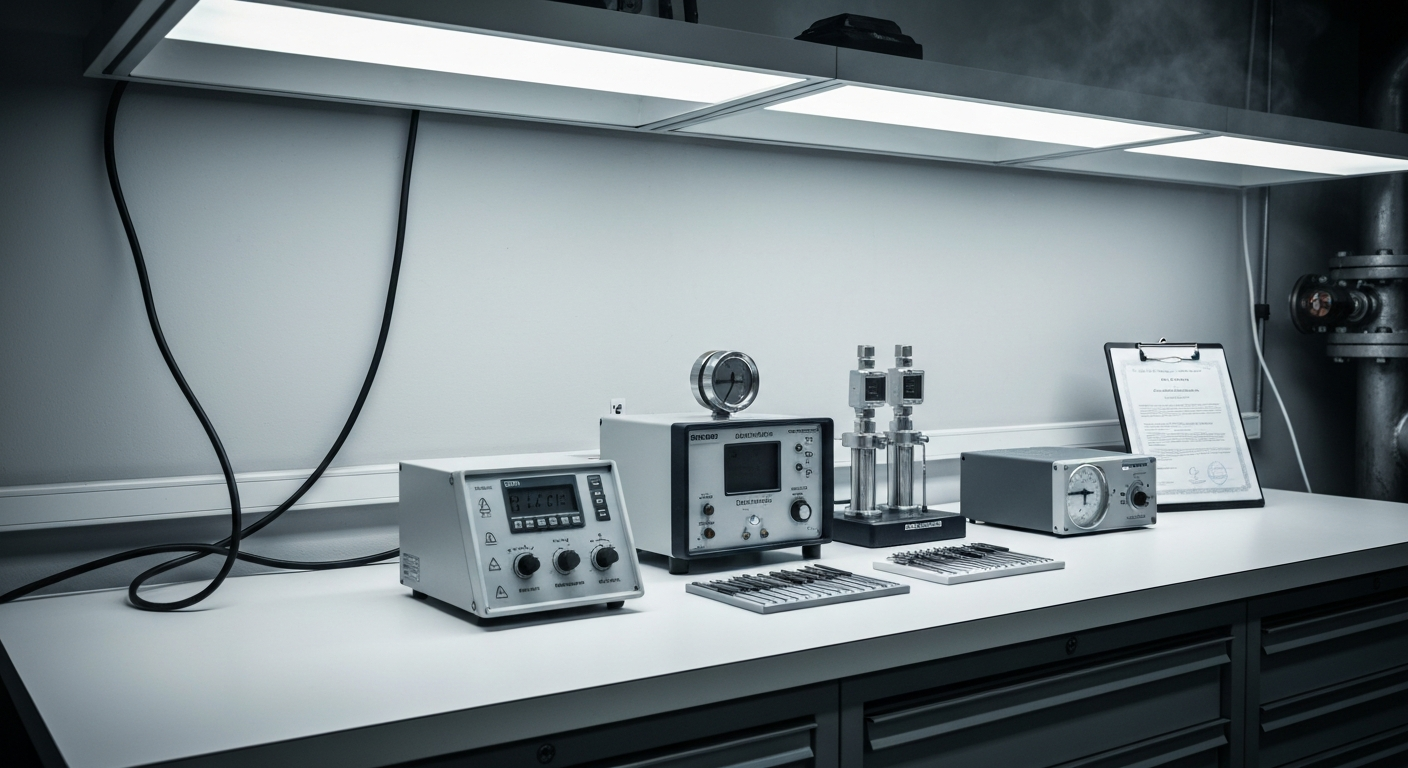 Regular calibration traceable to NIST/PTB standards remains the most cost-effective reliability measure available to maintenance teams
Accuracy degrades. Pressure diaphragms fatigue, thermocouple junctions oxidize, vibration sensor cables develop micro-cracks. Calibration every 6–12 months for process-critical instruments maintains traceability to national standards (NIST in the US, PTB in Germany) and catches drift before it affects process control or product quality. The average plant loses 27 hours per month to unplanned downtime (Siemens/Senseye, 2024) — much of that traceable to instrumentation failures.
Ingress protection ratings tell you how well a sensor survives its environment. Understanding IP codes isn't optional in wet, dusty, or washdown environments.
What happens when you install an IP65 sensor in an IP69K environment? Premature failure.
IP Rating Reference
| IP Rating | Dust Protection | Water Protection | Typical Use Case |
|---|---|---|---|
| IP54 | Dust protected (no full ingress) | Splash from any direction | Indoor control panels, light assembly |
| IP65 | Dust tight | Low-pressure water jets from any direction | Outdoor installations, washdown zones |
| IP67 | Dust tight | Submersion up to 1 m for 30 minutes | Food processing, outdoor flood zones |
| IP68 | Dust tight | Continuous submersion (depth per manufacturer) | Submersible level sensors, underwater |
| IP69K | Dust tight | High-pressure, high-temperature steam cleaning | Dairy, meat processing, vehicle wash |
| ATEX/IECEx Zone 1 | N/A | N/A | Flammable gas atmospheres (Zone 1) |
| ATEX/IECEx Zone 2 | N/A | N/A | Flammable gas atmospheres (intermittent risk) |
Beyond IP ratings, three factors govern sensor longevity: installation quality (correct mounting orientation, appropriate process connections, strain relief on cables), environmental compatibility (materials resistant to the specific chemicals, temperatures, and pressures in service), and calibration frequency (tied to process criticality and historical drift rates for that sensor type in that application).
Does your plant have a documented calibration schedule? ISO 9001 and ISO 17025 require it. Many plants run calibration on calendar schedules rather than condition-based intervals — meaning well-performing sensors get recalibrated unnecessarily while drifting outliers stay in service until the next scheduled date.
The average large manufacturing plant loses 27 hours per month to unplanned downtime, with sensor drift and miscalibration among the top root causes (Siemens/Senseye, 2024). Regular calibration traceable to ISO 17025 standards remains the most cost-effective reliability measure available to maintenance teams.
What's Next for Industrial Sensing Technology?
The market reaches $36.9 billion by 2030, driven by three converging trends: edge-AI embedded directly in sensor hardware, IO-Link becoming the universal point-to-point interface, and wireless mesh networks displacing hardwired installations where latency tolerances allow (Research and Markets, 2026). The sensor isn't just a measurement device anymore — it's the first node in an intelligent edge architecture.
Four technology trajectories are worth tracking. Edge AI in sensor hardware: DSPs and microcontrollers embedded in sensor housings now run lightweight inference models that classify machine state locally — no cloud round-trip, no latency, no network dependency. MEMS miniaturization: Micro-electromechanical sensors continue to shrink while improving performance, enabling dense sensor arrays on equipment where a single accelerometer used to sit. Self-powered sensors: Energy harvesting from vibration, heat differentials, and RF fields powers wireless sensors in locations where running cable is impractical or cost-prohibitive. 5G and Time-Sensitive Networking (TSN): Private 5G networks combined with TSN provide the deterministic latency required for closed-loop wireless control — previously achievable only over wired Ethernet.
Citation capsule: The industrial sensor market projects from $24.6 billion in 2025 to $36.9 billion by 2030 at 8.6% CAGR (Research and Markets, 2026). Key drivers include edge-AI embedded sensors, IO-Link as the dominant point-to-point interface, wireless mesh adoption in greenfield installations, and MEMS miniaturization enabling dense monitoring arrays at falling unit costs.
Frequently Asked Questions
What are the most common types of industrial sensors?
Pressure sensors hold the largest market share at 24.7%, followed by temperature, flow, level, proximity, vibration, and vision. These seven categories account for over 90% of the $24.6 billion industrial sensor market (Mordor Intelligence, 2025). Within each category, multiple technologies exist — for example, pressure alone encompasses absolute, gauge, and differential variants.
How much do industrial sensors cost?
Costs span four orders of magnitude. Thermocouples run $20–$50. RTDs cost $200–$500. Piezoelectric accelerometers range from $100 to $2,000 depending on frequency range and housing. Machine vision systems run $2,000–$15,000 including lighting and optics. IO-Link-enabled sensors typically carry a 15–25% premium over analog equivalents, but reduce installation and commissioning costs enough to lower total cost of ownership for most applications.
What IP rating do industrial sensors need?
IP65 is the minimum for any washdown or outdoor exposure — it provides dust-tight sealing and resistance to low-pressure water jets from any direction. IP67 handles temporary submersion up to one meter. IP69K is mandatory in dairy, meat processing, and any application where high-pressure, high-temperature steam cleaning is routine. Explosive atmospheres require ATEX or IECEx certification independent of IP rating. Mismatching IP rating to environment is one of the most common and expensive installation errors in practice.
How often should industrial sensors be calibrated?
Process-critical instruments — those whose readings directly affect product quality, safety systems, or regulatory compliance — should be calibrated every 6–12 months with traceability to national standards (NIST calibration services in the US, PTB in Germany). General-purpose monitoring instruments can often run 12–24 month intervals. Calibration frequency should be informed by historical drift data for that sensor type in that specific application environment, not just calendar schedules. Highly corrosive or thermally stressed environments accelerate drift and warrant shorter intervals.
What is IO-Link and why does it matter?
IO-Link (IEC 61131-9) is a point-to-point digital communication standard for sensors and actuators that reached 51.6 million installed nodes in 2024, growing at 22.5% CAGR (Mordor Intelligence, 2025). It uses standard three-wire unshielded cable, supports bidirectional communication for parameter upload/download and detailed diagnostics, and enables IO-Link masters to expose sensor data via OPC-UA or MQTT. It's the practical bridge between field-level sensing and IT/cloud analytics without replacing existing cable infrastructure.
What Should You Do Next With Industrial Sensors?
Industrial sensors are where physics meets automation. Get the fundamentals right — sensor type, selection criteria, protocol, calibration, and IIoT integration — and the data your systems rely on is accurate, consistent, and actionable.
Key takeaways from this guide:
- Seven major categories cover the types of industrial sensors used across industry: pressure (24.7% share), temperature, flow, level, proximity, vibration, and vision
- Six selection criteria determine the right sensor for any application: range, accuracy, environmental rating, output type, protocol, and total cost of ownership
- IO-Link is the fastest-growing protocol at 22.5% CAGR and 51.6 million nodes — it bridges OT and IT without infrastructure replacement
- Predictive maintenance delivers 30–50% downtime reduction when vibration, temperature, current, and ultrasonic sensors are deployed with proper analysis tooling
- 45% of sensor data processes at the edge — latency and data sovereignty keep the majority on-site, with cloud handling trend analysis and model training
- Calibration every 6–12 months for process-critical instruments maintains measurement traceability and catches drift before it affects process control
Start with the sensor type most relevant to your application. Then build outward — protocol selection, edge architecture, and maintenance program — from that foundation.
Read more: IIoT Protocols Compared: The Engineer's Decision Framework
Rihards Niparts is a Sales Engineer working with industrial sensors. His analysis is vendor-neutral and grounded in industry standards like IEC 61298 and ISA-S75.