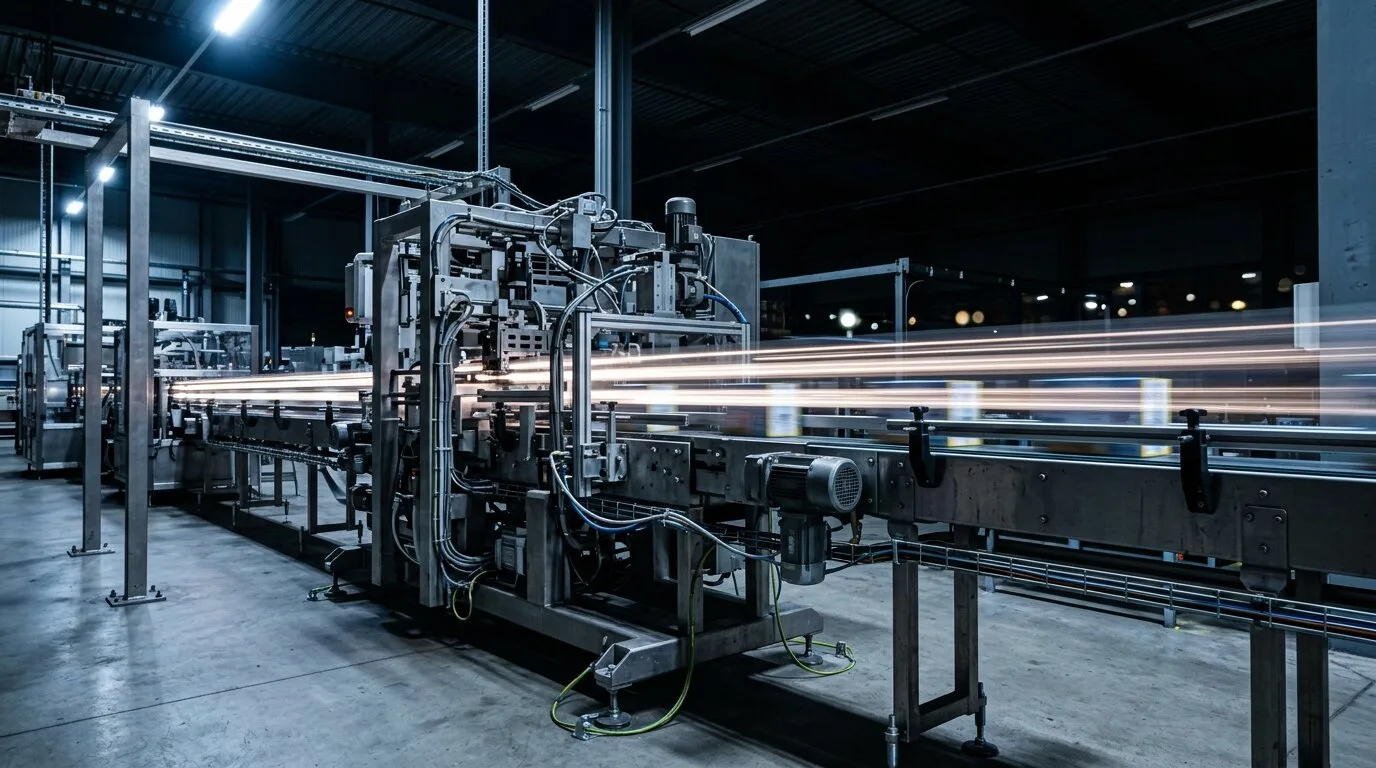
TSN vs Standard Industrial Ethernet: A Qbv Guide
Read more...

Both call themselves Industrial Ethernet. Both claim real-time performance. But one runs a servo axis at sub-100 microsecond cycles with no switches in the wiring closet. The other runs an entire plant on flexible star and ring topologies. That gap is the actual decision - not which vendor logo you like more.
Too many teams treat this as a brand loyalty question - Beckhoff versus Siemens, pick your camp. It's a cycle-time, topology, and safety question, and the wrong answer locks a machine's performance ceiling for a decade. This comparison pairs with our PROFINET vs EtherNet/IP guide and sits one layer below OPC UA vs MQTT in the stack.
TL;DR: EtherCAT and PROFINET are both Industrial Ethernet, but built differently. EtherCAT uses a "processing on the fly" summation frame - one telegram passes through every node, each reading and writing its slice as it goes - hitting sub-100 microsecond cycles and sub-microsecond jitter via Distributed Clocks, with no managed switches, on a strict line topology. PROFINET layers real-time on standard Ethernet with flexible star/line/ring topologies and roughly 79 million installed nodes (HMS Networks); its IRT tier reaches 31.25 microsecond cycles but needs certified managed switches. EtherCAT wins tight coordinated motion; PROFINET wins plant-wide flexibility.
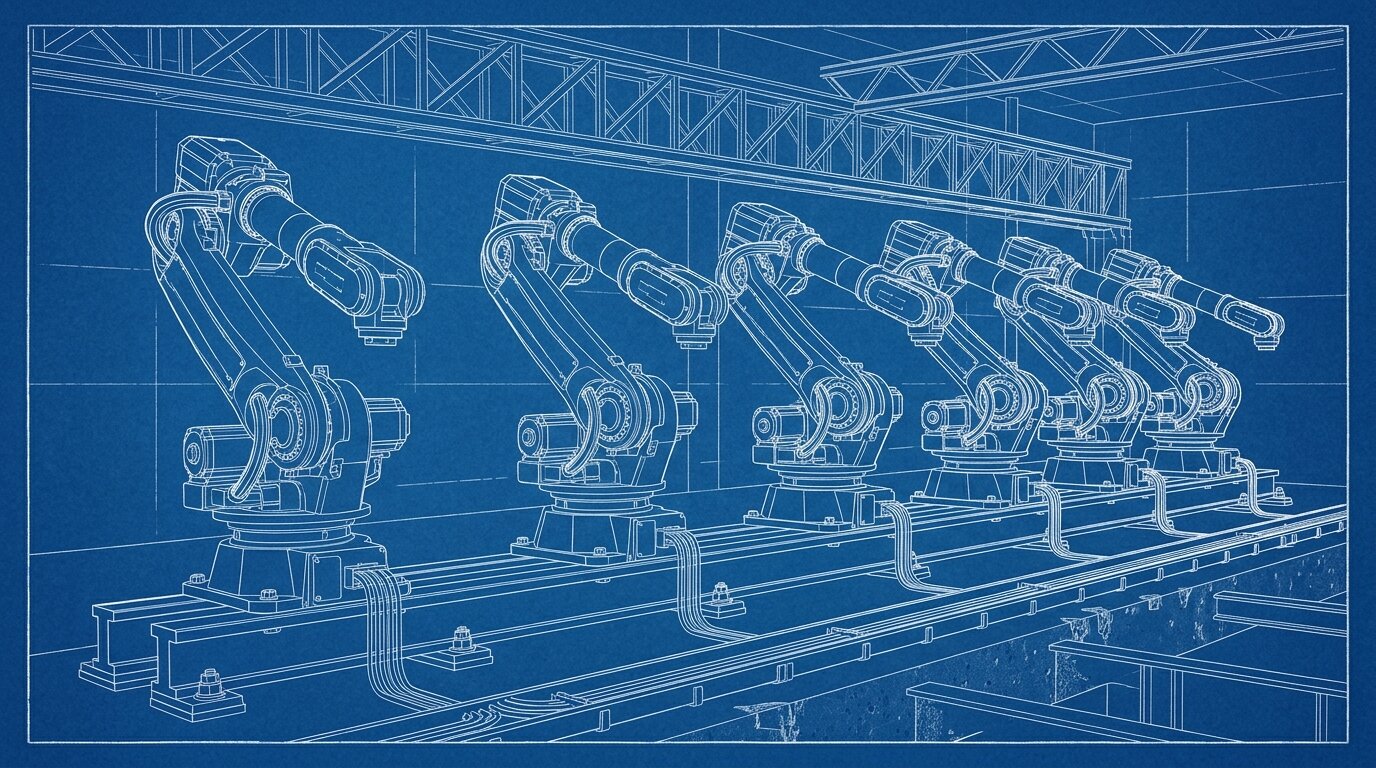
EtherCAT is a summation-frame protocol built for tight, coordinated motion; PROFINET is standard Ethernet plus a real-time layer, built for flexible, plant-wide automation. They share a cabling family and little else underneath.
Both fall under EtherCAT Technology Group (ETG) and PROFINET (PI) certification and ride on standard 802.3 cabling. That's roughly where the similarity ends. EtherCAT uses a master/slave architecture where dedicated ESC (EtherCAT Slave Controller) hardware chips process data inline. PROFINET IO uses a controller/device model layered on conventional Ethernet switching, split into RT and IRT tiers based on how much determinism a machine needs.
A machine builder speccing a six-axis pick-and-place cell cares about coordinated servo timing down to the microsecond. A plant engineer wiring a bottling line's PLCs, HMIs, and drives across three buildings cares about topology flexibility and diagnostics that plug into TIA Portal. Neither is wrong - they're solving different problems with the same cable.
Citation capsule: EtherCAT and PROFINET both run over standard 802.3 Ethernet cabling but use fundamentally different engines underneath. EtherCAT (ETG) relies on dedicated ESC hardware in every slave device to process a single summation frame as it moves through the line, achieving sub-100 microsecond cycle times without any external switches. PROFINET (PI) instead layers a real-time protocol on top of conventional Ethernet switching, splitting into an RT tier for standard I/O and an IRT tier for hardware-scheduled motion control, and depends on managed or certified switches to enforce that determinism. The choice between them is less about brand and more about whether a machine needs tightly coordinated axis-level motion or flexible, plant-wide connectivity across a large device count.
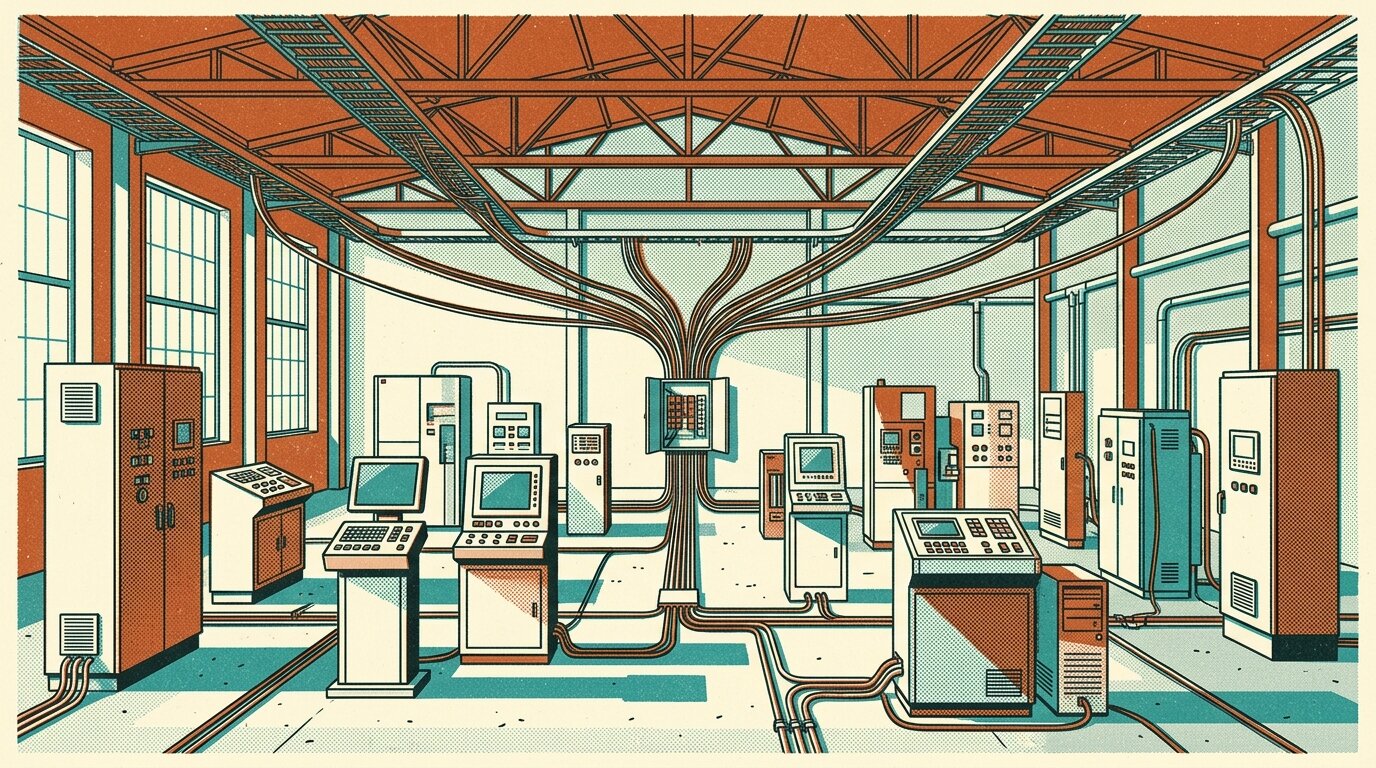
One EtherCAT telegram travels down the entire line through every slave in turn; each slave's ESC chip reads and writes its data directly into the moving frame at wire speed, then the frame returns to the master. No per-node store-and-forward step, no switches between devices.
A conventional Ethernet switch receives a full packet, buffers it, inspects the destination, then forwards it - a receive-decode-forward cycle that adds latency at every hop. EtherCAT skips that. The ESC hardware in each slave taps the passing frame, extracts the bits addressed to it, and inserts its own response bits. It then lets the frame keep moving without ever fully stopping. That's the "on the fly" part - a hardware trick, not a software scheduler.
Because the frame never stops moving, cycle time scales with physical propagation delay through the line, not per-node processing overhead - that's what gets EtherCAT to sub-100 microsecond cycles in real deployments (ETG). Distributed Clocks (DC), a hardware scheme that keeps every slave's internal clock aligned to a reference master clock, pushes jitter below 1 microsecond, since every node shares one coherent time base instead of estimating it in software.
Because the frame moves point-to-point through each device rather than being routed by a switch, EtherCAT needs no external managed switches - the network topology itself is the switching fabric. The cost savings follow from that design, not the other way around. The tradeoff is architectural: devices must sit in a strict line, since the frame has to physically pass through each node in order.
Citation capsule: EtherCAT's "processing on the fly" mechanism sends one summation frame through every slave device in sequence; each device's ESC hardware chip reads and writes its data slice as the frame passes at wire speed, without stopping or buffering it (ETG). Combined with Distributed Clocks - a hardware scheme that keeps every node's internal clock synchronized to a common reference - this delivers cycle times below 100 microseconds and jitter under 1 microsecond. No external switches are required, because the line of devices forms the switching path itself, which is why EtherCAT networks skip the managed-switch cost entirely. Because cycle time scales with the line's physical propagation delay rather than per-node processing overhead, adding devices barely changes the timing budget. That efficiency comes with an architectural constraint: devices must sit in a strict line or daisy-chain, since the frame has to pass through each node in order to reach the next.
PROFINET layers real-time performance on standard Ethernet through two tiers: RT (Real-Time), running 1-10 millisecond cycles on software-prioritized frames over ordinary switches, and IRT (Isochronous Real-Time), reaching as fast as 31.25 microseconds through hardware-scheduled time slots on certified managed switches.
RT bypasses the TCP/IP stack for cyclic I/O, mapping data straight to Layer 2 Ethernet frames with an IEEE 802.1Q priority tag. That's fast enough for most conveyor, packaging, and material-handling work, and it runs on off-the-shelf unmanaged switches. That's also why PROFINET can coexist with regular TCP/IP traffic like HTTP diagnostics on the same wire.
IRT works differently: it physically reserves hardware-scheduled time slots for critical cyclic traffic, so motion data never waits behind a broadcast storm or a diagnostic query. That guarantee only works with specialized switches carrying dedicated ASICs, such as Siemens SCALANCE X-series hardware, because the reservation scheme has to be enforced in silicon at every hop (PROFINET/PI). Done right, IRT reaches 31.25 microsecond cycles with sub-microsecond jitter - close enough to matter for some motion applications, though EtherCAT still edges it out on raw cycle time.
The gap between RT and IRT is what most comparisons gloss over. A plant running standard PROFINET RT at 1-10 ms is nowhere near EtherCAT's territory, and pretending otherwise sets the wrong expectation in a design review. Only IRT closes that gap, and it comes with its own switch bill.
EtherCAT mandates a line or daisy-chain topology, with an optional ring for redundancy, and needs no external industrial switches. PROFINET supports star, line, tree, and ring topologies on standard managed switches, with certified ASIC switches required specifically for IRT.
That constraint cuts both ways. EtherCAT's line topology is simple and cheap to wire - no switch cabinet, no port licensing, just device-to-device cable runs. It's also inflexible: adding a device mid-line means breaking into the chain, and a brownfield retrofit around existing conduit can force awkward routing a star topology would sidestep.
PROFINET's flexibility mirrors that tradeoff. Star, line, tree, and ring topologies all work, so a plant network can grow organically as cells get added without replanning the whole line. Ring topologies also unlock Media Redundancy Protocol (MRP), which recovers a broken connection in under 200 milliseconds - real margin where one cut cable shouldn't stall the whole line.
I've walked machines where a controls engineer wanted PROFINET's star flexibility bolted onto what was really a tightly coupled six-axis motion cell. It's the wrong instinct. That cell never needed to grow topology - it needed the tightest possible cycle time. EtherCAT's rigid line was never the constraint people assumed it would be. The line-topology "limitation" people worry about mostly matters for plant-wide device counts in the hundreds, not for a fixed motion cell that was never going to be rewired anyway.
Both safety layers certify to IEC 61508 SIL 3 / Performance Level e under the same black-channel principle - the underlying network is treated as untrusted, with independent error checking on top. The difference is timing: FSoE (Fail Safe over EtherCAT) runs 1-4 millisecond safety cycles with about 6 bytes of overhead, while PROFIsafe runs 4-32 milliseconds with about 12 bytes.
FSoE inherits EtherCAT's Distributed Clocks precision, so its watchdog timers evaluate against a genuinely coherent clock rather than a software estimate - that's what lets it run faster without sacrificing certainty about a fault window. PROFIsafe instead relies on a software-based F-Watchdog Time, part of why its typical cycle runs an order of magnitude slower.
Nobody quantifies this trade-off in comparison content, but it matters for fast-reacting or collaborative machinery. A cobot cell sharing a workspace with a person needs its emergency stop signal to propagate and act within a tight window; a 1-4 ms FSoE cycle gives meaningfully more margin than a 4-32 ms PROFIsafe cycle when a light curtain trips. On a slower line where nobody's hand is near a pinch point, that margin rarely changes the outcome.
I once reviewed a cobot cell where the integrator had specced PROFIsafe purely out of platform habit, not because the line demanded it. Once we walked through how close the operator's hands actually got to the pinch point during normal cycles, the safety cycle time margin became the deciding factor, not the PLC brand already on the shelf.
Citation capsule: FSoE (Fail Safe over EtherCAT) and PROFIsafe both certify to IEC 61508 SIL 3 / Performance Level e under the black-channel principle, treating the underlying network as untrusted. FSoE, inheriting EtherCAT's Distributed Clocks precision, runs safety cycles of 1-4 milliseconds with roughly 6 bytes of overhead per frame. PROFIsafe, relying on a software-based watchdog timer, runs 4-32 millisecond safety cycles with roughly 12 bytes of overhead. Neither is "less safe" - both meet the same certification ceiling - but the timing gap matters directly for fast-reacting or collaborative machinery where a shorter safety cycle buys real margin on an emergency stop. That margin shows up concretely in a cobot cell sharing a workspace with a person, where a shorter safety cycle gives more time for an emergency stop to propagate and act before a light curtain trip becomes a collision risk.
PROFINET is PI-led (Siemens-aligned) with the larger installed base - roughly 79 million nodes and about 30% of new industrial network installs in 2025, up from 27% the year before. EtherCAT is governed by ETG, founded by Beckhoff but run as a vendor-neutral group, and sits at about 20% of new installs, up from 17% (HMS Networks).
Governance shapes how each ecosystem grows. PI is Siemens-aligned, so PROFINET tooling integrates deeply with TIA Portal - an advantage if that's already your platform, friction if it isn't. ETG runs EtherCAT as an open, vendor-neutral standard; Beckhoff founded it but doesn't control certification, and open-source master stacks like SOEM give smaller integrators a path onto EtherCAT without buying into one vendor's tooling.
HMS Networks' 2025 data shows both protocols growing their share of new nodes year over year, with PROFINET holding the larger absolute base thanks to two decades of plant-wide deployments across automotive and process industries. EtherCAT's growth skews toward motion-heavy sectors - packaging, robotics, semiconductor equipment - where cycle time decides, not an incumbent PLC platform.
| Aspect | EtherCAT | PROFINET |
|---|---|---|
| Cycle time | Sub-100 us | RT: 1-10 ms; IRT: 31.25 us |
| Jitter | Under 1 us (Distributed Clocks) | Under 1 us (IRT) |
| Topology | Line / daisy-chain | Star, line, tree, or ring |
| Switches | None needed | Standard for RT; certified managed for IRT |
| Functional safety | FSoE, 1-4 ms | PROFIsafe, 4-32 ms |
| Governance | ETG, Beckhoff-founded, vendor-neutral | PI, Siemens-aligned |
| New-install share, 2025 | About 20% | About 30% |
| Best fit | Coordinated motion, CNC, robotics | Flexible plant-wide automation |
EtherCAT wins raw speed and simplicity; PROFINET wins flexibility and installed base.
Citation capsule: PROFINET holds the larger installed base at roughly 79 million nodes and about 30% of new industrial network installs in 2025, up from 27% a year earlier, reflecting PI's Siemens-aligned governance and two decades of plant-wide deployment. EtherCAT, governed by the vendor-neutral EtherCAT Technology Group, sits at about 20% of new installs, up from 17%, with growth concentrated in motion-heavy sectors like robotics and packaging (HMS Networks). Both figures describe adoption share, not market-size dollars - the takeaway is that both protocols are gaining ground on legacy fieldbuses, not that one is disappearing. The governance models track that split: PI's Siemens-aligned structure ties PROFINET tightly to TIA Portal and the broader Siemens ecosystem, while ETG's vendor-neutral certification and open-source stacks like SOEM keep EtherCAT accessible to smaller integrators building outside any single vendor's platform.
Choose EtherCAT for tightly coordinated multi-axis motion - CNC, robotics, semiconductor handling, packaging servos - where sub-100 microsecond cycles and no-switch simplicity outweigh topology flexibility. Choose PROFINET for plant-wide automation and Siemens-integrated lines, where the larger device ecosystem and existing TIA Portal investment matter more than the last few microseconds.
Choose EtherCAT if:
Choose PROFINET if:
That split holds up across most machines I've spec'd. A CNC gantry or six-axis cell needs the tightest loop between controller and servo drive, not topology flexibility. A plant network spanning multiple buildings needs the opposite: flexible topology and a device ecosystem that doesn't require re-platforming every time a machine gets added.
Neither protocol natively interoperates with the other; they use incompatible frame structures. No gateway makes them speak the same language at the field-bus level. Plants that need both run them as separate networks, sometimes bridging tag values through a translation gateway, the way legacy Modbus gets bridged into a modern Ethernet plant. For the layers above, see how OPC UA and OPC UA vs MQTT move plant-floor data to the cloud, and our full IIoT protocol framework for where both fit in the bigger picture.
EtherCAT is a summation-frame protocol built for tightly coordinated motion, reading and writing data as one telegram passes through every node at wire speed (ETG). PROFINET is standard Ethernet plus a real-time layer, built for flexible, plant-wide automation with a much larger installed base (PROFINET/PI).
EtherCAT runs sub-100 microsecond cycles with sub-microsecond jitter via Distributed Clocks. PROFINET IRT reaches 31.25 microseconds with comparable jitter, but standard PROFINET RT runs 1-10 ms - so the honest answer depends on which PROFINET tier you compare against (ETG; PROFINET/PI).
No for EtherCAT - it needs no external switches at all, since each node passes the frame directly to the next. Yes for PROFINET IRT, which needs certified managed switches with dedicated ASICs, like Siemens SCALANCE, to hold hardware-scheduled time slots.
EtherCAT generally wins tightly coordinated multi-axis robotics and CNC work, where sub-100 microsecond cycles and no-switch wiring simplify the cell. PROFINET fits robotics cells that are already Siemens-integrated or need to sit inside a larger plant-wide network.
Not natively - the two use incompatible frame structures and neither speaks the other directly. Plants that need both run them as separate networks, or bridge specific data points through a gateway, similar to how legacy Modbus is bridged into modern Ethernet networks.
Same cabling family, genuinely different engines. EtherCAT's summation frame delivers sub-100 microsecond cycles and sub-microsecond jitter with no switches, at the cost of a strict line topology. PROFINET's RT/IRT tiers trade some of that raw speed for flexible wiring and a much larger installed base. Safety timing tells the same story in miniature: FSoE's 1-4 ms cycles beat PROFIsafe's 4-32 ms, but both certify to the same SIL 3 / PL e ceiling.
Pick on cycle time, topology, and ecosystem, not on which name sounds more familiar. Tightly coordinated motion: EtherCAT's hardware trick wins outright. A flexible, growing plant network with deep Siemens integration: PROFINET's larger ecosystem wins just as clearly. Read our PROFINET vs EtherNet/IP comparison next, or step back to the full IIoT protocol framework to see where both fit against fieldbus and cloud-layer protocols.
Read more...