Sensors Edge Hub Logo
What Is OPC UA? The Protocol That Explains Itself

What Is OPC UA? The Protocol That Explains Itself

A raw Modbus register hands you the number 72. Nothing else. OPC UA hands you "Boiler 3 outlet temperature, 72 C, valid range 0-150, updated 40ms ago." Same physical reading, two very different amounts of information, and that gap is why OPC UA exists.

Engineers run into OPC UA constantly, in PLC configuration screens, in vendor spec sheets, in half the IIoT protocol conversations happening on a plant floor this week. Fewer can cleanly explain what separates it from an ordinary transport. This piece builds on OPC UA vs MQTT and Unified Namespace by going one level deeper: what OPC UA is, how its address space works, and what it costs to run.

TL;DR: OPC UA (OPC Unified Architecture, IEC 62541) is an open, platform-independent framework for industrial data, not just a wire protocol. Its defining feature is the information model: data lives in an address space of nodes (objects, variables, references, types) that carry their own metadata, so a value arrives self-describing instead of as a raw register number (OPC Foundation). It supports client-server and PubSub communication, including over MQTT, ships with built-in security (X.509 certificates, encryption, role-based access), and replaced the Windows-only OPC Classic.

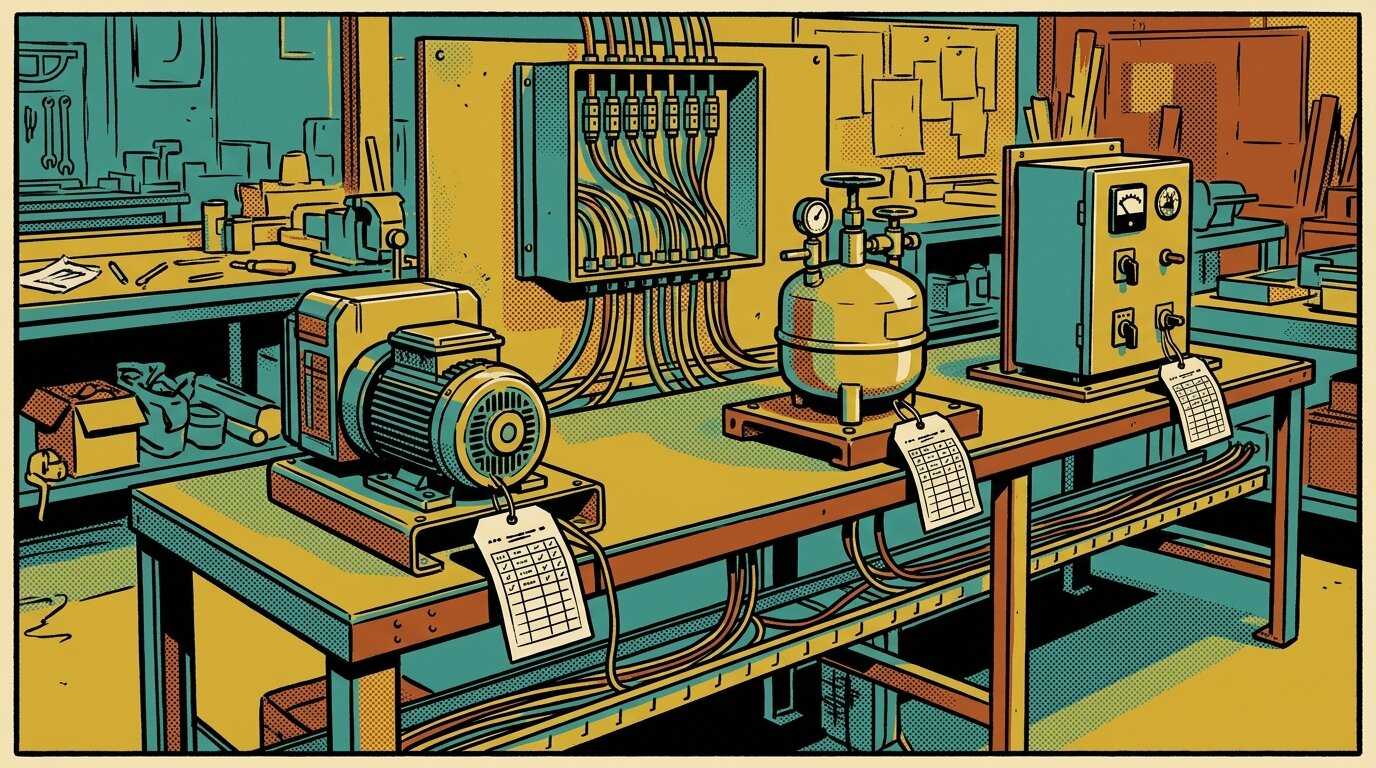
Different-vendor industrial machines feeding self-describing OPC UA data into one shared junction, illustrating vendor interoperability

What Is OPC UA, and What Does It Stand For?

OPC UA stands for OPC Unified Architecture, an open, platform-independent, service-oriented framework for industrial data, standardized as IEC 62541 by the OPC Foundation. It is an architecture for modeling and moving data, not a single transport protocol. That framework distinction drives the rest of this article.

From OPC Classic to OPC UA

The Foundation released OPC UA in 2008 to unify and replace the older OPC Classic (OPC DA) specifications. That family of standards only ran on Windows and depended on Microsoft's COM and DCOM technologies underneath. That dependency was the ceiling. A COM-based protocol could not run on a Linux gateway, an ARM-based edge device, or a cloud service, because none of those platforms speak COM.

What "platform-independent" means

OPC UA dropped that constraint entirely. It runs the same information model and the same services on a PLC, a Linux server, an ARM microcontroller, or a cloud instance. That is what "platform-independent" means in practice, rather than as marketing language. A vendor building a sensor gateway today doesn't need Windows anywhere in the stack to expose OPC UA data.

Most explainers list OPC UA's features: secure, platform-independent, PubSub-capable. That list misses the actual differentiator. What makes OPC UA "OPC UA," rather than just another secure transport, is the information model underneath everything else. The next section unpacks it with a concrete example instead of a definition.

Citation capsule: OPC UA (OPC Unified Architecture) is an open, platform-independent, service-oriented framework for industrial data, standardized as IEC 62541 by the OPC Foundation. Released in 2008, it was built to unify and replace the older OPC Classic specifications, which ran only on Windows and depended on Microsoft's COM and DCOM technologies. Because OPC UA carries no such dependency, the same information model and services run unchanged on a PLC, a Linux gateway, an ARM device, or a cloud instance. That portability is why OPC UA shows up at every layer of a modern plant, from a field controller to a cloud historian, using one consistent way of describing data rather than a different integration approach at each hop. The framework label matters because it signals that OPC UA covers far more ground than a bare wire protocol ever could on its own.

What Is the OPC UA Address Space and Information Model?

The address space is a structured graph of nodes, objects, variables, references, and types, and it is what makes OPC UA data self-describing rather than a bare number. A temperature reading isn't just "72"; it's a variable node carrying engineering units, a valid range, a data type, and a timestamp alongside the value itself (OPC Foundation).

Nodes, objects, and references

Everything inside an OPC UA server lives as a node in this graph. Object nodes represent real things, a boiler, a pump, a sensor. Variable nodes hold the actual values, like the current temperature reading. Reference nodes describe the relationships between other nodes, "this variable belongs to this object," "this object is a type of Boiler." Type nodes define the templates that objects and variables get built from, so a hundred boilers on a site can all expose the same shape of data without a hundred separate integration efforts.

That graph is browsable. A client connecting to a server for the first time can walk the address space and discover what exists, without a separate spreadsheet or a vendor's PDF describing register maps. Compare that to a raw Modbus register: 40012 on the wire, and the meaning of that number lives entirely in a document somebody wrote once and everyone else has to trust. Our piece on raw Modbus registers covers exactly that gap from the legacy side.

The first time I pointed a generic client at an unfamiliar OPC UA server and just browsed the tree, it felt almost anticlimactic: no register map PDF to hunt down, no calling the vendor to ask what tag 14 meant. The names, units, and ranges were already sitting right there in the address space.

Metadata that travels with the value

Metadata is what turns the number into information. Alongside a Value node, a well-modeled Temperature Sensor object typically carries an EngineeringUnits node (Celsius, not Fahrenheit), a Range node (0 to 150, so a client knows what's physically plausible), a DataType node, and a timestamp with a quality flag showing whether the reading is current or stale.

Temperature Sensor (Object) HasComponent HasProperty HasProperty HasProperty HasProperty Value = 72 (Variable) EngineeringUnits = degC Range = 0-150 DataType = Double Timestamp / Quality A raw Modbus register on the wire carries none of this: just the number 72 Illustration: OPC UA address space node graph for one temperature reading
Every OPC UA value node carries its own metadata; a bare Modbus register handing you "72" carries none of it.

Citation capsule: The OPC UA address space represents industrial data as a graph of nodes, objects, variables, references, and types, and every value node can carry metadata describing its own meaning: engineering units, valid range, data type, and timestamp (OPC Foundation). That is the information model, and it is the real differentiator behind OPC UA, more than the transport, the security, or the platform independence, because it is what lets a client discover and correctly interpret a value it has never seen before. A raw Modbus register carries none of that context on the wire; a client has to already know, from a separate document, that register 40012 is a Celsius reading bounded between 0 and 150. An OPC UA client just browses the address space and finds out. That single capability, data describing itself instead of requiring an external key, is what makes the Companion Specifications covered later in this article possible at all.

How Does OPC UA Communicate? Client-Server vs PubSub

OPC UA supports two communication models: the classic client-server pattern, where a client opens a session and requests or subscribes to data from a server, and the newer PubSub pattern, built for many-to-many fan-out through a message broker or over UDP, including OPC UA running over MQTT (OPC Foundation).

Client-server follows a service-oriented architecture, or SOA, design: a client sends a request, the server processes it, and a response comes back. Within that session, a client can call discovery services to browse the address space, session services to authenticate and open a connection, and subscription services to ask for updates. Subscriptions are where the efficiency lives, since monitored items only report a change when the underlying value moves, a pattern known as report-by-exception, rather than the client polling on a fixed interval.

PubSub flips that model. Publishers send messages to a broker without knowing whether any subscriber exists, and subscribers express interest in specific data types without needing to know where the data came from. That decoupling is exactly what a cloud fan-out or a Unified Namespace needs, and it's why OPC UA PubSub can ride MQTT directly, keeping the information model intact while trading the tightly coupled session for a broker-mediated one.

Client-Server Client Server request / subscribe response / notify One session, guaranteed reply PubSub Publisher A Publisher B Broker Sub 1 Sub 2 Sub 3 Many-to-many, no direct session Illustration: OPC UA client-server request-response vs PubSub many-to-many fan-out
Client-server keeps a client and server in a request-response session; PubSub decouples publishers from subscribers through a broker.

Client-server suits a SCADA client that needs to browse a live address space and get a guaranteed response back. PubSub suits a scenario with many consumers, a historian, a dashboard, a cloud analytics job, all wanting the same telemetry without each one opening its own dedicated session to the source. Most real deployments end up using both, client-server locally where discovery and guaranteed delivery matter, PubSub outward where fan-out matters more.

Is OPC UA Secure?

Security is built into the OPC UA specification, not bolted on afterward. Every client and server authenticates using X.509 certificates at both the application and the user level, and the specification also requires encryption, message signing, role-based access control, audit logging, and sequenced packets that block replay attacks (OPC Foundation).

Locked industrial gateway cabinets linked by a single trusted connection, representing OPC UA's X.509 certificate security model

The certificate trust model

The certificate model is the foundation everything else sits on. Before a client and server exchange a single value, each side presents an X.509 certificate identifying exactly which application it is, and the server decides whether that specific application is permitted to connect at all. That's a meaningfully different posture than a bare TCP socket accepting any connection that shows up on the right port.

On top of application-level trust, OPC UA layers user authentication, so an operator's login can restrict what parts of the address space they're allowed to see or write to. Session encryption protects data in transit at a configurable security level, and message signing lets a recipient verify a message wasn't tampered with in flight.

Audit and replay protection

Sequenced packets stop an attacker from capturing and replaying an old, legitimate-looking message later. An audit trail logs who connected, what they read, and what they changed.

Citation capsule: OPC UA's specification requires X.509 certificate authentication at both the application and user level, session encryption, message signing so recipients can verify data integrity, role-based access control, audit logging, and sequenced packets that prevent replay attacks (OPC Foundation). That security posture is baked into the standard rather than left to whoever implements it, which matters because it means a compliant OPC UA server ships with a defined security policy by default instead of arriving wide open until someone configures protection by hand. Compared with legacy plant protocols that transmit in plaintext with no authentication at all, this is a genuine architectural shift, not a checkbox feature added late. The certificate handshake at connection time is the gate everything else in the security model sits behind: no valid certificate, no session, no data.

What Can You Build on Top? Companion Specifications

Because OPC UA data is self-describing, industry groups can publish Companion Specifications, standardized information models for an entire equipment domain, so any compliant device from any vendor exposes data the same way. Robotics (VDMA), PackML (ISA-TR88) for packaging machinery, and Machine Vision (VDMA) are three examples already in wide use.

Companion Specs Robotics, PackML, Machine Vision Information Model address space: nodes, objects, types Services discovery, session, subscription Transport OPC UA TCP / HTTPS / WebSockets Illustration: OPC UA framework layers, each building on the one below it
Companion Specifications only work because they sit on top of a shared transport, service, and information model layer beneath them.

This is the payoff most write-ups skip past. A Companion Specification only works because OPC UA already gives every vendor the same building blocks, nodes, types, references, to model their equipment consistently. Once that base exists, a working group can agree on a standard "Robot" type once, and every robot vendor that implements it exposes joint positions, program state, and fault codes the same way, instead of every integrator writing custom mapping code per brand.

This is the actual reason the information model matters more than the transport. Security and platform independence are table stakes for any modern industrial protocol. An extensible, self-describing address space is what lets an entire industry agree on a shared vocabulary for "what a robot looks like on the network," and that agreement doesn't happen without the information model underneath it.

A plant that adopts a Companion Specification gets a real practical benefit: swap a robot from one vendor for another compliant unit, and the integration that already reads "joint position" and "program state" from the OPC UA server keeps working, because both vendors implemented the same standard type.

How Does OPC UA Compare to OPC Classic?

OPC Classic, the OPC DA family and its siblings, ran only on Windows and depended on Microsoft's COM and DCOM technologies for communication. OPC UA, released in 2008, is platform-independent and service-oriented, with security designed in from the start. It's a full re-architecture, not an incremental upgrade to the older specs (OPC Foundation).

Aspect OPC Classic OPC UA
Platform Windows-only Platform-independent (Linux, ARM, cloud)
Transport Microsoft COM/DCOM OPC UA TCP, HTTPS, WebSockets
Security Depends on OS/DCOM configuration Built-in X.509 certificates, encryption, RBAC
Data model Bare tag values Self-describing address space
Discovery Limited, manual mapping Built-in discovery services
Standard Proprietary, COM-based IEC 62541

OPC UA replaces a Windows-locked, proprietary transport with an open, self-describing, platform-independent standard.

That re-architecture shows up in the transports OPC UA defines. It ships with OPC UA TCP, a binary protocol built for high-performance local exchanges, alongside HTTPS and JSON over WebSockets for broader compatibility across firewalls and web-facing systems. OPC Classic never had that range of options. It was tied to COM/DCOM and, by extension, to Windows networking quirks that made it notoriously painful to run across a firewall.

Where OPC UA sits relative to MQTT is a separate question worth being precise about. OPC UA is a modeling framework that can run over multiple transports, including PubSub over MQTT; MQTT itself is a transport with no modeling layer of its own. The full breakdown of that distinction, and when you want both, lives in OPC UA vs MQTT. If your architecture also needs a shared broker layer downstream of OPC UA, Unified Namespace and Sparkplug B cover how that gets built in practice.

What Does OPC UA Cost You?

Self-describing power comes with real weight: implementation complexity, certificate management overhead, and genuine engineering effort to model legacy assets into an OPC UA information model. That cost is why adoption still skews toward greenfield projects rather than retrofits of equipment that predates OPC UA entirely.

The gateway tax

Bridging OPC UA into a broader architecture, especially where a cloud or cross-site system needs the data, usually means a gateway that translates between OPC UA and whatever transport sits downstream. That translation adds 50-200ms of latency (Arulnithika et al., 2025, via Azeta et al. 2025), and Arulnithika et al. (2025), via Azeta et al. 2025, also found that integration projects typically spend 40-60% of their total budget on middleware and gateway development rather than on the endpoint systems themselves. Modeling a legacy PLC's raw registers into a proper OPC UA address space, giving every value real units, ranges, and a sensible object hierarchy, is exactly the kind of work that eats that budget.

Why adoption still skews new-build

Mourtzis et al. (2023), via Azeta et al. 2025, found OPC UA adoption at 31% of new industrial installs versus just 7% of retrofits. That gap tracks the cost directly. A greenfield project can design the information model in from day one. A retrofit has to reverse-engineer decades of undocumented register maps into that same model, which is far more expensive than bolting a lighter transport onto the existing wiring.

Certificate management is the other operational tax that's easy to underestimate on paper. Every OPC UA client and server needs a valid X.509 certificate, and certificates expire, need rotation, and need a trust list that stays current across every device on the network. On a small deployment that's a manageable chore; across hundreds of field devices spanning multiple sites, it becomes a genuine operations job someone has to own, not a one-time setup step. I've seen a rollout stall for a week because nobody had assigned ownership of certificate renewal, and a batch quietly expired over a long weekend.

OPC UA earns its complexity when you need semantic interoperability across multiple vendors, when Companion Specifications matter to your equipment mix, or when the information model pays for itself downstream in reduced integration work. It's heavier than you need for a single point-to-point link between two devices that will never talk to anything else.

Citation capsule: Self-describing data comes at a real cost: gateway translation adds 50-200ms of latency and consumes 40-60% of integration budgets on middleware and gateway development rather than on endpoint systems (Arulnithika et al., 2025, via Azeta et al. 2025). OPC UA adoption reflects that cost directly, sitting at 31% of new industrial installs versus 7% of retrofits (Mourtzis et al., 2023, via Azeta et al. 2025). Greenfield projects can design the information model in from the start, while a retrofit has to reverse-engineer legacy register maps into that same model after the fact, which is meaningfully more expensive. Certificate management compounds the effort at scale, since every device needs a valid, rotated X.509 certificate and a current trust list. None of that makes OPC UA the wrong choice; it makes it the wrong choice for a job that doesn't need semantic interoperability across vendors in the first place.

Frequently Asked Questions

What does OPC UA stand for? OPC UA stands for OPC Unified Architecture, standardized as IEC 62541 by the OPC Foundation. It is a platform-independent, service-oriented framework for industrial data, not a single wire protocol, and it replaced the older Windows-only OPC Classic specifications released in 2008.

What is the OPC UA information model or address space? The address space is a graph of nodes, objects, variables, references, and types, that carries metadata alongside every value: engineering units, valid range, data type, and timestamp. A reading arrives self-describing instead of as a bare number a client has to look up elsewhere.

How is OPC UA different from MQTT? OPC UA is a framework that models what data means; MQTT is a lightweight transport that moves whatever payload you hand it. OPC UA can run over PubSub, including MQTT, but the modeling layer is what OPC UA adds. See the full comparison in OPC UA vs MQTT.

Is OPC UA secure? Yes, security ships as part of the specification rather than as an add-on. OPC UA requires X.509 certificate authentication for both applications and users, encryption, message signing, role-based access control, audit logging, and sequenced packets that block replay attacks.

What is the difference between OPC UA and OPC Classic? OPC Classic ran only on Windows, built on Microsoft COM and DCOM. OPC UA, released in 2008, is platform-independent and service-oriented, running on Linux, ARM devices, and the cloud, with security and an extensible information model designed in from the start.

Conclusion

OPC UA is a framework, not a wire protocol, and the information model is what makes that framing true rather than marketing language. Data lives as a browsable graph of nodes carrying its own units, range, and type, so a value arrives self-describing instead of needing an external key to decode it.

  • OPC Unified Architecture, IEC 62541, platform-independent, released 2008 to replace Windows-only OPC Classic.
  • The address space (nodes, objects, variables, references, types) is the real differentiator, not the transport.
  • Two communication models: client-server for discovery and guaranteed delivery, PubSub (including over MQTT) for fan-out.
  • Security is built into the spec: X.509 certificates, encryption, RBAC, audit logging, replay protection.
  • Companion Specifications (Robotics, PackML, Machine Vision) standardize entire equipment models on top of it.
  • The trade-off is real: gateway latency, budget spent on middleware, and certificate management at scale.

To see where OPC UA sits next to a message broker, read OPC UA vs MQTT and Sparkplug B, or step back to the full IIoT protocol framework for how all of these pieces fit together from sensor to cloud.

Frequently Asked Questions

What does OPC UA stand for?
OPC UA stands for OPC Unified Architecture, standardized as IEC 62541 by the OPC Foundation. It is a platform-independent, service-oriented framework for industrial data, not a single wire protocol, and it replaced the older Windows-only OPC Classic specifications released in 2008.
What is the OPC UA information model or address space?
The address space is a graph of nodes, objects, variables, references, and types, that carries metadata alongside every value: engineering units, valid range, data type, and timestamp. A reading arrives self-describing instead of as a bare number a client has to look up elsewhere.
How is OPC UA different from MQTT?
OPC UA is a framework that models what data means; MQTT is a lightweight transport that moves whatever payload you hand it. OPC UA can run over PubSub, including MQTT, but the modeling layer is what OPC UA adds. See the full comparison in OPC UA vs MQTT.
Is OPC UA secure?
Yes, security ships as part of the specification rather than as an add-on. OPC UA requires X.509 certificate authentication for both applications and users, encryption, message signing, role-based access control, audit logging, and sequenced packets that block replay attacks.
What is the difference between OPC UA and OPC Classic?
OPC Classic ran only on Windows, built on Microsoft COM and DCOM. OPC UA, released in 2008, is platform-independent and service-oriented, running on Linux, ARM devices, and the cloud, with security and an extensible information model designed in from the start.