Sensors Edge Hub Logo
Absolute vs Incremental Encoders: How to Choose
Industrial Sensors · 16 min read · Jul 15, 2026 · By Rihards Niparts

Absolute vs Incremental Encoders: How to Choose

A power blip hits the panel. The incremental encoder on that vertical axis just forgot exactly where the load is sitting. The absolute encoder bolted to the axis next to it didn't - it read its exact position the moment power came back. That fact is the whole decision. Most spec-sheet comparisons bury it under resolution numbers that don't matter until you've answered it.

Engineers often shop encoders the way they shop resistors: line up the numbers, pick the best PPR-per-dollar. But encoder selection is a homing problem, not a resolution problem. Can your machine safely and cheaply find its reference position after a stop? Everything else - resolution, interface, sensing technology - is secondary.

This guide covers how each encoder type works, the specs behind quadrature and Gray code, and a one-question decision rule. For the broader picture, see our industrial sensors guide; for related wiring, see proximity sensor wiring.

TL;DR: An incremental encoder reports motion as pulses - two channels (A and B) offset 90 degrees for direction, plus a Z index once per turn - and counts from a home reference, so it must re-home after any power loss. An absolute encoder reports a unique code for every shaft position, usually Gray code, where only one bit changes between steps, so it knows exact position the instant it powers on - no homing. Incremental is simpler and cheaper; absolute is essential where re-homing is dangerous, slow, or impossible.

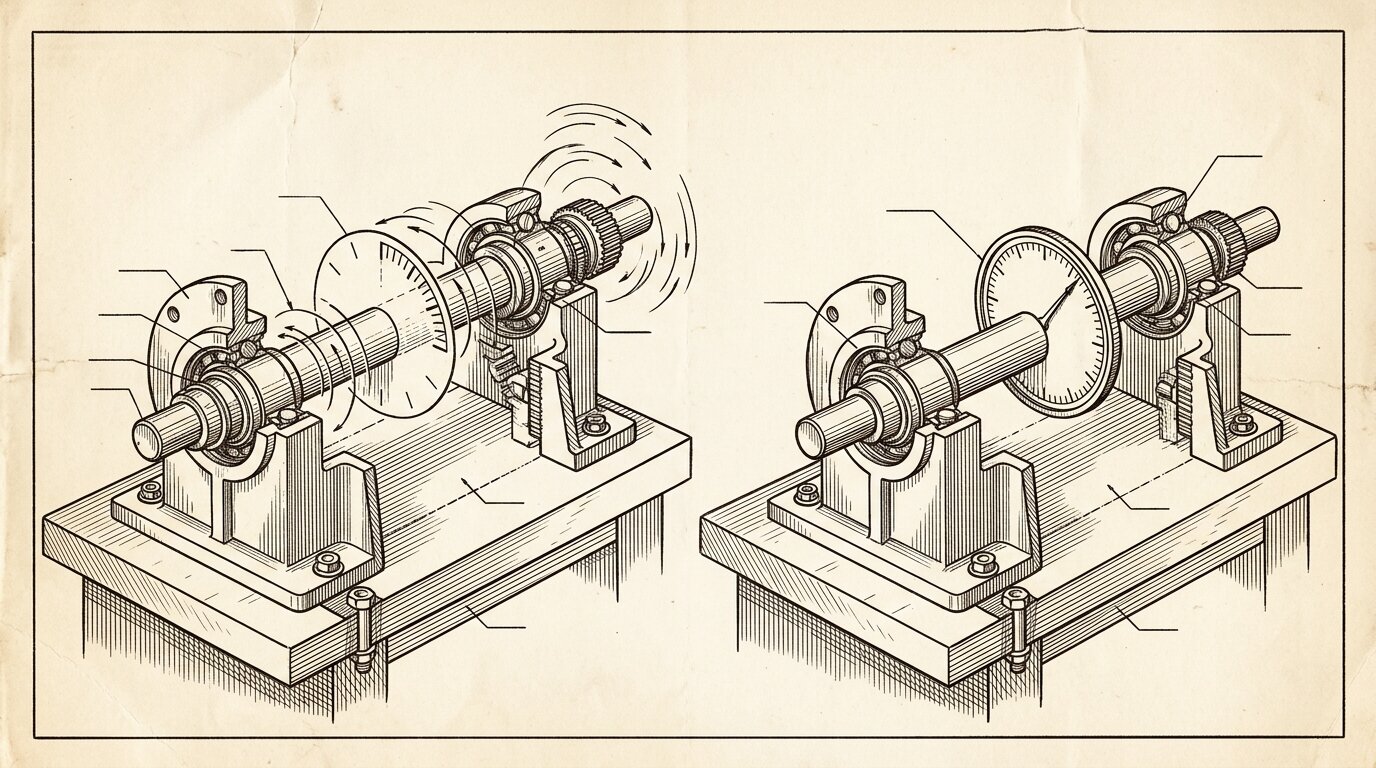
Encoder shaft counting pulses toward a position versus an encoder shaft that already knows its exact position


What Is the Core Difference Between Absolute and Incremental Encoders?

An incremental encoder measures change in position - it counts pulses from a reference point - while an absolute encoder reports the actual position as a unique code at every instant. That single distinction decides everything that follows: incremental must re-home after power loss; absolute never does.

Think of a trip odometer versus GPS. An odometer only tells you how far you've traveled since reset - it knows nothing about your actual location. An absolute encoder works like GPS: it reads its coordinates directly, regardless of where counting started.

Cut power to an incremental-encoder axis and the controller's position count evaporates. On restart, the machine must execute a homing routine - drive to a limit switch or index pulse - before it trusts its position again. An absolute encoder skips that step.

Neither approach is universally better. Incremental encoders are simpler, run at higher data rates, and cost less for equivalent resolution (US Digital, 2024). Absolute encoders trade some simplicity for a guarantee: position is never lost, whatever happens to the power supply.

Citation capsule: An incremental encoder measures change in position - it counts pulses from a reference point and only ever knows how far it has moved since that reference, not where it actually is. An absolute encoder reports the actual position as a unique digital code at every instant, so the controller reads it directly rather than reconstructing it from a pulse count, per US Digital (2024). The practical consequence shows up the moment power is interrupted: an incremental encoder must run a homing routine before the controller can trust its position again, while an absolute encoder knows exact position immediately at power-on, with no reference move required. That single difference - not resolution, not price - is what should drive the initial encoder selection on any new axis.

The question most buying guides bury under resolution charts: can your machine safely re-home after a power loss? If yes, incremental almost always wins on cost. If re-homing is dangerous, slow, or impossible, resolution stops mattering until you've committed to absolute.


How Does an Incremental Encoder Work?

An incremental encoder produces pulses on two channels, A and B, offset 90 degrees - a relationship called quadrature. Whether A leads or lags B gives direction, pulse count gives distance, and a third channel, Z, fires once per revolution as a fixed reference point.

Quadrature and Direction

Two slotted tracks on the disk are read by detectors staggered a quarter-cycle apart. As the shaft rotates, each detector produces a square wave. If A rises before B, the shaft turns one direction; if B rises first, it's the other - no separate direction sensor needed.

The Z (index) channel matters more than its once-per-revolution spec suggests. It gives a fixed, repeatable reference angle, useful for homing and essential in applications like radar antenna positioning. Without Z, an incremental encoder has no idea where "zero" is - only how far it has moved since the last reference.

Incremental Encoder: Quadrature Signals A, B, and Z B is offset a quarter-cycle (90 degrees) behind A A B Z Z pulses once per revolution quarter-cycle offset A leads B = one direction; B leads A = the other Source: US Digital (2024)
Quadrature - phase gives direction, edges give resolution.

Resolution: PPR, CPR, and x1/x2/x4

Resolution is described in CPR (cycles per revolution, the physical line count) and PPR (pulses per revolution, what the controller decodes). Counting only A's rising edge gives x1 decoding; counting both edges of A and B quadruples it to x4, turning a 100-CPR disk into 400 counts per revolution with no added hardware.

Raw disk resolution varies by sensing technology. Optical incremental encoders run from a basic 32-64 CPR up to 10,000 PPR or more; magnetic units typically span roughly 120-240 up to about 2,048 PPR (Dynapar, 2024). A 2,048-PPR magnetic disk at x4 decode can out-resolve a modest optical unit at x1.

None of this changes power-loss behavior - an incremental encoder still has to re-home after a stop, however fine its resolution. If you're also wiring discrete sensing on the same axis, our optical vs inductive sensing comparison covers the proximity-switch side of homing hardware.

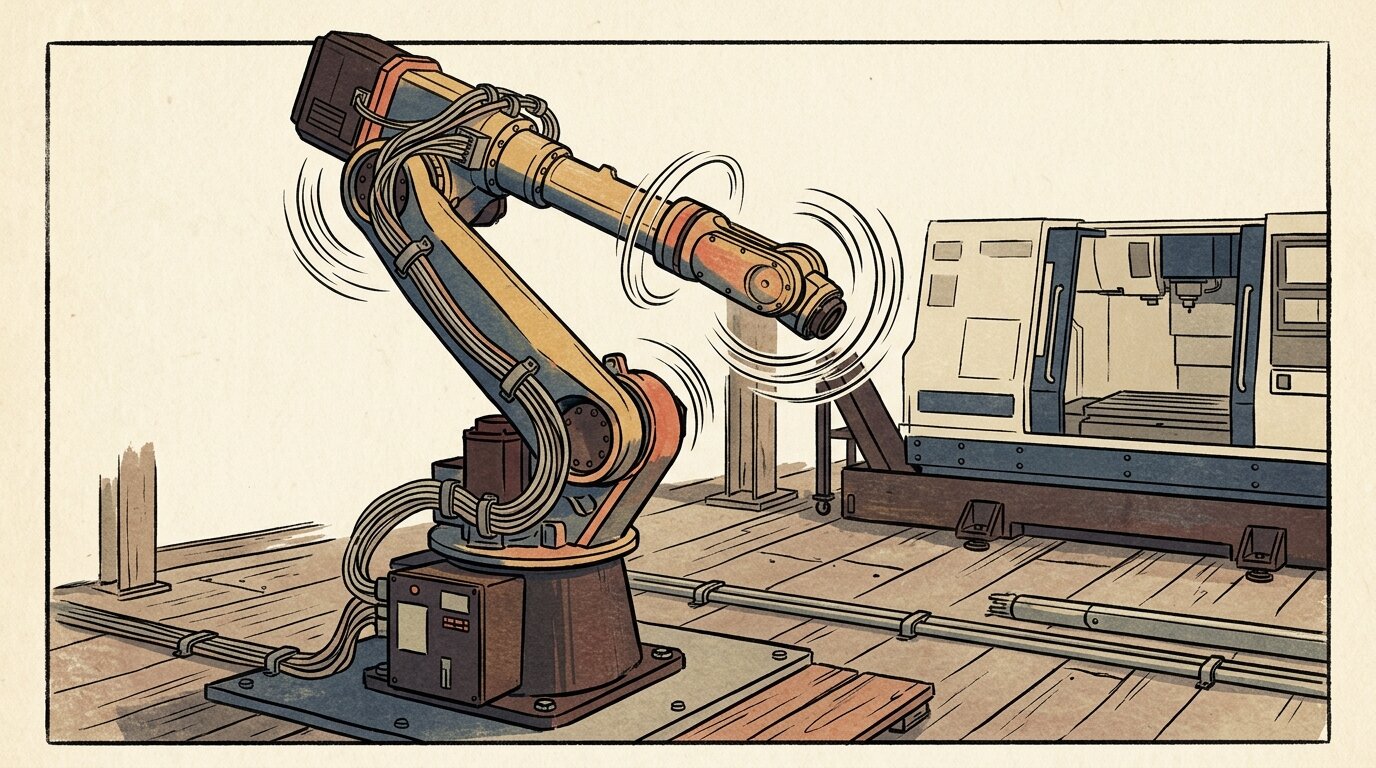
Encoder position feedback driving precise motion on a CNC or robot axis

Citation capsule: Incremental encoders output two channels, A and B, electrically offset 90 degrees in a relationship called quadrature; the order in which one leads the other gives direction, and the pulse count gives distance traveled, per US Digital (2024). A third channel, Z, fires once per revolution as a fixed reference. Quadrature decoding at x1, x2, or x4 multiplies effective resolution without adding hardware, by counting one, two, or all four signal edges per cycle. Optical incremental disks run from a basic 32-64 CPR up to 10,000+ PPR; magnetic disks typically span roughly 120-240 up to 2,048 PPR (Dynapar, 2024). None of that resolution changes the power-loss behavior - the encoder still has to re-home after any stop.


How Does an Absolute Encoder Work?

An absolute encoder's disk carries a unique code for every angular position, most commonly Gray code, where only one bit changes between adjacent positions to prevent misreads. Because the controller reads that code directly rather than counting pulses, it knows exact shaft position the instant power comes on - no homing move required.

Gray Code and Why It Matters

If an absolute disk used ordinary binary counting, a transition like 0011 to 0100 changes three bits at once. A detector slightly misaligned during that transition can momentarily read a garbage intermediate value. Gray code eliminates that by construction: from any position to the next, exactly one bit flips, even the wraparound from the last position back to zero (Encoder Products Company, 2010). It doesn't improve resolution - it removes an entire class of transition error.

Absolute Encoder: Gray-Coded Disk 3 ring tracks, 8 sectors - only one bit changes between neighbors 000 001 011 each ring is one bit; shaded = 1, blank = 0 - adjacent sectors differ by one bit only Source: Encoder Products Company (2010)
Every angle has a unique code, readable instantly at power-on.

Single-Turn vs Multi-Turn

A single-turn absolute encoder knows its exact position within one revolution, down to as many as 18-20 bits on high-end optical units - up to roughly 1,000,000 discrete counts across 360 degrees (Dynapar; US Digital, 2024). But it has no memory of how many full turns the shaft has made, so a lead screw or multi-rotation hoist loses its revolution count on power loss.

Multi-turn absolute encoders add a second tracking layer: mechanical gear trains counting whole revolutions alongside the fine single-turn disk, battery-backed electronic counters, or the Wiegand effect, where a specially treated wire generates its own voltage pulse from shaft motion, retaining turn count with zero external power - no battery to maintain, useful in hard-to-service locations.

Citation capsule: Absolute encoders assign a unique digital code to every shaft angle, most commonly Gray code, in which only one data bit changes between any two adjacent positions - a property that prevents the multi-bit read errors natural binary encoding is vulnerable to during a transition (Encoder Products Company, 2010). Single-turn optical absolute encoders reach 18-20 bit resolution, up to roughly 1,000,000 discrete counts across a single revolution (Dynapar; US Digital, 2024). But a single-turn unit has no memory of completed revolutions, so multi-turn absolute encoders add a second tracking layer - mechanical gearing, battery-backed counters, or Wiegand-effect energy harvesting - to retain the full travel range across a power cycle.


Should You Choose an Optical or Magnetic Encoder?

Both absolute and incremental encoders come in optical and magnetic versions, plus less common capacitive and inductive designs. Optical sensing gives the highest resolution but is vulnerable to dust, oil, and moisture; magnetic sensing trades some resolution for near-total immunity to contamination and vibration.

Optical encoders read light through slots in a glass or metal disk - precise, but fragile. A film of oil mist or metal dust scatters the light path and produces false counts, so harsh-environment units need IP-rated sealing that adds cost. Where contamination is unavoidable - oil rigs, heavy off-highway equipment, foundries - magnetic encoders sense a field rather than light and keep working through dust and moisture that would blind an optical disk (Dynapar; Broadcom, 2024).

The tradeoff runs both ways: magnetic encoders cap out at lower resolutions than the best optical units, so sub-micron applications still specify optical. Phased-array optical designs spread detection across an array of sensors instead of one, tolerating larger air gaps and vibration better than a single-detector disk. For the mechanical-shock side of the same axis, see how to select a vibration sensor.

Optical wins on resolution, magnetic wins on ruggedness - match the sensing technology to the environment, not the encoder type (Dynapar; Broadcom, 2024).


What Output Interfaces Do Encoders Use? SSI, BiSS, and EnDat

Incremental encoders output simple A/B/Z pulses over HTL or TTL voltage levels - no protocol, just raw square waves the controller counts directly. Absolute encoders need a serial protocol, and the three dominant choices - SSI, BiSS-C, and EnDat 2.2 - differ enough in speed, cable length, and diagnostics to deserve their own line item on a spec sheet.

SSI (Synchronous Serial Interface) is the oldest and simplest: unidirectional, point-to-point, encoder to controller only, at speeds up to 2 Mbit/s (Novanta, 2024). It's inexpensive and well understood but offers no diagnostics beyond basic parity checking.

BiSS-C is SSI's bidirectional successor - the controller can send parameters without interrupting the data stream - running at up to 10 Mbit/s over cables up to 100 meters, with CRC error checking and support for chaining multiple encoders on one bus (Novanta, 2024).

EnDat 2.2, from Heidenhain, is bidirectional, high-speed, and carries far more than position data - onboard diagnostics, mounting parameters, and the encoder's internal temperature travel over the same cable (Heidenhain, 2022). That extra channel is why EnDat is popular on precision machine tools, where catching drift before failure matters as much as the position reading.

Absolute encoders increasingly report position over industrial Ethernet fieldbuses too - see our EtherCAT vs PROFINET guide when the encoder sits on a networked motion-control backbone.

The interface decision most comparisons skip: SSI vs BiSS vs EnDat sets cable run, data rate, diagnostics, and SIL 3 eligibility. BiSS and EnDat support SIL 3; Gray code's one-bit-change property helps make that safety case possible (Heidenhain, 2022).

Citation capsule: Incremental encoders output raw A/B/Z pulses with no protocol involved; absolute encoders need a serial interface to transmit their position code. SSI (Synchronous Serial Interface) transmits data unidirectionally at up to 2 Mbit/s (Novanta, 2024). BiSS-C adds bidirectional communication, CRC error checking, daisy-chaining of multiple encoders, and speeds up to 10 Mbit/s over cables as long as 100 meters (Novanta, 2024). EnDat 2.2 from Heidenhain runs bidirectionally at high speed and carries onboard diagnostics and temperature data alongside position (Heidenhain, 2022). The protocol choice, not the resolution spec, decides maximum cable length, top data rate, and whether the loop can support SIL 3 functional safety.


Which Should You Choose?

Ask one question first: does this axis need exact position the instant it powers on, or can it find that position again safely and cheaply after a stop? If a cheap, safe re-home is available, choose incremental. If re-homing is dangerous, slow, or impossible, choose absolute - resolution and interface are secondary.

Which Encoder Type Should You Choose? Does the axis need exact position at power-on, or is re-homing dangerous, slow, or impossible? NO YES Incremental encoder (re-home on power-up) Absolute encoder (exact position at power-on) One revolution only? -> Single-turn absolute Needs revolution count? -> Multi-turn absolute
The one question that picks your encoder.

Choose incremental if:

  1. The axis can re-home safely and cheaply - a horizontal conveyor, a spindle with a known start switch.
  2. You need high-speed velocity feedback more than absolute position.
  3. Cost is the deciding factor and incremental resolution meets your needs.
  4. It's a simple motor-feedback loop where a brief startup homing move costs nothing.

Choose absolute if:

  1. Re-homing is dangerous - a vertical axis or hoist that would drop before finding a reference.
  2. Re-homing is slow or costly - a long gantry, or a machine where every startup homing cycle burns production time.
  3. Re-homing is impossible - a continuously rotating tool, or a machine resuming mid-cycle.
  4. Functional safety is part of the spec - BiSS or EnDat support SIL 3, which A/B/Z outputs alone cannot claim.
  5. It's a multi-axis machine where homing every axis is itself costly - robotics, elevators, CNC centers, AGV steering.
Aspect Incremental Absolute
Position at power-on Must re-home Known instantly
What it measures Change / pulses since reference Actual coded position
Typical output A/B/Z pulses, HTL/TTL SSI / BiSS / EnDat serial
Resolution Up to 10,000+ PPR 18-20 bit, ~1,000,000 counts
Speed Very high, low latency High, protocol-limited
Functional safety Limited BiSS/EnDat support SIL 3
Cost Lower Higher
Best fit High-speed/simple positioning, cost-sensitive Vertical/multi-axis, robotics, where homing is unsafe

Position at power-on decides the encoder type; everything else in this table is a secondary spec.

Answer the homing question first; resolution and sensing technology narrow the field from there. A vertical hoist tracking multiple drum revolutions points to multi-turn absolute. A cost-sensitive conveyor spindle that re-homes every startup anyway points to incremental with x4 decoding for the resolution boost.


Common Pitfalls and Gotchas

The failure modes are predictable: incremental encoders miscount on electrical noise or lose position on a power blip; multi-turn absolute encoders with battery backup need periodic maintenance; optical encoders of either type fail in dirty environments; poorly designed homing routines create their own hazards.

Electrical noise corrupts incremental position counts quietly. Quadrature signals on long, poorly shielded cable runs near variable-frequency drives pick up interference the controller misreads as a real pulse edge, producing position drift unrelated to the mechanical system. Differential line drivers, shielded twisted-pair cable, and routing away from motor power runs fix it.

Battery-backed multi-turn absolute encoders trade incremental's power-loss vulnerability for a different maintenance item: the battery. Untracked battery life means a dead battery produces exactly the position-loss failure absolute encoders exist to prevent. Gearing-based or Wiegand-effect designs sidestep this, worth the extra cost on equipment nobody visits often.

On a retrofit project, a multi-turn absolute encoder with a dead backup battery produced the exact symptom of an incremental encoder losing position on a power cycle - the machine came up thinking it was at zero when it wasn't. It took longer to diagnose because the team assumed "absolute" meant immune to every failure mode. It isn't.

A poorly designed homing routine is itself a hazard. A move that drives an axis into a hard stop at full speed, with no soft-limit awareness, can damage the mechanism it's finding a reference on. A slow, monitored homing move costs a few seconds and saves unplanned maintenance.


Frequently Asked Questions

What is the difference between absolute and incremental encoders?

An incremental encoder measures change - it outputs pulses counted from a reference point, so it loses its position on power loss and must re-home. An absolute encoder outputs a unique code for every shaft angle, usually Gray code, so it knows exact position the instant it powers on (US Digital; Encoder Products Company, 2010).

When should you use an incremental encoder?

Use incremental when the axis can safely and cheaply re-home after a power loss - conveyor drives, spindle speed feedback, simple positioning loops. Incremental encoders are simpler, run at higher data rates, and cost less than absolute units with an equivalent resolution (US Digital, 2024).

What are the advantages of absolute encoders?

Absolute encoders report exact position at power-on with no homing move, which matters most on vertical axes, robotics, and multi-axis machines where re-homing is dangerous or slow. Their serial interfaces (BiSS-C, EnDat 2.2) also carry diagnostics and support SIL 3 functional safety (Heidenhain, 2022).

How does an absolute encoder work?

A coded disk or magnetic ring carries a unique digital pattern for every angular position, most often Gray code, where only one bit changes between adjacent positions. The controller reads that code directly, so it knows position immediately without counting pulses from a reference (Encoder Products Company, 2010).

What is the cost difference between absolute and incremental encoders?

Absolute encoders typically cost more than incremental units of similar resolution, since they need a coded disk, onboard electronics, and often a battery or gearing for multi-turn tracking. None of our sourced manufacturer data gives a hard cost multiple, so treat the premium as qualitative and get a quote for your specific resolution and interface.


Conclusion

The decision reduces to one question: does this axis need exact position the instant it powers on, or can it safely find a reference again after a stop? Incremental encoders report relative motion through A/B/Z pulses, cost less, and run faster, but forget everything on a power blip. Absolute encoders report a unique coded position, usually Gray code, that survives power loss without a homing move.

The interface matters more than most spec sheets suggest: SSI, BiSS-C, and EnDat 2.2 set cable length, data rate, diagnostics, and SIL 3 eligibility. Decide the homing question first, then let resolution, sensing technology, and interface follow.

For more selection frameworks like this one, see the complete industrial sensors guide and RTD vs thermocouple for another sensor-choice comparison.

Frequently Asked Questions

What is the difference between absolute and incremental encoders?
An incremental encoder measures change - it outputs pulses counted from a reference point, so it loses its position on power loss and must re-home. An absolute encoder outputs a unique code for every shaft angle, usually Gray code, so it knows exact position the instant it powers on (US Digital; Encoder Products Company, 2010).
When should you use an incremental encoder?
Use incremental when the axis can safely and cheaply re-home after a power loss - conveyor drives, spindle speed feedback, simple positioning loops. Incremental encoders are simpler, run at higher data rates, and cost less than absolute units with an equivalent resolution (US Digital, 2024).
What are the advantages of absolute encoders?
Absolute encoders report exact position at power-on with no homing move, which matters most on vertical axes, robotics, and multi-axis machines where re-homing is dangerous or slow. Their serial interfaces (BiSS-C, EnDat 2.2) also carry diagnostics and support SIL 3 functional safety (Heidenhain, 2022).
How does an absolute encoder work?
A coded disk or magnetic ring carries a unique digital pattern for every angular position, most often Gray code, where only one bit changes between adjacent positions. The controller reads that code directly, so it knows position immediately without counting pulses from a reference (Encoder Products Company, 2010).
What is the cost difference between absolute and incremental encoders?
Absolute encoders typically cost more than incremental units of similar resolution, since they need a coded disk, onboard electronics, and often a battery or gearing for multi-turn tracking. None of our sourced manufacturer data gives a hard cost multiple, so treat the premium as qualitative and get a quote for your specific resolution and interface.