Sensors Edge Hub Logo
What Is a Unified Namespace? One Source of Truth for OT

What Is a Unified Namespace? One Source of Truth for OT

Connect ten plant systems point to point and you end up with dozens of brittle, one-off integrations, each a custom project with its own failure mode. Add an eleventh system, and in the worst case you touch pieces of all ten that came before it. A Unified Namespace is the architecture built to end that cycle.

The term shows up constantly in IIoT circles, usually as an undefined buzzword. Strip away the hype and it's a specific architectural pattern: a central broker holding the current state of everything, structured so any system finds what it needs without rewiring a producer. This piece builds on Sparkplug B and OPC UA vs MQTT, and shows where both fit into the bigger picture.

TL;DR: A Unified Namespace (UNS) is a single, event-driven source of truth for an entire operation: one central MQTT broker where every system publishes its current state and any system subscribes. The namespace is structured with the ISA-95 hierarchy (Enterprise / Site / Area / Line / Cell / Device), and retained messages hold each node's latest value. It replaces brittle point-to-point integration, which grows roughly as n-squared connections, with hub-and-spoke, so a new consumer subscribes without touching a single producer. Popularized by Walker Reynolds.

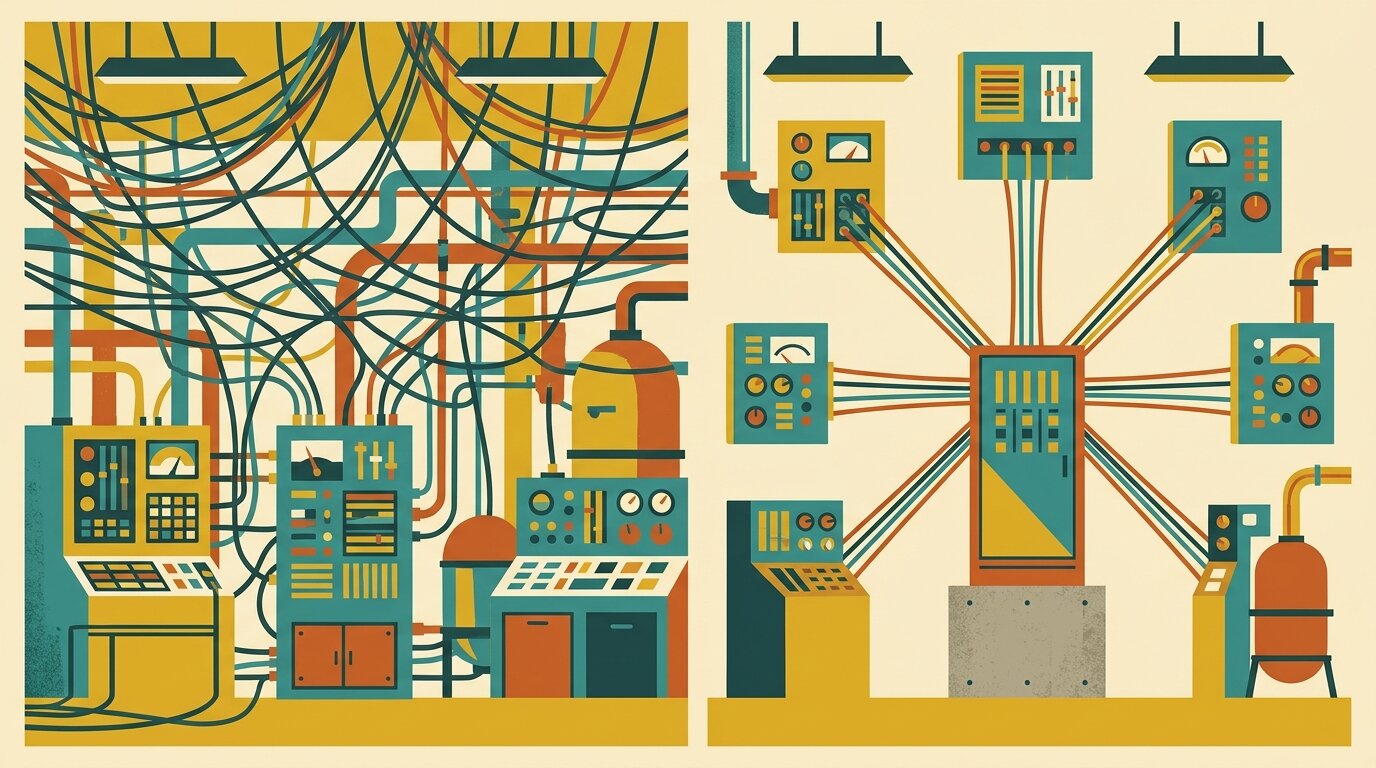
A mid-century poster-style illustration contrasting a tangled mess of factory cabling with the same systems reorganized into one clean radial hub, representing the single source of truth a unified namespace creates

What Is a Unified Namespace, in Plain Terms?

A Unified Namespace is a centralized, event-driven architecture that acts as the real-time, single source of truth for an entire operation. It's typically built on an MQTT broker, where edge devices push data only when something changes (FlowFuse, HiveMQ).

That last part matters more than it sounds. A UNS isn't a historian, and it isn't trying to store everything that ever happened. It holds the current state, the value right now, for every tag it tracks. Ask it what a tank level is, and you get an answer that reflects the plant as it stands this second, not a snapshot from a nightly batch job.

The event-driven part is the other half of the definition. Instead of some system polling every device on a schedule, edge nodes publish only when a value changes, a pattern called report-by-exception. The broker holds each topic's last known value, so a new subscriber that connects five minutes into a production run still gets current state immediately, not silence until the next change.

Walker Reynolds, a systems integrator, is widely credited with popularizing the Unified Namespace concept. His framing was blunt: MQTT gives you a broker and a publish-subscribe model, but it doesn't stop you from creating a "mess in the topic namespace" if nobody enforces discipline on what gets published where. A UNS is what happens when you take that raw capability and impose real structure on it.

Citation capsule: A Unified Namespace is a centralized, event-driven architecture serving as the single, real-time source of truth for an entire operation, typically built on an MQTT broker where edge devices publish only when a value changes rather than on a fixed poll (FlowFuse, HiveMQ). It holds current state, not history, which is what separates it from a historian or a data lake. A subscriber connecting mid-shift still gets an accurate answer immediately, because the broker retains the last published value for every topic rather than waiting for the next change to arrive. That property is what makes the pattern useful as shared infrastructure: any new dashboard, analytics tool, or control system can plug in and read current state without asking a producer to change how or when it publishes. The architecture doesn't care how many consumers exist or what they do with the data; producers and consumers never need direct knowledge of each other, which is the decoupling that a point-to-point integration model can never offer at scale.

Most UNS deployments run on the same MQTT brokers already common in IIoT stacks; what changes is the discipline. Everyone agrees to publish to one namespace, structured one way, instead of each team wiring its own point-to-point connection.

What Problem Does a UNS Actually Solve?

A UNS kills point-to-point integration spaghetti. Wire N systems directly to each other and the number of connections grows roughly as n-squared; a UNS collapses that into an n:m model through one hub, so adding a consumer means subscribing, not touching any producer.

The n-squared integration problem

Picture a plant with a SCADA system, an MES, an ERP, a historian, and a couple of cloud analytics tools. Wired point to point, that's potentially ten separate custom integrations, and the eleventh new system means building connections to some or all of the existing ten. Every integration is its own project, with its own mapping logic and its own failure mode, and usually one person who understands it, until that person leaves the company.

Point-to-point (n:n) Unified Namespace (n:m) PLC SCADA MES ERP Historian PLC SCADA MES ERP Historian UNS Broker Illustration: point-to-point spaghetti vs hub-and-spoke Unified Namespace topology
Point-to-point integration grows tangled with every new system; a Unified Namespace collapses the same systems into one hub-and-spoke broker.

That cost isn't hypothetical. Research by Arulnithika et al. (2025) found that integration projects typically spend 40% to 60% of their total budget on middleware and gateway development, not on the actual endpoint systems. That money goes into the connective tissue between systems, the layer a UNS replaces with one shared broker.

Citation capsule: Point-to-point industrial integration grows roughly as n-squared connections as systems are added, and integration projects typically spend 40% to 60% of their total budget on middleware and gateway development rather than the endpoint systems themselves (Arulnithika et al., 2025). A UNS replaces that model with a decoupled hub-and-spoke broker, enabling an n:m architecture where producers and consumers don't need to know about each other. That budget split matters because it means most integration money never touches the actual value the endpoint systems provide; it goes toward custom mapping logic, protocol translation, and one-off connectors that exist purely to bridge two systems that were never designed to talk to each other. A hub-and-spoke broker collapses all of that into a single, reusable interface: every system publishes and subscribes to the same namespace instead of negotiating a bespoke connection with every other system it needs data from. The practical effect shows up first in new-project timelines, since adding a consumer becomes a subscription rather than a multi-week integration effort with its own testing and failure modes.

The failure mode nobody notices

The failure mode most teams describe is quieter than a single catastrophic outage. It's a slow accumulation of undocumented glue code. Eventually the tenth integration takes longer to plan than the first five combined, because every new connection has to account for everything already wired in.

A UNS decouples producers from consumers entirely. A PLC publishing a tank level has no idea whether zero systems or twenty are subscribed to that topic, and it doesn't need to. Add a new dashboard, and it subscribes to an existing topic. Nothing about the PLC's publishing logic changes, because it never knew the dashboard existed in the first place.

How Is a UNS Structured? (ISA-95)

A Unified Namespace is organized as a semantic hierarchy, almost always the ISA-95 equipment model: Enterprise, Site, Area, Line, Cell, Device. A topic path reads like a plant address, so Acme/Prague/Packaging/Line3/Cell2/TankLevel tells you exactly where that value lives without opening a mapping document.

The six ISA-95 levels

Contrast that with a legacy PLC register address. A raw Modbus holding register like 40012 carries no meaning on its own; you need a separate spreadsheet to know it's a tank level on line three. An ISA-95-structured UNS topic carries that context in the path itself. Anyone browsing the broker can understand where a tag sits in the physical plant, which cuts the ramp-up time for a new engineer or a new integration.

Enterprise Site Area Line Cell Device Example: Enterprise/Riga/Packaging/Line3/Filler/temperature Illustration: ISA-95 equipment hierarchy applied to a UNS topic path
The ISA-95 equipment hierarchy gives every UNS topic a plant address, from Enterprise down to a single Device.

ISA-95 is a naming convention, not a cage. That distinction gets lost constantly. The hierarchy describes how you organize meaning in the namespace; it says nothing about which transport protocol carries the bytes underneath it. The common failure is forcing that six-level structure into a transport that was never built to hold it, which is the trap Sparkplug B sets.

Citation capsule: A Unified Namespace structures data using the ISA-95 equipment hierarchy: Enterprise, Site, Area, Line, Cell, Device (Corso Systems, Inductive Automation). This gives every tag full business and physical context in its topic path itself, so high-level applications like ERPs or analytics platforms can navigate the broker and use wildcard subscriptions to pull exactly the data they need, without a separate mapping layer. That context is what turns a raw broker into something a new engineer can read on day one, instead of a black box only its original architect understands. It also means the hierarchy doubles as documentation: browse the topic tree and you're looking at the plant's org chart and physical layout at once. Skip this step, or let it drift, and every later benefit of the namespace, wildcard subscriptions, self-describing tags, fast onboarding, quietly erodes until the broker is just as opaque as the point-to-point mess it replaced.

Getting the hierarchy right early pays off later. Wildcard subscriptions let a consumer ask for every tank level across a site in one subscription, instead of enumerating dozens of topics by hand. That only works if the namespace was built consistently from day one, which is why governance matters as much as the technology choice.

What Does a UNS Run On? MQTT, Retained Messages, and Sparkplug B

A Unified Namespace is almost always built on an MQTT broker using retained messages, so the broker holds each topic's latest value and a new subscriber gets current state the instant it connects. Sparkplug B is optional, and where it belongs is at the edge, not at the UNS layer itself.

Most generic UNS write-ups skip this distinction. Sparkplug B is genuinely good at what it does: a standardized topic structure and birth/death certificates that make a device's connection state knowable in real time. That's what you want when collecting data from a fleet of field devices over a constrained network.

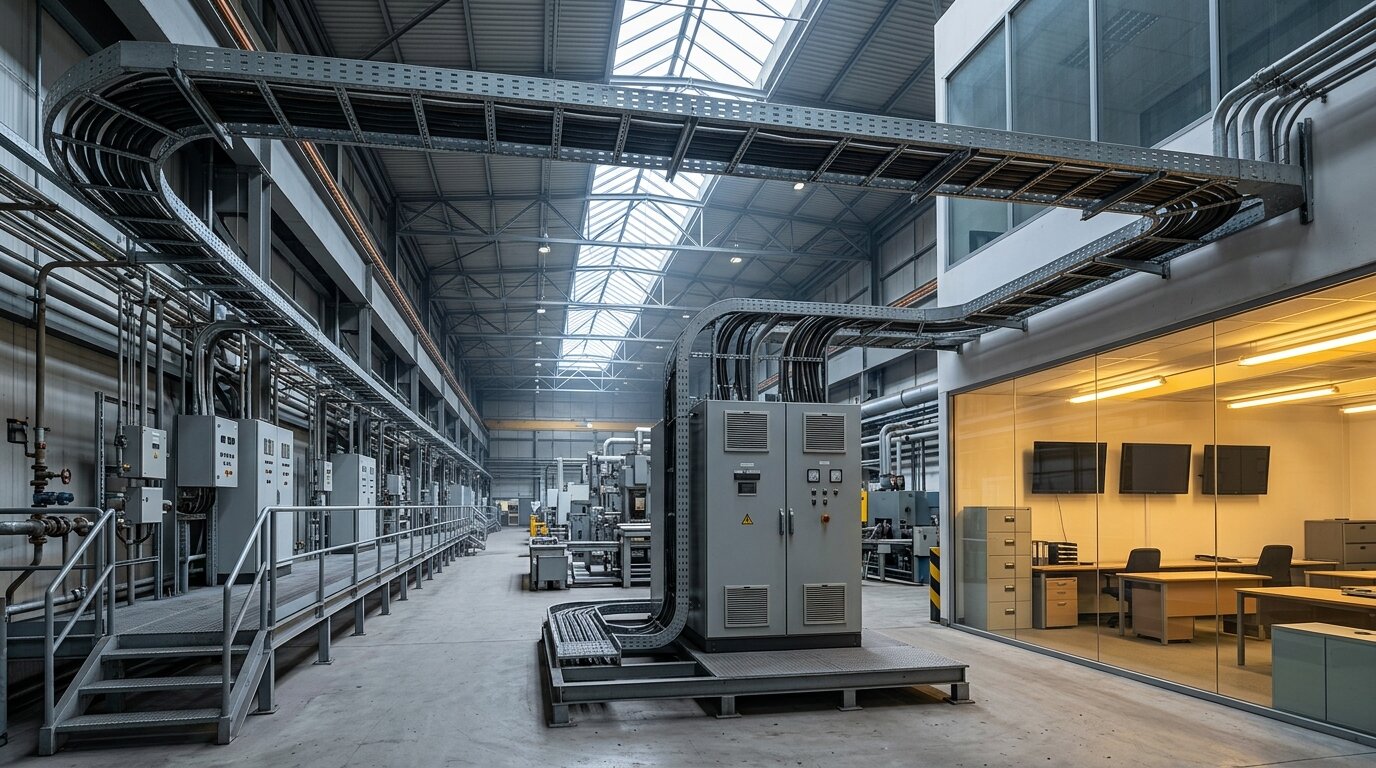
A wide-angle industrial photograph of an unbroken cable tray running from plant-floor edge instrument panels through a central switch cabinet to an office of dashboards, illustrating how data flows from edge devices to consumers through a unified namespace

The problem is that Sparkplug B's own design fights a flexible n:m namespace in two specific ways. First, it enforces a rigid four-level topic structure (spBv1.0/group_id/message_type/edge_node_id/[device_id]), which can't cleanly hold a six-level ISA-95 hierarchy without awkward workarounds (HiveMQ, FlowFuse). Second, and more fundamentally, Sparkplug B prohibits retained MQTT messages. Without a retained value, the broker can't hold a "last known good" state, so a new consumer connecting to the network has no way to instantly query current state (HiveMQ).

That's why the practical pattern is a hybrid. Deploy Sparkplug B at the edge, where its structure and birth/death discipline earn their keep on bandwidth-constrained links. Then, one hop before the namespace, break those Sparkplug payloads apart into plain, retained MQTT messages (Corso Systems, FlowFuse). The UNS layer gets the flexibility and statefulness it needs; the edge still gets Sparkplug's discipline where it matters most.

Citation capsule: A Unified Namespace runs on retained MQTT at the namespace layer, so the broker holds each topic's latest value for instant current-state lookups by new subscribers. Sparkplug B is optional and belongs at the edge. Its rigid four-level topic structure and its prohibition on retained messages conflict with a flexible n:m namespace. Best practice breaks Sparkplug payloads apart into plain, retained MQTT one hop before they reach the UNS (Corso Systems, HiveMQ, FlowFuse). The distinction matters because Sparkplug B and a Unified Namespace solve different problems: one gives edge devices a disciplined way to announce their connection state over a constrained link, the other gives every downstream system a flexible, current-state view of the whole plant. Treating them as interchangeable is a common mistake that reintroduces the rigidity a UNS is supposed to remove. Keeping the translation step at the edge is what lets a namespace absorb new consumers without redesigning the topic structure every time a new device joins.

Wildcard subscriptions pay off here too: a dashboard team that wants every tank level across a site subscribes to one pattern and gets everything matching it, without asking a producer to change anything or enumerating each device by name. New consumers arrive by subscribing; producers never notice.

UNS vs SCADA, Historians, and Data Lakes

A Unified Namespace is not a replacement for control, and it's not a store of history. SCADA still runs the machines, a historian still logs the past, and a data lake still holds raw data for analytics; the UNS is the real-time, current-state integration layer that sits between OT and IT and feeds all three.

What each layer actually does

The clearest way to separate these roles is by what each system does. SCADA is an operational application for real-time monitoring and control of equipment. Historically it polled devices directly in an n:1 model; in a modern architecture, SCADA becomes just another node on the UNS, subscribing to telemetry and publishing control commands back through the same broker. A historian is a specialized database optimized for time-series data, the system of record for the past, and it plugs into the UNS as a consumer that subscribes and writes what it receives to disk. A data lake plays a similar consumer role for raw, high-volume data destined for machine learning pipelines and big-data analytics.

Edge devices (Sparkplug B) UNS Broker (retained MQTT) Consumers MES ERP Analytics Dashboards Sparkplug B does the heavy lifting at the edge; plain retained MQTT carries current state through the UNS layer Illustration: edge-to-consumer data flow through a Unified Namespace
Sparkplug B handles the constrained edge link; the UNS broker itself runs plain, retained MQTT that any consumer can subscribe to.
Layer Purpose Time focus Coupling
SCADA Real-time control of machines Now Tightly coupled to devices
Historian Long-term logging The past Query-based
Data lake Bulk analytics store Batch / past ETL
Unified Namespace Real-time integration and current state Now Decoupled pub-sub

Four systems, four different jobs: the UNS is the only one built to be everyone's real-time source of truth at once.

None of those systems compete with the UNS for the same job. The UNS is infrastructure; SCADA, the historian, and the data lake are applications that plug into it. Teams sometimes treat a UNS rollout as "replacing SCADA," which misreads what it's for. It's the plumbing everything else runs through, not a rival to any of them.

How Do You Build One (and What Goes Wrong)?

Building a UNS starts with three concrete steps: stand up a broker, define the ISA-95 namespace, and publish current state from the edge by exception. The hard part is governance, and that's where most rollouts actually run into trouble.

Governance and naming discipline

Plain MQTT enforces no topic layout, which is the flexibility that makes a UNS possible. It is also the liability that turns it into chaos without discipline. One team publishes to line2/temp. Another publishes to plant/line5/sensors/temperature/value, and a contractor wires up a convention nobody can explain a year later. Left unchecked, this is the "mess in the topic namespace" Walker Reynolds warned about: the broker keeps working, nothing crashes, but eventually nobody can look at it and understand the whole system anymore. In practice, this is the pitfall that shows up first: the naming convention that made perfect sense to whoever wrote it in month one is usually unrecognizable to the second engineer who inherits the namespace.

Do not force ISA-95 into Sparkplug B

A second recurring failure is the ISA-95-into-Sparkplug-B mistake covered above: forcing a six-level namespace hierarchy into a transport's fixed four-level topic structure. Conflating the namespace hierarchy with the transport's topic structure is how teams end up with awkward, half-working topic paths that satisfy neither model.

Security and retained-state

Security is the third pitfall, and it's not optional. Connecting a UNS bridges OT networks, historically air-gapped, to IT systems and the cloud. Legacy protocols underneath the bridge, like Modbus, transmit in plaintext with no authentication. Exposing them to a wider network without controls is a real risk. IEC 62443's zone-and-conduit model is the standard answer: dedicated VLANs for OT devices, stateful firewalls with default-deny rules between zones, an industrial DMZ at the boundary, and full connection logging for forensics.

Two smaller but common issues round it out. One is retained-message state conflicts, where two producers disagree about what the "current" value for a topic should be. The other is consumer-granularity mismatch, where a subscriber designed for one topic per device chokes on a namespace that publishes at a finer or coarser grain than expected. Both are solvable, but only if someone owns the namespace design instead of letting it grow organically.

On the performance side, report-by-exception is what makes the whole model efficient. By publishing only on change instead of polling every device on a fixed interval, this pattern cuts overall network bandwidth by 80% to 95% compared to a comparable polling architecture (FlowFuse). That's the same mechanism Sparkplug B uses at the edge, carried through into the namespace itself.

Citation capsule: Report-by-exception publishing, where devices send data only when a value changes rather than on a fixed poll interval, cuts overall network bandwidth by 80% to 95% compared to a polling architecture (FlowFuse). The harder problem in a UNS rollout is governance: without enforced naming discipline, plain MQTT's flexibility turns into what Walker Reynolds called a "mess in the topic namespace," where the broker still works but nobody can read the whole system anymore. The bandwidth savings come almost entirely from eliminating redundant traffic. A polling loop asks every device for its value on a fixed schedule whether or not anything changed, while report-by-exception only puts a message on the wire when the state actually moves. On a plant network with hundreds of slow-changing tags, that difference compounds fast. The governance problem is the opposite kind of challenge: it has no technical fix, only organizational discipline, which is why teams that treat naming conventions as an afterthought tend to end up right back in integration chaos, just wrapped in a single broker instead of ten point-to-point connections.

When Is a UNS Worth It?

A UNS earns its complexity when multiple systems need each other's data in real time. It also pays off when an IT/OT convergence or Industry 4.0 push is already underway, or when your team is drowning in point-to-point integrations that each take longer to plan than the last. It's overkill for a single line running one SCADA system with no cloud ambitions.

Not every plant needs this architecture. A standalone line with one PLC, one HMI, and no plan to feed data anywhere else doesn't gain much from a broker-centric namespace; the integration problem a UNS solves simply doesn't exist yet at that scale. The pattern earns its keep once the number of systems, sites, or consumers starts climbing. In conversations with plant teams, the case usually becomes obvious the moment someone starts listing point-to-point connections from memory and loses count partway through.

Some sources report that UNS-style decoupled architectures cut integration engineering substantially compared to custom point-to-point work, though that specific figure comes from a single source and should be read as a reported claim rather than a hard benchmark. What's better documented is the underlying mechanism: fewer custom connections, less middleware spend, and new consumers that arrive by subscribing instead of by a new integration project.

The plants where this pattern clicks fastest tend to be the ones already fighting integration fatigue, not the ones chasing a buzzword. If someone on the team can already name five brittle point-to-point connections off the top of their head, that's usually the signal a UNS is worth the governance investment.

If you're evaluating this stack, the transport-layer decision underneath a UNS is covered in OPC UA vs MQTT, the edge-protocol discipline that feeds it is covered in Sparkplug B, and if you need a refresher on what OPC UA actually is underneath that comparison, our dedicated explainer covers the address space and security model. For where a UNS sits inside the broader stack, from field devices through fieldbus and industrial Ethernet, see the full IIoT protocol framework. Plants still running legacy Modbus devices at the edge or instruments tied to legacy field signals don't need to rip anything out first; a gateway can bridge those protocols into the namespace just as it would into any other MQTT-based architecture. Industrial Ethernet still carries the large majority of new industrial networking nodes, roughly 79% by recent count (HMS Networks), which is the physical layer most of these bridges ultimately run over.

Frequently Asked Questions

What is a unified namespace in manufacturing? A Unified Namespace is a single, event-driven source of truth built on a central broker, almost always MQTT. Every system in the plant publishes its current state to it, and any system subscribes to whatever data it needs, without a custom integration per connection (FlowFuse, HiveMQ).

How do you build a unified namespace? Stand up an MQTT broker, define a namespace structured by the ISA-95 hierarchy (Enterprise, Site, Area, Line, Cell, Device), and have edge systems publish current state as retained messages, by exception, rather than on a fixed poll. Governance of naming conventions matters more than the tooling.

What is the difference between a unified namespace and SCADA? A UNS is the real-time integration and current-state layer; SCADA is an operational application for monitoring and controlling equipment. In a modern architecture, SCADA becomes just another node that subscribes to the UNS for telemetry and publishes control commands back to it.

Does a unified namespace use MQTT or Sparkplug B? The UNS layer itself runs on plain, retained MQTT. Sparkplug B is optional and belongs at the edge, where its structure and birth/death certificates earn their keep, then gets broken apart into retained MQTT before it reaches the namespace (Corso Systems, HiveMQ).

Why is a unified namespace important for Industry 4.0? It gives every IT and OT system, from SCADA to ERP to cloud analytics, one real-time, current-state source to subscribe to instead of a custom point-to-point integration. That decoupling is what makes adding new consumers or analytics tools fast instead of a multi-week integration project.

Conclusion

A Unified Namespace is a discipline rather than a new protocol: one broker, one structure, and a shared agreement about where current state lives.

  • Single source of truth, event-driven, real-time current state, not history.
  • Structured with the ISA-95 hierarchy: Enterprise, Site, Area, Line, Cell, Device.
  • Runs on retained MQTT at the namespace layer, keeping every subscriber's initial state instant.
  • Sparkplug B belongs at the edge, then gets broken into plain MQTT before the namespace.
  • Governance, naming discipline and security segmentation, is the hard part, not the technology.
  • It complements SCADA and historians; it doesn't replace either one.

To understand the transport layer underneath a UNS in more depth, read Sparkplug B and OPC UA vs MQTT, or step back to the full IIoT protocol framework for where all three pieces fit together.

Frequently Asked Questions

What is a unified namespace in manufacturing?
A Unified Namespace is a single, event-driven source of truth built on a central broker, almost always MQTT. Every system in the plant publishes its current state to it, and any system subscribes to whatever data it needs, without a custom integration per connection (FlowFuse, HiveMQ).
How do you build a unified namespace?
Stand up an MQTT broker, define a namespace structured by the ISA-95 hierarchy (Enterprise, Site, Area, Line, Cell, Device), and have edge systems publish current state as retained messages, by exception, rather than on a fixed poll. Governance of naming conventions matters more than the tooling.
What is the difference between a unified namespace and SCADA?
A UNS is the real-time integration and current-state layer; SCADA is an operational application for monitoring and controlling equipment. In a modern architecture, SCADA becomes just another node that subscribes to the UNS for telemetry and publishes control commands back to it.
Does a unified namespace use MQTT or Sparkplug B?
The UNS layer itself runs on plain, retained MQTT. Sparkplug B is optional and belongs at the edge, where its structure and birth/death certificates earn their keep, then gets broken apart into retained MQTT before it reaches the namespace (Corso Systems, HiveMQ).
Why is a unified namespace important for Industry 4.0?
It gives every IT and OT system, from SCADA to ERP to cloud analytics, one real-time, current-state source to subscribe to instead of a custom point-to-point integration. That decoupling is what makes adding new consumers or analytics tools fast instead of a multi-week integration project.