

Radar vs Ultrasonic Level Measurement: Which Wins in 2026?
Radar vs ultrasonic level measurement used to come down to price: 80GHz radar transmitters cost up to $4,000 as recently as a few years ago. The average price now runs $1,000-1,200, closing in on ultrasonic's $500-2,000 range (Level Measurement notebook, 2026). That shift changes how engineers should weigh the two technologies.
Vendors keep pushing their own answer. VEGA and Endress+Hauser argue radar wins everywhere. Water-utility suppliers point to ultrasonic's decades-long track record instead. Both stories skip the parts that don't favor their product. Buyers end up guessing.
This guide skips the sales pitch. You'll get exact dead-zone numbers pulled from real datasheets, a five-year cost breakdown, and the five specific situations where ultrasonic remains the smarter buy. For broader context on where level measurement fits into a plant's instrumentation stack, see our industrial sensor fundamentals guide, and for the full technology lineup beyond radar and ultrasonic, including float, capacitive, hydrostatic, and guided-wave sensors, see our comparison of level measurement technologies.
TL;DR: 80GHz radar now costs about the same as ultrasonic but wins on beam angle (3-4° vs 5-15°) and dead zone (under 0.1 m vs up to 1.5 m). It's also immune to foam, vapor, and vacuum (Level Measurement notebook, 2026). Ultrasonic still wins on cost-sensitive, clean, atmospheric tanks under 20 m.
Radar vs Ultrasonic Level Measurement: Quick Comparison Table
80GHz radar achieves a 3-4° beam angle against ultrasonic's 5-15° cone, roughly a quarter the spread, and that gap explains most of the accuracy difference between the two technologies (VEGAPULS 64 datasheet). The table below lines up seven specs side by side, so you can scan the numbers and jump straight to the section that matters for your tank.
Price used to decide this argument on its own. Modern radar averages $1,000-1,200, while ultrasonic still runs $500-2,000 depending on range and housing material (Level Measurement notebook, 2026). With that much overlap, cost alone won't settle the choice the way it once did.
Cost rarely settles the argument by itself anymore, now that the price gap between the two technologies has closed this much.
| Spec | 80GHz Radar | 26GHz Radar | Ultrasonic |
|---|---|---|---|
| Accuracy | ±1-3 mm (under 1 mm possible) | ±2-3 mm (resolution ~±5 mm) | ±3-10 mm (±0.25-1% of span) |
| Beam angle | 3-4° | 8-20° | 5-15° |
| Dead zone | Under 0.1 m | 0.3-1 m | 0.2-1.5 m |
| Max range | 100-150 m | 70-80 m | 0.5-40 m |
| Temperature limits | Up to 400-1000°C (special antennas) | Up to 230-1000°C | -40°C to 80°C standard |
| Pressure rating | Full vacuum to 160-400 bar | Full vacuum to 160-400 bar | Atmospheric only, up to ~2 bar |
| Price | $1,000-5,000 | $1,000-5,000 | $500-2,000 |
Each row gets a full explanation in the sections ahead, starting with beam angle and dead zone since they drive almost everything else. If you're speccing a full instrumentation package, our flow meter selection criteria and pressure sensor comparison cover the other two measurement points most tanks need.
How Do Radar and Ultrasonic Level Sensors Actually Work?
Radar sends microwave pulses that reflect off the liquid surface based on its dielectric constant; ultrasonic sends sound pulses that need a gas medium to carry them. That single difference determines which tanks each technology can even enter (Level Measurement: Principles, Technologies, and Applications).
FMCW radar sweeps a continuous range of microwave frequencies toward the surface and back. Distance comes from the frequency difference between the signal sent and the signal returned, a technique borrowed from aircraft radar altimeters and shrunk to fit a 4-inch process fitting.
Ultrasonic works on timing instead. A transducer fires a sound pulse, waits for the echo, and calculates distance from the time of flight and the local speed of sound. No frequency sweep and no phase math, only a stopwatch measuring a round trip. For the underlying mechanics, including blind zone, beam cone, and how ultrasonic compares to optical and inductive sensing outside of level applications, see how ultrasonic sensors work.
Ultrasonic level sensors cannot operate below about 0.1 bar absolute, because sound waves need a gas medium to propagate. Radar has no such floor and reads a full vacuum the same way it reads open air (Level Measurement: Principles, Technologies, and Applications).
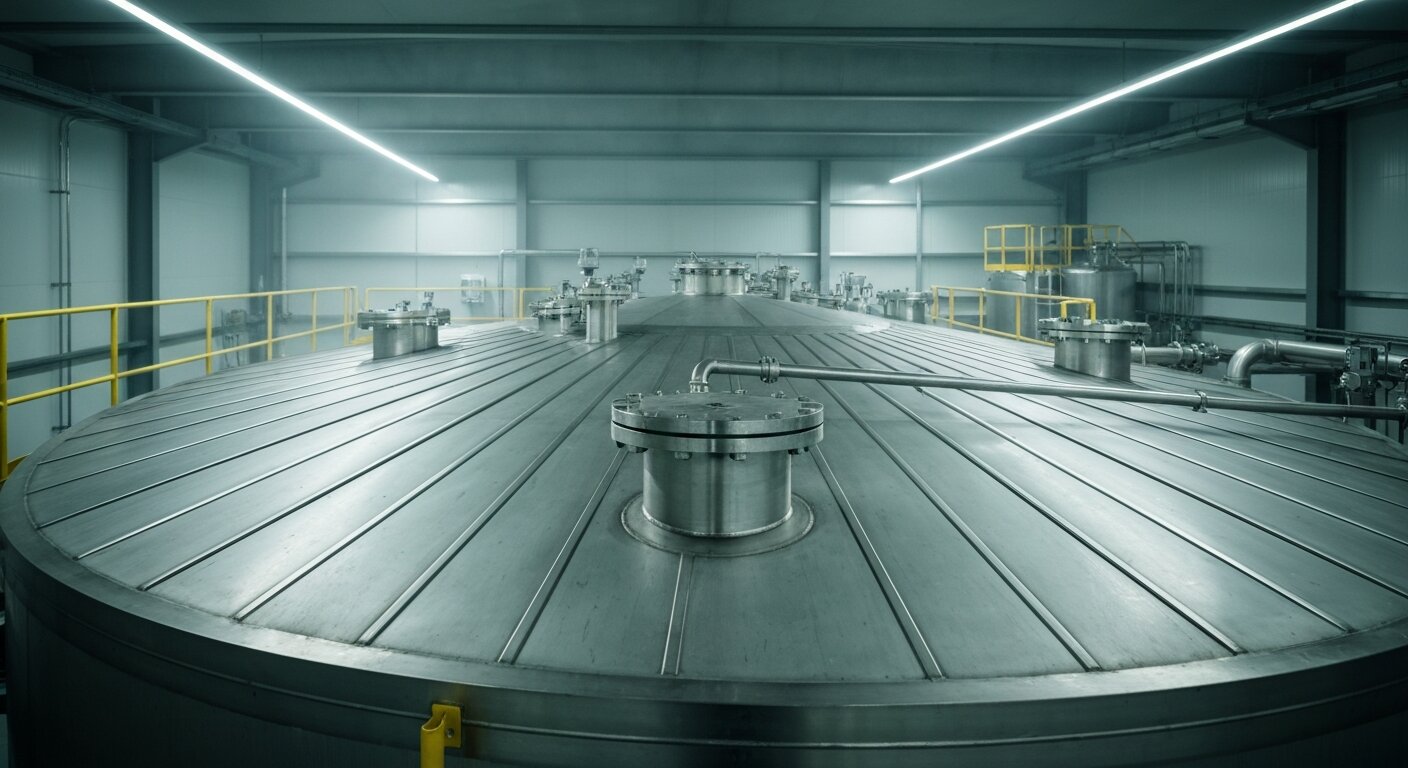 An 80GHz radar's 3-4 degree beam threads past tank internals that scatter a 5-15 degree ultrasonic cone
Does a few degrees of beam angle matter in practice? At 10 meters, an 80GHz radar's 3° beam covers about half a meter across; a 15° ultrasonic cone covers more than two and a half meters. That footprint gap shows up next as a dead-zone difference measured in millimeters.
Which Technology Has Better Accuracy, Beam Angle, and Dead Zone?
80GHz radar reaches ±1-3 mm accuracy with a dead zone near 0.1 m; ultrasonic reaches ±0.25-1% of span with a dead zone of 0.2-1.5 m. The beam-angle gap covered above explains most of that difference (Level Measurement notebook; VEGAPULS 64 and E+H Micropilot FMR67B datasheets).
Dead zone, sometimes called blanking distance, is the stretch directly below the sensor face where the instrument can't trust its own echo. Inside that zone the signal sits too close to separate a real reflection from ringing in the antenna or housing. Siemens documents this limit for its own 80GHz units in the SITRANS LR100 operating instructions. A shorter dead zone means the sensor keeps reading accurately closer to empty.
Line the specs up and the pattern holds. Radar's tight 3-4° beam avoids the tank walls, agitator blades, and ladder rungs that scatter a wider ultrasonic cone back at the transducer. Ultrasonic's 5-15° spread picks up more false echoes, so its dead zone runs two to fifteen times wider as a result.
Does a tighter beam angle translate into better real-world accuracy? In tanks crowded with agitators or ladders, yes, dramatically so.
What the datasheet misses: Beam angle eliminates false echoes in a crowded tank far more effectively than the accuracy spec on a datasheet suggests. A radar unit with a 3° beam physically can't detect an agitator shaft eight inches off its centerline, so there's nothing left to filter in software. A wider beam catches that reflection first, then has to guess whether it's noise.
What Do Vendor Datasheets Actually Show?
VEGA's VEGAPULS 64 uses an 80mm antenna for a 3° beam and a near-zero blocking distance, measuring almost to the vessel bottom (VEGAPULS 64 datasheet). Endress+Hauser's Micropilot FMR67B runs 3-6° depending on antenna size and recommends a 10 mm minimum tip clearance (E+H Micropilot FMR67B datasheet). Endress+Hauser's antenna selection whitepaper explains why antenna size, not frequency, drives that accuracy gap. Ultrasonic dead zones run 0.2-1.5 m as frequency drops, confirmed by an independent AZoSensors overview.
80GHz radar reads within centimeters of a tank bottom, since VEGAPULS 64's blocking distance sits near zero. Ultrasonic needs up to 1.5 m of clearance depending on frequency, a gap that determines how much usable tank volume each technology can measure (VEGAPULS 64, E+H Micropilot FMR67B datasheets).
Is 26GHz Radar the Same as 80GHz Radar?
26GHz radar carries a wider beam, 8-20° against 80GHz's 3-4°, because beam width tracks antenna size relative to wavelength rather than the frequency number alone (Rosemount, Siemens datasheets).
A bigger antenna relative to the signal's wavelength focuses the beam tighter. 80GHz's wavelength runs roughly a third of 26GHz's, so an antenna the same physical size focuses far more sharply at the higher frequency. That's why "80GHz" has become shorthand for "narrow beam" in the industry, though the shorthand hides real variation between models.
Rosemount's 5408 reference manual shows the 24-27 GHz unit ranging from a tight 4.5° with an 8-inch parabolic antenna down to a spread-out 22° on a compact 1.5-inch cone antenna. The same frequency band produces very different beams, depending on antenna choice. Rosemount's 1408H (77-81 GHz) holds a steady 10°, and Siemens' SITRANS LR250 (25 GHz) spans 8-19° depending on antenna size (Rosemount, Siemens datasheets).
A higher GHz number doesn't automatically mean a better radar. The datasheets above show beam angle and antenna design decide that instead.
From the field: Nearly every level-measurement quote brings some version of "should I just get the higher GHz one?" Beam angle and dead zone against the actual tank geometry, agitator placement, and nozzle size settle the answer, not the frequency number alone. A cheap 80GHz unit with a wide-angle antenna can measure worse than a well-specified 26GHz unit with a narrow horn.
FMCW vs Pulse Radar: Why Modulation Matters More Than Frequency
FMCW radar sweeps frequency continuously and calculates distance from the difference between sent and returned signals, giving finer resolution than timing a single pulse. Pulse radar times discrete bursts instead, with simpler electronics but coarser resolution. Neither approach ties to one frequency band, so GHz alone predicts neither beam angle nor dead zone. Antenna design and modulation type decide both.
26GHz radar's beam runs 8-20° while 80GHz radar holds 3-4°, but that gap comes from antenna size relative to wavelength, not frequency itself. Rosemount's 5408 line spans 4.5-22° at a single 24-27 GHz frequency, depending on which antenna gets ordered (Rosemount, Siemens datasheets).
Why Do Ultrasonic Sensors Fail in Foam, Vapor, and Vacuum?
Dense or neutral foam absorbs and scatters acoustic energy instead of reflecting it cleanly. That causes signal loss or badly wrong readings, one of three documented ultrasonic failure modes that push plants toward radar (Level Measurement: Principles, Technologies, and Applications).
Foam has no reliable workaround short of switching technology. Once a foam layer builds up, an ultrasonic pulse either scatters into the foam matrix and never returns, or it bounces off the foam's top surface instead of the liquid underneath. Either way, the sensor has no way to distinguish which happened.
Vapor and condensation cause two separate problems. Heavy vapor in the headspace changes the speed of sound the pulse travels through, throwing off the time-of-flight math. Condensation forming directly on the transducer face is worse: it physically blocks the sound wave from leaving the sensor at all.
Temperature Drift and Vacuum: The Physics Limits
Temperature stratification is a third failure path: vertical gradients inside a tall tank bend sound waves through refraction, the same effect that makes a mirage shimmer over hot pavement. That bending causes drift and instability, not an obvious fault, making it the hardest of the three problems to diagnose from the control room. A similar drift problem shows up in temperature instrumentation, covered in our guide to temperature drift and accuracy in RTD vs thermocouple sensors.
Ever notice an ultrasonic sensor drifting worse in August than in March? A roughly 15% swing in the speed of sound between 0°C and 100°C usually explains it.
From the field: I've quoted radar and ultrasonic on the same tank farm in the same week. One plant kept an existing ultrasonic sensor on a foaming digester tank to save budget. Eight months later, the plant manager called back asking for a radar retrofit. The foam layer had grown thick enough that the level reading had drifted by half a meter before anyone noticed.
Speed of sound shifts roughly 15% between 0°C and 100°C. That's why ultrasonic instruments on outdoor or unheated tanks typically need seasonal recalibration to hold spec, a maintenance cost radar doesn't carry (Level Measurement: Principles, Technologies, and Applications).
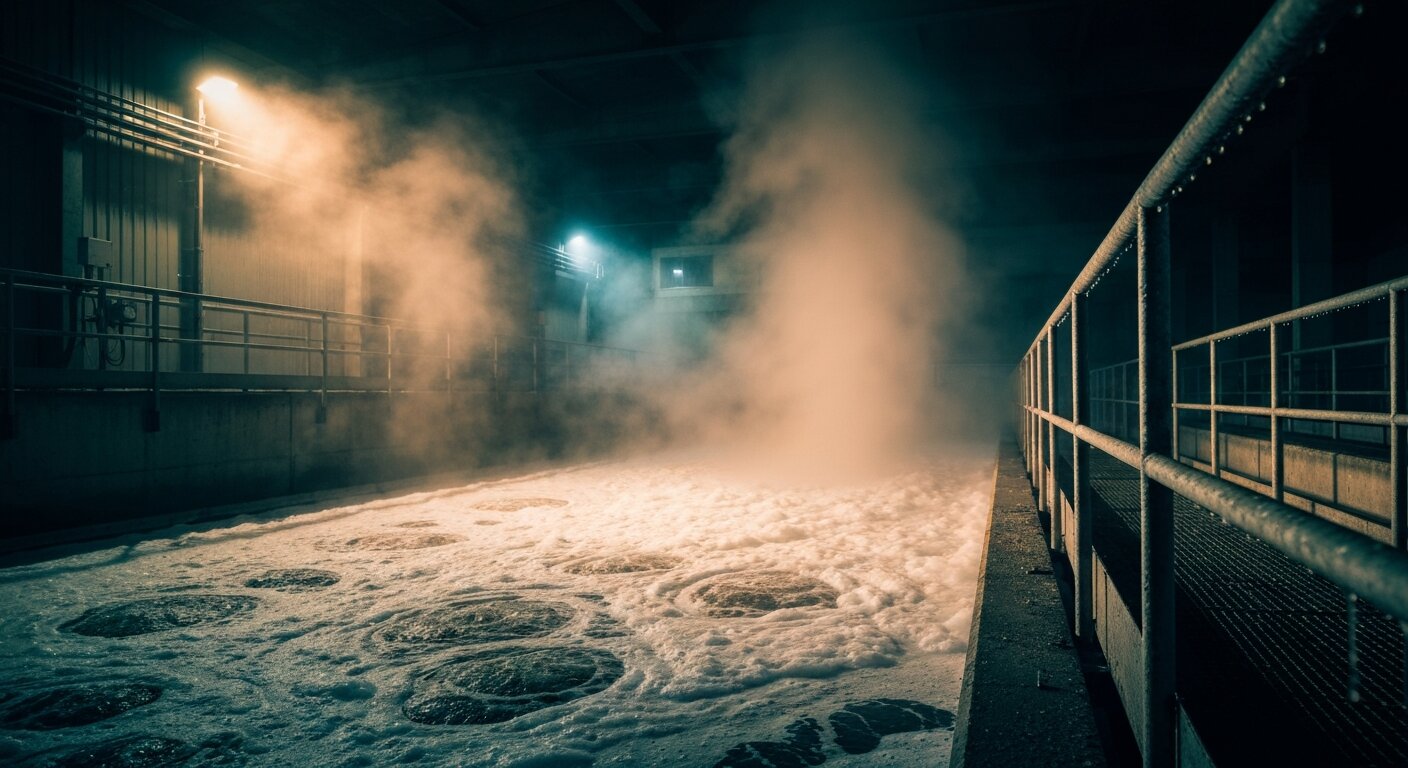 Dense foam absorbs sound instead of reflecting it - the same surface that blinds ultrasonic reads cleanly on radar
What Does 5 Years of Ownership Actually Cost - Radar vs Ultrasonic?
Ultrasonic costs 30-50% less upfront, $500-2,000 versus radar's $1,000-1,200 average, but radar runs about 15% lower total cost of ownership over five years thanks to near-zero maintenance (Level Measurement notebook, 2026).
Run the numbers on a representative install and the crossover shows up fast. A $2,500 radar transmitter (a mid-range industrial spec) needs almost no recurring spend once it's commissioned. A $1,000 ultrasonic unit on the same tank typically adds $350-400 a year in cleaning and seasonal recalibration, and that cost compounds every year the sensor stays in service.
By around year four, the ultrasonic unit's cumulative cost overtakes the radar transmitter's flat total, even though ultrasonic started roughly $1,500 cheaper. Over five years that gap widens enough to match the notebook's ~15% total-ownership advantage for radar (Level Measurement notebook, 2026).
MTBF and the Hidden Cost of Drift
Radar's mean time between failures exceeds 50,000-100,000 hours regardless of conditions. Ultrasonic can reach 229,000 hours, but only in stable, condensation-free environments. Introduce vapor, foam, or a temperature swing, and that number collapses well before the datasheet's headline figure holds true (Level Measurement notebook, 2026).
Field data point: Large storage tanks running legacy ultrasonic instruments with unaddressed drift have shown inventory discrepancies as high as $500,000 a year (Level Measurement notebook, 2026). That gap comes purely from the difference between the reading on the screen and the product actually in the tank. A precision radar upgrade on a site like that typically pays for itself within 6-12 months.
Radar costs more to buy but runs roughly 15% lower total cost of ownership over five years. That gap comes from MTBF above 50,000-100,000 hours, against ultrasonic's 229,000-hour rating that only holds in stable, condensation-free conditions (Level Measurement notebook, 2026).
When Does Ultrasonic Still Win? Five Scenarios Worth Knowing
Ultrasonic remains the right call in five specific situations, and pretending otherwise is exactly the vendor bias this article is trying to avoid.
- Cost-sensitive, simple applications. Ultrasonic delivers solid performance at 30-50% of radar's price when the tank is clean and stable enough that the failure modes above don't apply (Level Measurement: Principles, Technologies, and Applications).
- Open-channel flow and water/wastewater monitoring. Ultrasonic is the historical incumbent here, and most units ship with pre-programmed weir and flume algorithms that output flow rate directly, no separate flow computer needed (KOBOLD).
- Low dielectric constant media. Ultrasonic works with dielectric constants as low as 1.5, since it reflects sound acoustically rather than depending on a strong microwave reflection. Free-space radar needs a dielectric constant above 1.8 to reflect reliably, ruling it out for some solvents and light hydrocarbons (KOBOLD, via Level Measurement notebook).
- Clean, stable plastic or fiberglass tanks. Atmospheric pressure, low humidity, and a still surface are ultrasonic's sweet spot, the exact conditions under which its foam and vapor failure modes never come into play.
- Large multi-sensor networks on a constrained budget. When a site has dozens of measurement points, upgrading only the priority tanks to radar and leaving the rest on ultrasonic often makes more financial sense than a blanket switch.
New installs shouldn't default to radar in these five situations.
Why Vendor Comparisons Hide These Cases
The gap competitors skip: Search "radar vs ultrasonic level measurement" and most top results come from VEGA, Endress+Hauser, or Emerson, companies selling radar transmitters with an obvious incentive to declare radar the universal winner. VEGA's own 2019 comparison barely mentions when ultrasonic still makes sense.
Radar remains the pricier option for a job ultrasonic already handles well in these five cases.
How Do You Choose Between Radar and Ultrasonic for Your Tank?
Four questions settle 90% of cases: is the medium vapor- or foam-prone, what's its dielectric constant, is the vessel under vacuum or pressure, and what's the budget per measurement point?
Start with the vessel, not the sensor. A vacuum distillation column or a high-pressure reactor rules out ultrasonic immediately, since it can't function outside atmospheric conditions. If foam, vapor, or wide temperature swings are part of daily operation, radar is the safer default even before cost enters the conversation.
If neither applies, check the medium's dielectric constant. Below 1.5, ultrasonic's acoustic reflection outperforms free-space radar, which needs a constant above 1.8 to bounce back a usable signal. Above that threshold, and without vacuum or foam concerns, budget and application type, like open-channel flow, settle the choice (KOBOLD, via Level Measurement notebook).
Can four questions settle 90% of level-measurement decisions? In our experience specifying both technologies across dozens of tanks, yes.
An instrumentation engineer speccing a new chemical reactor with a pressure rating and occasional foam should default to radar. The higher purchase price is a small line item against the process risk. A procurement lead managing a 40-tank retrofit on a fixed budget should upgrade only the tanks with documented drift or foam history, leaving stable, clean tanks on ultrasonic. A plant running a single atmospheric clean-water tank has little reason to pay radar's premium at all.
One factor can override every branch above: hazardous-area certification. A tank in a classified Zone 0/1 or Class I Division 1 area needs a transmitter with the matching ATEX or IECEx rating. It also needs an appropriate SIL loop rating - a gate that can rule out an otherwise ideal sensor regardless of what the flowchart says.
For point-level detection alongside continuous measurement, see our comparison of photoelectric, inductive, and capacitive proximity sensors.
Frequently Asked Questions
What is the difference between radar and ultrasonic level sensors?
Radar sends microwave pulses that need no medium to travel through; ultrasonic sends sound pulses that require air or another gas to propagate. That distinction makes radar immune to vacuum and most vapor interference, while ultrasonic depends on stable atmospheric conditions to read accurately (Level Measurement notebook, 2026). For related output-side troubleshooting, see our guide to troubleshooting 4-20 mA loop noise.
What is the dead zone (blanking distance) in level measurement?
The dead zone is the blind stretch directly below the sensor face where echoes can't be trusted. 80GHz radar's dead zone runs about 0.1 m; ultrasonic's runs 0.2-1.5 m depending on frequency, so radar reads much closer to an empty tank (VEGAPULS 64 and E+H Micropilot FMR67B datasheets).
Why do ultrasonic level sensors fail in foam?
Dense or neutral foam absorbs and scatters the acoustic signal instead of reflecting it cleanly back to the transducer. That causes signal loss or badly wrong readings, a documented failure mode with no reliable fix short of switching technology (Level Measurement: Principles, Technologies, and Applications).
What is the difference between 26GHz and 80GHz radar?
80GHz radar produces a narrower beam, 3-4° against 26GHz's 8-20°, because beam width tracks antenna size relative to wavelength, not frequency alone. It comes down to beam-forming and modulation, not a higher frequency number (Rosemount, Siemens datasheets).
Can ultrasonic level sensors work in a vacuum?
No. Ultrasonic needs a gas medium to carry sound and cannot operate below roughly 0.1 bar absolute. Radar has no such limit and reads from full vacuum up to 160-400 bar, which explains why vacuum distillation columns and degassing vessels typically default to radar (Level Measurement notebook, 2026).
Conclusion
80GHz radar has closed the price gap that used to make ultrasonic the automatic choice. Its narrow beam, plus immunity to foam, vapor, and vacuum, now make it the stronger pick for most new tank installs. Ultrasonic hasn't disappeared. It still wins on cost-sensitive, clean, low-dielectric, atmospheric applications, and especially on open-channel flow monitoring.
Match the technology to your medium and vessel conditions first, then let budget settle any remaining ties. Before finalizing a multi-instrument spec, our industrial sensor fundamentals guide and IIoT protocol comparison for level transmitters cover the rest of the measurement and connectivity stack this sensor plugs into.
What is the difference between radar and ultrasonic level sensors?
Radar sends microwave pulses that need no medium to travel through; ultrasonic sends sound pulses that require air or another gas to propagate. That distinction makes radar immune to vacuum and most vapor interference, while ultrasonic depends on stable atmospheric conditions to read accurately (Level Measurement notebook, 2026).
What is the dead zone (blanking distance) in level measurement?
The dead zone is the blind stretch below the sensor face where echoes can't be trusted. 80GHz radar's dead zone runs about 0.1 m; ultrasonic's runs 0.2-1.5 m depending on frequency, so radar reads much closer to an empty tank (VEGAPULS 64 and E+H Micropilot FMR67B datasheets).
Why do ultrasonic level sensors fail in foam?
Dense or neutral foam absorbs and scatters the acoustic signal instead of reflecting it cleanly. That causes signal loss or badly wrong readings, a documented failure mode with no reliable fix short of switching technology (Level Measurement: Principles, Technologies, and Applications).
What is the difference between 26GHz and 80GHz radar?
80GHz radar produces a narrower beam, 3-4° against 26GHz's 8-20°, because beam width tracks antenna size relative to wavelength, not frequency alone. It comes down to beam-forming and modulation, not a higher frequency number (Rosemount, Siemens datasheets).
Can ultrasonic level sensors work in a vacuum?
No. Ultrasonic needs a gas medium to carry sound and cannot operate below roughly 0.1 bar absolute. Radar has no such limit and reads from full vacuum up to 160-400 bar, which is why vacuum distillation columns typically default to radar (Level Measurement notebook, 2026).
Related Articles

