

Photoelectric Sensor Types: How to Choose the Mode
A photoelectric sensor that counts bottles perfectly on the bench can start missing them the moment the conveyor gets dusty, or start counting phantom bottles because a shiny guard rail sits right behind the line. Same sensor, same wiring, different result once it leaves the test bench. The gap is almost never the sensor. It's the mode.
TL;DR: Photoelectric sensors detect objects with light, in three modes. Through-beam (Type T) puts the emitter and receiver in separate housings and gives the longest range and highest reliability. Retroreflective (Type R) uses one housing and a reflector for medium-range, one-side install. Diffuse (Type D) uses one housing and bounces light off the target itself, easiest to mount but shortest and least predictable range (IEC 60947-5-2, 2026). Background suppression and enough excess gain keep any of them working once the line gets dirty.
For the wider picture on where optical detection fits among other sensing technologies, start with the industrial sensors guide. If your target is metal and you don't need optical detection at all, inductive vs capacitive proximity sensors covers the non-optical alternative.
What Are the Three Main Types of Photoelectric Sensors?
Every photoelectric sensor uses an emitter and a receiver, but the three modes differ in where those parts sit and what interrupts the light. Through-beam (Type T) and retroreflective (Type R) are dark-on: the output switches when a target breaks the beam. Diffuse (Type D) is light-on: the output switches when reflected light returns (IEC 60947-5-2, 2026).
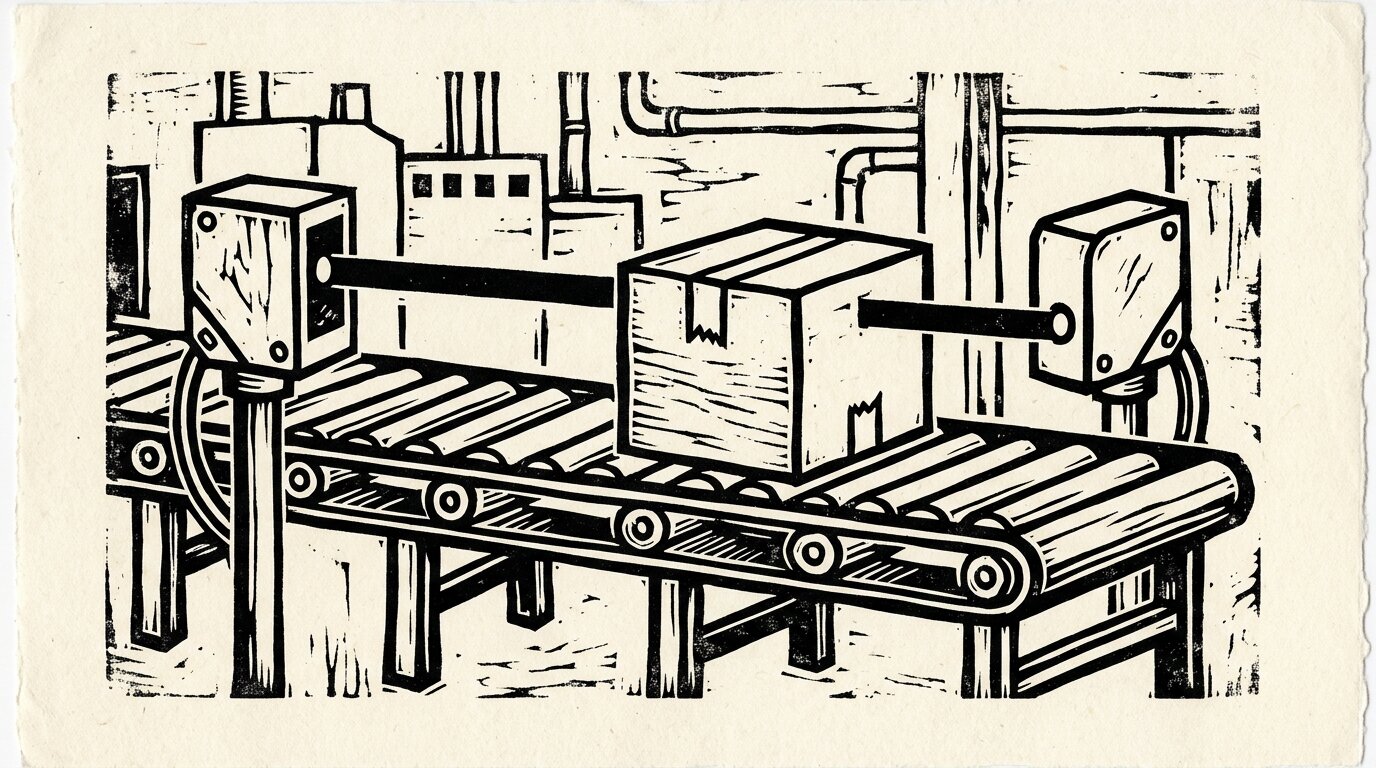
Through-beam splits the emitter and receiver into two separate housings, one on each side of the detection zone. Retroreflective keeps the emitter and receiver together in one housing, aimed at a reflector across the gap. Diffuse also keeps both in one housing, but there's no reflector at all - the sensor just watches for light bouncing back off the target itself.
That single design choice, where the light goes and what sends it back, sets range, install effort, and reliability for each mode. Otherwise the physics stays the same: an emitter fires light, a receiver measures it, and a switching element trips the output once the received light crosses a threshold.
Citation capsule: IEC 60947-5-2 defines three photoelectric proximity switch types: Type T (through-beam), an indirectly operated sensor where a target breaks the reference axis between a separate emitter and receiver; Type R (retroreflective), where the target breaks the beam between a combined emitter-receiver and a separate reflector; and Type D (diffuse), a directly operated sensor that triggers when the target itself reflects light back to the combined unit (IEC 60947-5-2, 2026). Through-beam and retroreflective are dark-on; diffuse is light-on.
How Does Through-Beam Detection Work?
An emitter and a receiver face each other across the detection zone, and the target is detected the instant it blocks the beam between them. This geometry gives through-beam the longest range and highest reliability of the three modes. It works on any opaque object regardless of color or surface finish, because all it needs is a broken beam (Banner, 2026).
Range is the standout advantage. Through-beam pairs typically reach tens of metres, far beyond what retroreflective or diffuse can manage at a comparable price point. Because detection depends only on the beam being interrupted, a through-beam sensor doesn't care whether the target is matte black, mirror-polished, or transparent enough to scatter some light. If it blocks enough of the beam, it registers.
The cost is install complexity. Two housings mean wiring, mounting, and aligning both sides of the gap, which isn't always practical on a machine with access from only one side. Through-beam earns its keep on long spans, small or thin targets that other modes struggle to see reliably, and dirty environments where its naturally high excess gain (more on that below) buys the most margin.
Citation capsule: Through-beam photoelectric sensors put the emitter and receiver in separate housings on opposite sides of the detection zone, so a target is sensed the moment it interrupts the beam between them (IEC 60947-5-2; Banner, 2026). That geometry gives through-beam the longest typical range and the highest reliability of the three modes, and detection works regardless of target color or surface finish, because only the interruption of the beam matters.
How Do Retroreflective and Polarized Sensors Work?
A retroreflective sensor puts the emitter and receiver in one housing aimed at a reflector on the far side of the zone, and the target is detected when it breaks the beam returning from that reflector. It installs and wires on one side only, at a medium range between through-beam's long reach and diffuse's short one.
That one-side install is the whole appeal. You mount and wire a single housing, aim it at a reflector, and you're done - no second junction box, no alignment across the gap. The trade-off: a standard retroreflective sensor can misread a shiny target the same way it reads its own reflector. A mirror-finish part or a foil label bounces enough light straight back to trip a false detection before the actual target ever gets close.
Polarized retroreflective for shiny and clear targets
Polarized retroreflective sensors solve that failure mode with a 90-degree polarizing filter. A corner-cube reflector depolarizes the light it bounces back, rotating its polarization; a plain specular reflection off a shiny or clear target does not. The filter passes only the depolarized return, so the sensor tells a genuine reflector apart from a shiny target's mirror-like bounce (Baumer, 2026).
That mechanism makes polarized retroreflective the practical answer for detecting glass bottles, clear film, or foil-wrapped packaging - targets a plain retroreflective sensor would either see through or misread as the reflector itself. It's also why most retroreflective sensors sold for general industrial use ship polarized by default rather than as an upcharge option. When a target is clear, liquid, or otherwise unfriendly to any light-based mode, ultrasonic sensors sidestep the optics problem entirely by timing a sound pulse instead.

Citation capsule: A polarized retroreflective sensor uses a 90-degree polarizing filter to distinguish the depolarized light returning from a corner-cube reflector from the specular reflection of a shiny or clear target (Baumer, 2026). Without that filter, a mirror-finish part or foil label can trip a false detection by mimicking the reflector's return - the reason most retroreflective sensors used in general industry ship polarized as standard.
How Does Diffuse (Proximity) Detection Work?
A diffuse sensor puts the emitter and receiver in one housing and detects the light bouncing back off the target itself - no reflector, just the sensor and the part. It's the easiest mode to mount, needing wiring and clearance on one side only. But it has the shortest range, and that range depends heavily on the target's own color and reflectivity (IEC 60947-5-2; AutomationDirect, 2026).
Datasheet range figures for diffuse sensors are rated against a standard 90% reflectivity white-paper target: 100x100 mm for ranges up to 400 mm, and 200x200 mm for ranges beyond that (IEC 60947-5-2, 2026). Swap that white paper for a dark, matte, or textured surface and the same sensor sees dramatically less distance, sometimes barely a fraction of its rated spec.
That reflectivity dependence is the classic diffuse failure mode: a dark or matte part reads short, and a bright or reflective one reads long, so the "rated range" on the box is closer to a best case than a guarantee. In the field, I've watched a plain diffuse sensor false-trigger on a shiny machine frame sitting behind a dark part. The frame reflected more light back than the actual target did, so the sensor fired on the background and missed the part entirely. We fixed it by switching to a background-suppression model that ignores anything past a set cutoff.
Citation capsule: Diffuse photoelectric sensors detect light reflected directly off the target, with datasheet range rated against a standard 90% reflectivity white-paper target measuring 100x100 mm for ranges up to 400 mm and 200x200 mm beyond that (IEC 60947-5-2, 2026). A dark or matte target shortens the effective range well below the rated figure, while a bright or reflective one extends it, which is why diffuse range is never a fixed number in practice.
What Is Background Suppression, and Why Does It Matter?
Background suppression (BGS) is a diffuse-mode feature that triangulates the angle of the returning light instead of just measuring its intensity. The sensor detects targets within a set distance and ignores anything beyond it, including a shiny machine frame right behind the part. It was standardized with new definitions and test procedures in the IEC 60947-5-2 2019 edition.
The geometry behind it is straightforward: the emitter fires a beam, and a position-sensitive receiver reads the angle at which the reflected light returns, not just how bright it is. A near target sends light back at one angle; a far background sends it back at a different, more oblique angle. The sensor's electronics use that angle difference to set a hard cutoff distance, beyond which returning light gets ignored entirely, regardless of how bright or reflective the background is.
That single change fixes the classic diffuse problem covered above: a bright, shiny surface behind the actual target no longer competes with the target for the sensor's attention. Foreground suppression works the same way in reverse, ignoring anything closer than a set distance - useful when a conveyor guide rail or fixture sits in front of the true target zone.
Citation capsule: Background suppression measures the angle of returning light through triangulation rather than its intensity alone, letting a diffuse sensor detect targets within a set distance while ignoring anything past a defined cutoff, including a reflective background directly behind the part. The IEC 60947-5-2 2019 edition introduced dedicated definitions and test procedures for Type D sensors with background suppression, formalizing what had been a manufacturer-specific feature into a standardized one.
What Is Excess Gain, and How Much Do You Need?
Excess gain is the ratio of the light the receiver actually gets to the minimum amount it needs to switch reliably. It's your margin against dust, fog, misalignment, and a weak or distant target - and the dirtier the environment, the more of that margin you should design in from the start (Banner; IEC 60947-5-2, 2026).
Think of excess gain as light in reserve. A sensor with 1x gain is right at its switching threshold - fine on a clean bench, but with zero margin against a film of dust settling on the lens or reflector. As Banner's own rule of thumb frames it, roughly 10x excess gain covers a dusty plant floor, and roughly 50x covers a very dirty or foundry-type environment, where smoke, oil mist, or heavy grime accumulate fast on optical surfaces. That's a design guideline, not a guarantee - actual requirements shift with cleaning schedule, target contrast, and mounting distance.
Excess gain by sensing mode
Excess gain also isn't evenly distributed across the three modes. Through-beam sensors generally carry the most excess gain at a given range, because the full beam only has to travel one way before it's measured directly. Diffuse sensors carry the least, since the light has to hit the target, scatter, and return before the receiver ever sees it. That's one more reason through-beam wins in the dirtiest environments, and diffuse needs the most conservative range derating in the same conditions. Dirt on the lens erodes excess gain gradually over time. That's why a sensor that worked fine at commissioning can start missing targets months later, with no change to the wiring or the part.
Citation capsule: Excess gain is the ratio of light received to the minimum light a photoelectric sensor needs to switch, and it's the practical margin against dust, fog, and misalignment. As a rule of thumb, aim for roughly 10x excess gain in a dusty industrial environment and roughly 50x in a very dirty or foundry setting (Banner, 2026). Through-beam sensors typically carry the most excess gain at a given range; diffuse carries the least.
Which Mode Should You Choose?
Choose through-beam when you can wire both sides and need the longest, most reliable, color-independent detection. Choose retroreflective for one-side install at medium range, adding a polarized filter for shiny or clear targets. Choose diffuse, ideally with background suppression, when you can only mount on one side and the target sits close and consistent.
Choose by:
- Range needed - long spans favor through-beam; short, close-in detection favors diffuse
- Access to both sides - only one side accessible rules out through-beam
- Target color and reflectivity - dark or variable-color targets punish plain diffuse
- Transparency or shine - glass, foil, or clear film needs polarized retroreflective (or through-beam)
- Background clutter - a reflective surface behind the target calls for background suppression
- Environment dirtiness - dustier lines need higher excess gain, favoring through-beam or a conservative range derating
- Cost and wiring effort - diffuse and retroreflective are cheaper to install than a two-side through-beam pair
| Attribute | Through-beam | Retroreflective | Diffuse |
|---|---|---|---|
| Typical range | Longest | Medium | Shortest |
| Reliability / excess gain | Highest | High | Lowest |
| Install side | Two sides | One side + reflector | One side |
| Detects color-independent | Yes | Yes | No, depends on reflectivity |
| Transparent/shiny objects | Yes | Yes, polarized | Hard |
| Relative cost | Higher, two units | Medium | Lower |
| Best for | Long range, small parts, dirty | Medium range, easy install | Short range, tight space, one-side access |
Through-beam wins on range and reliability; diffuse wins on install simplicity - the trade-off runs in a straight line across every row.
Once you've settled on a mode, the output side still needs sorting: NPN or PNP, normally open or normally closed, light-operate or dark-operate. That decision is covered separately in wiring the sensor output, and it applies the same way regardless of which photoelectric mode you land on. If the application calls for a continuous measurement rather than a simple on/off detection, analog output signals covers that separate wiring standard.
What Emitter and Output Options Matter?
The light source and output type round out the spec once the mode is chosen. Visible red light makes alignment easy to see by eye; infrared punches through dust and ambient light better; laser gives a tiny, precise spot for small-target or long-range work. Outputs are NPN or PNP discrete signals with light-operate or dark-operate logic, at a minimum of IP54, with IP67 or IP69K available for washdown duty (IEC 60947-5-2, 2026).
Response time and switching frequency matter more than most specs suggest on paper. A sensor rated for a slow conveyor won't keep up with a fast-indexing part counter, which is why datasheets list switching frequency at all. Hysteresis, sometimes called differential travel, separates the point where the output switches on from the point where it switches back off, which prevents chatter on a vibrating target or a part with a ragged edge (AutomationDirect, 2026).
None of these choices override the mode decision covered above; they fine-tune it. A through-beam sensor with a laser emitter and a fast switching frequency solves a different problem than a diffuse sensor with background suppression and a slow, forgiving response time, even though both get called "photoelectric sensors" on the same page of a catalogue.
Citation capsule: Photoelectric emitters come in three common light sources - visible red for easy alignment, infrared for better penetration through dust and ambient light, and laser for a tiny, precise spot at longer range - paired with NPN or PNP discrete outputs at a minimum IP54 rating per IEC 60947-5-2, with IP67 or IP69K available for washdown environments. Hysteresis separates the operate and release points to prevent output chatter on a vibrating or edge-detected target (AutomationDirect, 2026).
Frequently Asked Questions
What are the three main types of photoelectric sensors?
Through-beam, retroreflective, and diffuse. Through-beam and retroreflective are dark-on (Type T and Type R), switching when a target breaks the beam; diffuse is light-on (Type D), switching when reflected light returns to the receiver (IEC 60947-5-2, 2026).
When should you use through-beam vs retroreflective vs diffuse?
Use through-beam when you can wire both sides and need the longest, most reliable range. Use retroreflective for one-side install at medium range. Use diffuse when you can only mount on one side and the target is close and consistent (Banner, 2026).
What is background suppression and how does it work?
Background suppression is a diffuse-mode feature that triangulates the angle of returning light instead of just its intensity, so the sensor detects targets within a set distance and ignores anything beyond it, standardized in the IEC 60947-5-2 2019 edition.
Can photoelectric sensors detect transparent objects like glass?
Yes, with a polarized retroreflective sensor. A 90-degree polarizing filter tells the depolarized return from a corner-cube reflector apart from a shiny or clear target's specular reflection, so the sensor still sees the reflector through the glass (Baumer, 2026).
How does excess gain affect reliability?
Excess gain is the ratio of light the receiver actually gets to the minimum it needs to switch. A rule of thumb is roughly 10x for a dusty plant and roughly 50x for very dirty or foundry conditions (Banner, 2026).
Conclusion
The three photoelectric modes trade reliability and range for install simplicity, in that order. Through-beam is the most reliable and longest-range option but needs wiring on both sides. Retroreflective installs on one side at medium range, and polarized versions handle shiny and clear targets. Diffuse is the easiest to mount but the shortest-range and most target-dependent, and background suppression is what fixes its classic false-trigger-on-background failure.
Excess gain ties all three together as the practical margin against dirt, fog, and misalignment - the higher the contamination risk, the more of it you want designed in. Pick the mode by range, side access, target properties, and environment, and the sensor that worked on the bench will keep working once the line gets dusty.
For the wider view of where photoelectric sensors fit alongside other detection technologies, read the industrial sensors guide, and for the non-optical alternative, see inductive vs capacitive proximity sensors. For rotating equipment rather than part presence, how to select a sensor walks through the same environment-first selection logic for vibration sensing. None of the three modes above are rated for personnel safeguarding - that's a different product category built to a different standard, covered in our comparison of light curtains, safety laser scanners, and safety mats.
What are the three main types of photoelectric sensors?
Through-beam, retroreflective, and diffuse. Through-beam and retroreflective are dark-on (Type T and Type R), switching when a target breaks the beam; diffuse is light-on (Type D), switching when reflected light returns to the receiver (IEC 60947-5-2, 2026).
When should you use through-beam vs retroreflective vs diffuse?
Use through-beam when you can wire both sides and need the longest, most reliable range. Use retroreflective for one-side install at medium range. Use diffuse when you can only mount on one side and the target is close and consistent (Banner, 2026).
What is background suppression and how does it work?
Background suppression is a diffuse-mode feature that triangulates the angle of returning light instead of just its intensity, so the sensor detects targets within a set distance and ignores anything beyond it, standardized in the IEC 60947-5-2 2019 edition.
Can photoelectric sensors detect transparent objects like glass?
Yes, with a polarized retroreflective sensor. A 90-degree polarizing filter tells the depolarized return from a corner-cube reflector apart from a shiny or clear target's specular reflection, so the sensor still sees the reflector through the glass (Baumer, 2026).
How does excess gain affect reliability?
Excess gain is the ratio of light the receiver actually gets to the minimum it needs to switch. A rule of thumb is roughly 10x for a dusty plant and roughly 50x for very dirty or foundry conditions (Banner, 2026).
Related Articles

