

IP Ratings Explained: IP67, IP68, and IP69K Decoded
An engineer specs a sensor stamped IP69K for a coolant tank, assuming a rating built for 80 bar hot-water jets will handle a slow dunk in fluid too. It floods within a week. The rating was real. It just tested the wrong thing, because IP69K certifies washdown spray, not submersion, and nobody checked the second half of the datasheet for an immersion rating to match.
That mix-up is more common than it should be, and it comes from treating an IP rating like a single "toughness score" instead of what it actually is: two separate test results written as two digits. Read both digits, and you know exactly what the device survives. Skip one, and you're guessing.
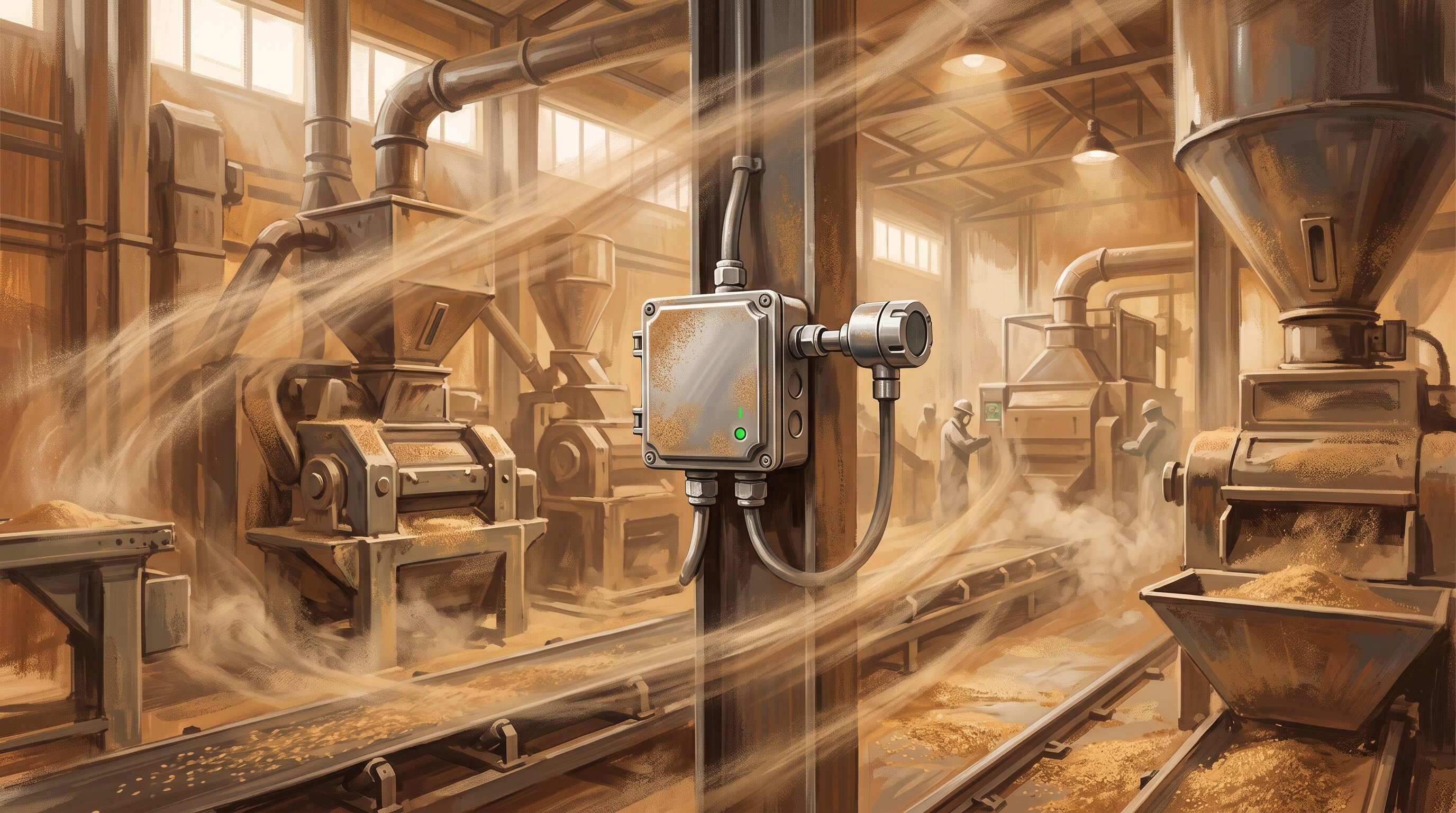 A sealed enclosure staying clean in a dusty plant floor - the scenario the first IP digit tests.
TL;DR: An IP (Ingress Protection) rating from IEC 60529 is two digits: the first (0-6) covers solids and dust, the second (0-9K) covers water. IP67 survives a 1-metre dunk for 30 minutes; IP68 is continuous immersion at a depth the manufacturer sets; IP69K survives an 80-100 bar hot washdown at roughly 80 C. The catch: the water digit is not a simple ladder past IPX6, so an IP69K sensor is not automatically IP67 - many devices need a dual rating to prove both.
This sits alongside our broader industrial sensors guide, and pairs well with inductive vs capacitive proximity sensors, where IP67 and IP69K variants show up constantly on datasheets.
What Does an IP Rating Actually Mean?
An IP rating is two digits defined by IEC 60529: the first digit (0-6) rates protection against solid objects and dust, and the second digit (0-9K) rates protection against water (Intertek; Turck, 2026). Read left to right, solids then water; an "X" in either slot means that aspect was never tested.
The code starts with the letters "IP," followed by exactly two digits, sometimes trailed by a letter suffix for extra details like high-voltage protection or chemical resistance, which vary by manufacturer. IP67 means the first digit is 6, the second is 7. IPX7 means only the water test ran; the solids digit was skipped, so you don't know how well it keeps out dust.
Higher digits generally mean more protection, but that "generally" is doing real work. It applies within each digit's own ladder, not across the two digits, and (as the water section below shows) not even cleanly within the water digit past a certain point. An IP rating is a specific, repeatable lab test against clean fresh water and standardized dust, not a general verdict on how rugged a device is.
Citation capsule: An IP rating under IEC 60529 is always two digits: the first (0-6) for solids and dust, the second (0-9K) for water, with "X" marking an aspect that was never tested. IP67 decodes to dust-tight (6) plus temporary 1-metre immersion (7). Because the two digits test entirely different hazards, a sensor's dust protection tells you nothing about its water protection, and vice versa - you have to check both (Intertek; Turck, 2026).
What Does the First Digit (Solids and Dust) Mean?
The first digit runs from 0 to 6 and rates how well an enclosure keeps out solid objects and dust, from no protection at all up to fully dust-tight. Industrial sensor and enclosure datasheets - including dust-tight load cells and strain gauges used in hopper and silo weighing - rarely go below a 5 or 6, because anything less lets in fingers, tools, or fine particulate (Turck; Intertek, 2026).
Each level corresponds to a calibrated test probe size that must not touch live or moving parts inside the housing. Level 1 blocks objects larger than 50 mm (roughly a hand); level 2 blocks anything over 12.5 mm (a finger). Level 3 stops objects over 2.5 mm (a tool or thick wire); level 4 stops anything over 1 mm (a thin wire or small screw) (Turck; BONAD; Intertek, 2026).
The two levels that matter most in industrial settings are 5 and 6. Level 5, "dust-protected," allows a limited amount of dust ingress as long as it doesn't interfere with the device's operation or create a safety hazard. Level 6, "dust-tight," permits zero dust ingress, verified by running the device inside a talc-dust chamber under vacuum for up to eight hours (Turck; BONAD; Intertek, 2026). That gap between "some dust is fine" and "no dust at all" is the distinction to check before installing a sensor in a cement plant, grain elevator, or woodshop.
First digit (solids and dust):
| Digit | Protects against |
|---|---|
| 0 | No protection |
| 1 | Solids larger than 50 mm (a hand) |
| 2 | Solids larger than 12.5 mm (a finger) |
| 3 | Solids larger than 2.5 mm (tools) |
| 4 | Solids larger than 1 mm (wires) |
| 5 | Dust-protected: limited ingress, no harmful deposit |
| 6 | Dust-tight: no ingress |
Second digit (water):
| Digit | Protects against |
|---|---|
| 0 | None |
| 1-2 | Dripping water |
| 3 | Spraying water |
| 4 | Splashing water |
| 5 | Water jets (6.3 mm nozzle) |
| 6 | Powerful jets (12.5 mm nozzle) |
| 7 | Temporary immersion (1 m, 30 min) |
| 8 | Continuous immersion (manufacturer depth) |
| 9K | High-pressure hot washdown |
Higher digits mean more protection within each column, but the two columns are independent tests - always check both.
Citation capsule: The first IP digit's top two levels split on a real distinction: level 5 ("dust-protected") tolerates limited dust ingress that doesn't affect operation, while level 6 ("dust-tight") permits none at all and is proven with an eight-hour talc-chamber test under vacuum (Turck; BONAD; Intertek, 2026). Any sensor destined for a genuinely dusty plant floor - foundry, mill, grain handling - should carry a 6, not a 5.
What Does the Second Digit (Water) Mean?
The second digit runs from 0 to 9K and rates protection against water, but it is not one continuous ladder. It climbs from dripping water through sprays and jets (levels 5 and 6), then switches to an entirely different immersion test (7 and 8), and finally to a separate high-pressure washdown test (9K) (Turck; Wikipedia, 2026).
The full ladder: 0 is no protection; 1-2 cover dripping water at various tilt angles; 3 covers spraying water; 4 covers splashing water from any direction; 5 is protection against water jets from a 6.3 mm nozzle; 6 is protection against powerful jets from a 12.5 mm nozzle; 7 is temporary immersion; 8 is continuous immersion; 9K is high-pressure, high-temperature washdown (Turck; Wikipedia, 2026).
Jets vs immersion vs washdown
Levels 5 and 6 fire a directed stream of water at the enclosure from a fixed distance, simulating a hose or spray-down. Levels 7 and 8 submerge the entire device in still water for a set time and depth, no directed pressure involved. Level 9K sprays water at high pressure and high temperature from four specific angles, close to the device, simulating an industrial washdown or pressure-washer scenario. These are three physically distinct rigs, not three points on a single scale.
Why the water ratings do not stack
Because jets, immersion, and washdown are different tests, passing one does not prove you'd pass another. An IP69K device has demonstrated it survives close-range, high-pressure, hot spray - it has not necessarily been submerged in still water for half an hour. IP69K is not automatically IP67 (Turck; Wikipedia, 2026). This is why many sensors and enclosures carry a dual rating on the datasheet, like IP66/IP68 or "IP69K + IP67," listing both tests because each one covers a hazard the other doesn't.
Citation capsule: Water protection under IEC 60529 branches into three separate tests past level 4: jets (levels 5-6, directed pressurized streams), immersion (levels 7-8, still-water submersion), and washdown (9K, close-range hot high-pressure spray). Passing one does not certify the others, so an IP69K rating does not automatically imply IP67 - a device rated for washdown may never have been tested for temporary immersion at all, which is why dual ratings like IP66/IP68 or IP69K plus IP67 appear on datasheets (Turck; Wikipedia, 2026).
How Do IP67, IP68, and IP69K Differ?
IP67, IP68, and IP69K are the three ratings engineers argue about most, and all three sound like "waterproof," but they certify three different tests. IP67 is a 30-minute dunk in 1 metre of water. IP68 is continuous immersion at a depth the manufacturer specifies. IP69K is a close-range, high-pressure, hot-water spray (Turck; Designplan; Banner, 2026).
IP67 requires the device to survive temporary immersion, 1 metre deep, for 30 minutes, and come out working (Turck; Intertek; Banner, 2026). It's the standard for a sensor that might get briefly flooded, dropped in a puddle, or splashed hard during a wash cycle, but that isn't meant to live underwater.
IP68 requires continuous immersion, a more severe test than IP67's temporary dunk. The manufacturer sets the exact depth and duration for that product, typically 1-3 metres, though some products rate much deeper (Turck; Wikipedia, 2026). Because IEC 60529 leaves depth and time up to the manufacturer for IP68, always check the datasheet's stated conditions rather than assuming "IP68" alone means unlimited depth.
IP69K, defined by ISO 20653 and folded into current IEC 60529 references, requires the device to survive water at roughly 80-100 bar and around 80 C, at about 14-16 litres per minute. The spray hits from four angles - 0, 30, 60, and 90 degrees - for 30 seconds each (Designplan; Turck; Banner, 2026). It's the standard for food, beverage, pharmaceutical, and transport equipment - including washdown-rated photoelectric sensors - that gets pressure-washed with hot water and detergent daily.
In the field, I've had a sensor stamped IP69K get pulled off a washdown line and dropped into a parts-cleaning tank overnight because everyone assumed the rating meant "waterproof, full stop." It came back dead. The datasheet never claimed IP67 or IP68; the washdown test and the immersion test weren't the same thing, and nobody had read past the first number that looked impressive.
| IP67 | IP68 | IP69K | |
|---|---|---|---|
| Test | Temporary immersion, 1 m for 30 min | Continuous immersion, manufacturer-specified depth and time | High-pressure hot-water jets |
| Conditions | Fresh water, 1 m, 30 min | Typically 1-3 m, continuous | 80-100 bar, roughly 80 C, 14-16 L/min, sprayed at 0, 30, 60, and 90 degrees |
| Standard | IEC 60529 | IEC 60529 | ISO 20653, now referenced in IEC 60529 |
| Typical use | Occasional flooding or dunk | Permanent submersion | Washdown - food, beverage, transport |
Three different tests, not three points on one scale - a device rated for one is not automatically rated for the others.
 IP69K in practice: a food-grade sensor withstanding a close-range hot washdown jet.
Citation capsule: IP67, IP68, and IP69K each certify a different water test: IP67 is 1 metre for 30 minutes (temporary immersion), IP68 is continuous immersion at a manufacturer-specified depth typically in the 1-3 metre range, and IP69K is roughly 80-100 bar water at about 80 C sprayed from four angles for 30 seconds each per ISO 20653 (Turck; Designplan; Banner, 2026). None of the three implies the other two - check the datasheet for exactly which tests a device has passed.
What About NEMA Ratings?
North American enclosure datasheets often list a NEMA rating instead of, or alongside, an IP code. The two roughly cross-reference, but they are not interchangeable: NEMA tests additional hazards that IP ignores entirely (Rittal; Banner; Turck, 2026).
Approximate mappings that show up often: NEMA 3 is roughly comparable to IP54/IP55, and NEMA 4 and 4X are approximately equivalent to IP66. NEMA 6 is roughly equivalent to IP67, and NEMA 6P is roughly equivalent to IP68 (Rittal; Banner; Turck, 2026). Treat each as an approximation, never a certified equivalence. A device rated NEMA 4X has not automatically passed the IEC 60529 IP66 test procedure, and vice versa.
The "X" suffix in NEMA 4X means corrosion-resistant, a property IP ratings don't test for. NEMA enclosure standards fold in corrosion resistance, ice formation, oil and coolant exposure, and construction requirements that have no IP equivalent, while IP is purely about solids and fresh water (Rittal; Wikipedia; Intertek, 2026). If a spec sheet only lists a NEMA number and your project needs IP-certified proof, ask for the actual IEC 60529 test result rather than converting on the fly.
Citation capsule: NEMA and IP ratings roughly cross-reference (NEMA 4/4X approximately equal to IP66, NEMA 6 approximately equal to IP67, NEMA 6P approximately equal to IP68) but are not certified equivalents, because NEMA also tests corrosion, ice formation, and oil resistance that IP ratings never touch (Rittal; Banner; Turck, 2026). Convert with care, and ask for the actual IEC 60529 test result when a project specifically requires IP certification.
What an IP Rating Does NOT Tell You
An IP rating is a fresh-water and dust test, full stop. It says nothing about chemical resistance, saltwater corrosion, oil exposure, UV degradation, temperature cycling, or mechanical impact (Rittal; Wikipedia; Intertek, 2026). A high IP number is proof against ingress, not a general durability score.
IEC 60529's water tests use clean fresh water, so a device's resistance to saltwater, cutting fluid, cleaning chemicals, or corrosive vapors is a separate material question, governed by the housing and seal materials rather than the IP number. That's why food and beverage washdown equipment specifies 304 or 316L stainless steel housings on top of an IP69K rating: plastic and lower-grade metals can pit, corrode, or harbor bacteria under repeated hot-chemical washdown even when the ingress test passes clean.
Mechanical robustness against drops, impacts, and crushing runs on a separate scale, the IK rating under EN 62262, which spans IK00 (no protection) to IK10 (protection against substantial impact energy). An enclosure can be IP69K and still crack if dropped from a ladder; that has nothing to do with its water or dust rating.
Citation capsule: IP ratings test only fresh water and standardized dust; they say nothing about chemical resistance, saltwater corrosion, oil exposure, or mechanical impact, which is why food-grade washdown sensors specify 304 or 316L stainless housings on top of an IP69K rating (Rittal; Wikipedia; Intertek, 2026). Impact resistance runs on a separate scale entirely, the IK rating under EN 62262, so a high IP number is never a substitute for checking material and impact specs too.
Which IP Rating Do You Actually Need?
Match the rating to the real environment the device will sit in, not the highest number on the shelf. A dry indoor cabinet doesn't need the same rating as a sensor bolted next to a pressure washer, and over-specifying adds cost without adding relevant protection.
Choose by environment:
- Dry indoor panel or cabinet: IP54 (dust-protected, splash-resistant)
- Outdoor exposure or occasional hose-down: IP65/IP66
- Occasional flooding or brief submersion risk: IP67
- Permanent or near-permanent submersion: IP68 (check the manufacturer's stated depth and time)
- High-pressure, hot-water washdown (food, beverage, pharma): IP69K, paired with 304/316L stainless housing where hygiene matters
If a device faces more than one hazard, such as a daily hot washdown and standing water on the floor, check whether the datasheet lists a dual rating like IP69K plus IP67. Don't assume one test covers the other. Material selection matters as much as the digits in food and pharma settings: a plastic housing rated IP69K can still be the wrong choice if it can't be cleaned to sanitation standards or resists the cleaning chemicals in use.
The same IP discipline applies to machine-safeguarding devices, not just measurement sensors - a safety light curtain or laser scanner mounted at a washdown-rated cell needs the matching ingress protection alongside its safety rating, a selection factor covered in our comparison of light curtains, safety laser scanners, and safety mats.
How Are IP Ratings Tested and Marked?
IP ratings come from standardized IEC 60529 lab tests. Calibrated probes and a talc-dust chamber prove the first digit; defined water volumes, pressures, and durations prove the second. The manufacturer or an accredited lab, such as Intertek, performs the testing (Intertek; Turck, 2026).
The dust test runs the device inside a sealed chamber with talc powder circulating under partial vacuum, for up to eight hours to earn a dust-tight (level 6) rating. The water tests use dedicated rigs. Oscillating spray nozzles cover the jet levels, and submersion tanks with a controlled depth and timer cover the immersion levels. For IP69K, the ISO 20653 washdown rig sprays hot water at the specified pressure and flow from four fixed angles.
A correctly marked datasheet states the exact conditions tested, not just the digits. That matters most for IP68, since IEC 60529 leaves the actual depth and duration up to the manufacturer to declare. Two products can both say "IP68" while one survives 1 metre for 30 minutes and another survives 3 metres indefinitely; always read the stated depth and time rather than assuming the digit alone.
Frequently Asked Questions
What does IP mean?
IP stands for Ingress Protection, defined by IEC 60529. The first digit (0-6) rates protection against solid objects and dust, and the second digit (0-9K) rates protection against water (Intertek; Turck, 2026).
Is IP67 waterproof?
Not permanently. IP67 survives temporary immersion in 1 metre of water for 30 minutes. It is not rated for continuous submersion or high-pressure jets, which are separate tests entirely (Turck; Intertek, 2026).
What is the difference between IP67 and IP68?
IP67 is a 30-minute, 1-metre temporary dunk. IP68 is continuous immersion at whatever depth and duration the manufacturer states, typically 1-3 metres, and is the more severe test of the two (Turck; Wikipedia, 2026).
What does IP69K mean?
IP69K certifies a device survives close-range, high-pressure, hot-water washdown: roughly 80-100 bar at about 80 C, sprayed from several angles per ISO 20653 (Designplan; Turck; Banner, 2026).
Does an IP rating protect against chemicals?
No. IP ratings only test fresh water and dust. Chemical resistance, saltwater corrosion, and mechanical impact are separate concerns, with impact covered by the IK rating under EN 62262 (Rittal; Wikipedia; Intertek, 2026).
Conclusion
An IP rating is two digits, not one score: the first for solids and dust, the second for water. Higher is generally better within each digit, but the water digit branches into separate jet, immersion, and washdown tests past level 4, so a high second digit doesn't guarantee a lower one. IP67, IP68, and IP69K each prove a different scenario, and an IP69K device is not automatically IP67.
NEMA ratings roughly map to IP but test extra hazards, so convert with care. And no IP number, however high, covers chemicals, corrosion, or physical impact - those live on entirely separate scales. Read the whole code, check the stated test conditions, and match the rating (and the housing material) to the environment the sensor actually faces.
For another rating that shows up on the same datasheets, see ultrasonic sensors.
What does IP mean?
IP stands for Ingress Protection, defined by IEC 60529. The first digit (0-6) rates protection against solid objects and dust, and the second digit (0-9K) rates protection against water (Intertek; Turck, 2026).
Is IP67 waterproof?
Not permanently. IP67 survives temporary immersion in 1 metre of water for 30 minutes. It is not rated for continuous submersion or high-pressure jets, which are separate tests entirely (Turck; Intertek, 2026).
What is the difference between IP67 and IP68?
IP67 is a 30-minute, 1-metre temporary dunk. IP68 is continuous immersion at whatever depth and duration the manufacturer states, typically 1-3 metres, and is the more severe test of the two (Turck; Wikipedia, 2026).
What does IP69K mean?
IP69K certifies a device survives close-range, high-pressure, hot-water washdown: roughly 80-100 bar at about 80 C, sprayed from several angles per ISO 20653 (Designplan; Turck; Banner, 2026).
Does an IP rating protect against chemicals?
No. IP ratings only test fresh water and dust. Chemical resistance, saltwater corrosion, and mechanical impact are separate concerns, with impact covered by the IK rating under EN 62262 (Rittal; Wikipedia; Intertek, 2026).
Related Articles

