

Thermocouple Types Explained: J, K, T, E, N and More
A thermocouple is nothing more than two wires twisted together at one end. Heat that junction, and it hands you back a few thousandths of a volt. Which two metals you twisted - the "type" - decides how hot it reads, how accurate it is, and what atmosphere it survives.
Most engineers default to Type K and stop thinking about it. Then it drifts in a reducing furnace, or someone wires the color code backwards and the reading runs cold when it should run hot. This guide walks through the physics, a per-type spec reference, the color-code trap, and a selection order that gets you past "just use K."
Read more: industrial sensors guide and RTD vs thermocouple for the other main temperature-sensing technology.
TL;DR: A thermocouple makes a tiny voltage from two dissimilar metals joined at a hot junction (the Seebeck effect). The reading depends on knowing the cold (reference) junction temperature - which is why cold-junction compensation matters. Type K (Chromel/Alumel, about -270 to 1372 C, ~41 uV/C) is the general-purpose default, but Type T is more accurate, Type N resists drift, and noble R/S/B reach 1600-1820 C at 10-20x the cost, per Fabrico (2026).
How Does a Thermocouple Actually Work?
A thermocouple joins two dissimilar metals at a point; the temperature difference between that measuring junction and a reference junction produces a small voltage by the Seebeck effect, per Industrial Monitor Direct (2026). It measures a difference, not an absolute temperature - which is the part most spec sheets skip.
That last point matters more than it sounds. A thermocouple can't tell you "it's 400 C" on its own. It can only tell you "the hot end is this much hotter than the cold end." Get the cold end wrong and every reading downstream is wrong by the same amount.
The Seebeck Effect
Join two wires of different alloys at one end and leave the other open. They generate a voltage proportional to the temperature difference between the two ends. Reverse that: if both ends sit at the same temperature, the output is 0 mV, no matter how hot that shared temperature is (Industrial Monitor Direct, 2026). The instrument reading a thermocouple is really reading a voltage and inferring a temperature difference from it.
Cold-Junction Compensation
Because the thermocouple only reports delta-T, the measuring instrument needs to know the temperature of the reference (cold) junction to back out the actual process temperature. Older setups used a literal ice bath at 0 C as the reference. Modern instruments measure the terminal-block temperature electronically and add that offset automatically - cold-junction compensation, or CJC (Industrial Monitor Direct, 2026).
Skip CJC, or let it drift, and the whole reading shifts by whatever the terminal block temperature happens to be that day. A control panel running warm from a nearby motor drive can add a couple of degrees of error to every thermocouple wired into it if the CJC sensor isn't tracking the actual terminal temperature.
Citation capsule: A thermocouple generates voltage from the Seebeck effect. Two dissimilar metals joined at a measuring junction produce an EMF proportional to the temperature difference against a reference junction, not an absolute temperature (Industrial Monitor Direct, 2026). Output is 0 mV when both junctions sit at the same temperature. That's why every thermocouple instrument needs cold-junction compensation, converting the measured delta-T back into a real process temperature reading.
What Are the Base-Metal Thermocouple Types - J, K, T, E, N?
The five common base-metal types - J, K, T, E, and N - cover most industrial temperature work. They differ by alloy pair, usable range, sensitivity, and atmosphere tolerance. Picking among them means matching those four traits to the job.
Type K and Type J
Type K (Chromel/Alumel) is the general-purpose default: about -270 to 1372 C, with a sensitivity around 41 uV/C. It holds up well in oxidizing atmospheres (ITS-90 reference tables, 2026). It's cheap, widely stocked, and "good enough" for most dry, oxidizing industrial applications - which is why it gets specified by habit rather than by fit.
Type J (Iron/Constantan) covers about -210 to 1200 C, with a common practical range closer to -40 to 750 C, per Fabrico and IEC 60584-1 (2026). It outputs a higher EMF than Type K at moderate temperatures, and the iron leg is magnetic. A small magnet stuck to one lead is a genuine field trick for telling a Type J from a Type K when the labels have worn off. The tradeoff: iron rusts in humid environments, and Type J degrades above roughly 760 C (KLEEVME, 2026).
Type T and Type E
Type T (Copper/Constantan) runs about -270 to 400 C and is the most accurate of the base-metal types, per KLEEVME and ITS-90 (2026). Its copper leg is also readily available in high purity. That's part of why it's the standard choice for cryogenic work, cold-chain monitoring, and food-processing applications where sub-zero accuracy matters.
Type E (Chromel/Constantan) spans about -270 to 1000 C and produces the highest EMF of any base-metal type, roughly 63 uV/C (KLEEVME / ITS-90, 2026). That higher sensitivity translates to better resolution on the same instrument - useful for picking a small temperature change out of electrical noise.
Type N
Type N (Nicrosil/Nisil) covers about -270 to 1300 C and exists because Type K wasn't stable enough at high temperature over the long run. It resists the drift and "green rot" that plague Type K in demanding atmospheres. Dual-wall mineral-insulated metal-sheathed (MIMS) construction cuts drift by roughly a factor of three at 1200 C compared to standard sheathing, per NPL (2026). It costs a little more than Type K and isn't stocked quite as widely, but for a new high-temperature installation that will run for years, it's usually worth specifying.
| Type | Alloy pair (+ / -) | Temp range | Sensitivity (nominal, ITS-90 0-100 C average) | IEC Class 1 | Best use |
|---|---|---|---|---|---|
| K | Chromel / Alumel | ~-270 to 1372 C | ~41 uV/C | +/-1.5 C | General purpose, oxidizing |
| J | Iron / Constantan | ~-210 to 1200 C | ~52 uV/C | +/-1.5 C | Older/cheap, dry moderate temp |
| T | Copper / Constantan | ~-270 to 400 C | ~43 uV/C | +/-0.5 C | Cryogenic, food, most accurate base metal |
| E | Chromel / Constantan | ~-270 to 1000 C | ~63 uV/C | +/-1.5 C | Highest sensitivity |
| N | Nicrosil / Nisil | ~-270 to 1300 C | ~28 uV/C | +/-1.5 C | Stable high temp, anti-drift |
| R | Pt-13%Rh / Pt | ~0 to 1600 C practical | ~10 uV/C | +/-1.0 C | Very high temp, noble |
| S | Pt-10%Rh / Pt | ~0 to 1600 C practical | ~10 uV/C | +/-1.0 C | Very high temp, noble |
| B | Pt-30%Rh / Pt-6%Rh | ~0 to 1820 C | near 0 at room temp, rises with heat | Class 2 only | Extreme temp, unreliable below ~50 C |
Eight types, one decision tree: temperature range narrows the field, then atmosphere, accuracy class, and cost pick the winner. Sensitivity values are nominal (ITS-90 0-100 C average) and rise with temperature.
Citation capsule: Among base-metal thermocouples, Type K (Chromel/Alumel, ~41 uV/C) covers about -270 to 1372 C as the general-purpose default. Type E (Chromel/Constantan, ~63 uV/C) delivers the highest sensitivity of the group, per ITS-90 reference tables and KLEEVME (2026). Type T is the most accurate base-metal option for cryogenic work, and Type N was engineered specifically to resist the drift that limits Type K at sustained high temperature.
What Are the Noble-Metal Types - R, S, and B?
When a process runs hotter than base metals survive, platinum-rhodium types R, S, and B take over. They reach up to about 1600 to 1820 C, at roughly 10-20x the cost of a base-metal thermocouple, per Superb Heating and Fabrico (2026). They're specialty instruments, not general-purpose sensors, and the price reflects it.
Type R (Pt-13%Rh/Pt) and Type S (Pt-10%Rh/Pt) both reach about 1600 C practical service. Type B (Pt-30%Rh/Pt-6%Rh) pushes higher still, to roughly 1820 C. But it's unreliable below about 50 C because its output near ambient temperature is low (KLEEVME, 2026). Don't expect a usable reading from a Type B probe sitting at room temperature on the bench - that's normal, not a fault.
All three require compensating cable rather than ordinary copper extension wire, because the platinum-rhodium alloys don't match copper's thermoelectric behavior closely enough to substitute. Glassmaking, ceramics kilns, semiconductor diffusion furnaces, and aerospace test stands are the typical home for noble-metal thermocouples. These are applications where the process temperature exceeds what a base-metal junction can survive.
Citation capsule: Noble-metal thermocouples extend measurement well past what base metals can survive. Type R and Type S (platinum-rhodium alloys) reach about 1600 C, and Type B reaches roughly 1820 C but is unreliable below about 50 C, per Superb Heating, KLEEVME, and Fabrico (2026). They cost roughly 10-20x more than base-metal types and require compensating cable, making them a deliberate specialty choice rather than a default.
What Temperature Range Does Each Type Cover?
Every thermocouple type has a usable window, and those windows overlap in the middle of the range - which is why Type K "works" almost anywhere but is rarely the optimal choice. The overlap hides how differently each type behaves at its extremes.
At the cold end, Types T, E, K, and N all reach down toward -270 C on paper, though Type T is the one rated and commonly used for cryogenic service. At the hot end, base metals top out around 1300-1372 C (Type N and Type K, respectively), while noble Type B alone climbs to about 1820 C. The ranges quoted on datasheets are often the absolute standardized limits. The practical range for continuous service is usually narrower, particularly for Type J above 760 C where iron oxidation accelerates.
The takeaway: don't check only whether a type "covers" your target temperature. Check whether it covers it comfortably, with margin, for continuous duty rather than a brief excursion.
How Accurate Is Each Thermocouple Type?
Accuracy is set by standardized tolerance classes, not a single number. IEC 60584-1 defines Class 1 and Class 2 limits for base-metal thermocouples, and Type T is the most accurate of the base-metal group (IEC 60584-1:2013). Reading a spec sheet without checking which class applies is a common way to overestimate how tight a reading is.
Under IEC 60584-1, Class 1 tolerance is +/-1.5 C or +/-0.4% of reading, whichever is greater; Class 2 tolerance is +/-2.5 C or +/-0.75%, whichever is greater. Type T carries a tighter Class 1 tolerance of about +/-0.5 C, reflecting its status as the most accurate base-metal type (IEC 60584-1:2013).
Noble-metal types R and S reach a Class 1 tolerance of about +/-1.0 C up to 1100 C - tight, but achieved at a much higher price point than any base metal. Type B has no Class 1 grade at all; it's only offered in Class 2, reflecting its lower output and reduced accuracy at moderate temperatures (IEC 60584-1:2013).
It's worth distinguishing standard limits of error from special limits of error, which some manufacturers offer at a premium for tighter tolerances than the base IEC class. If a process needs sub-degree accuracy across a wide range, it's worth checking whether an RTD vs thermocouple comparison points you toward resistance thermometry instead - RTDs generally beat any thermocouple class on stability at moderate temperatures.
Citation capsule: IEC 60584-1 sets base-metal thermocouple tolerance at Class 1 = +/-1.5 C or +/-0.4% (whichever is greater) and Class 2 = +/-2.5 C or +/-0.75%. Type T tightens to about +/-0.5 C at Class 1, the most accurate base-metal type (IEC 60584-1:2013). Noble R and S reach +/-1.0 C at Class 1 up to 1100 C, while Type B is offered only at the looser Class 2 tolerance, with no Class 1 grade available.
What's the Difference Between ANSI and IEC Color Codes?
The wire jacket and lead colors tell you the type and polarity, but ANSI and IEC disagree in a way that can bite you. In ANSI wiring, the negative lead is always red; in IEC wiring, it's always white, per HT-Heater (2026). Mixing the two conventions on the same job is the most common wiring mistake in thermocouple installations.
Take Type K as the example. Under ANSI, the outer jacket is yellow, the positive lead is yellow, and the negative lead is red. Under IEC, the outer jacket is green, the positive lead is green, and the negative lead is white. Same thermocouple type, two different color schemes, and a red wire that means "negative" under one standard and nothing in particular under the other.
That red-wire convention runs backwards from normal electrical practice, where red almost always signals positive or "hot." I've seen a technician wire a Type K the way he'd wire any other control circuit - red to the positive terminal, out of habit. The reading ran cold every time the process ran hot. The thermocouple wasn't faulty. The polarity was reversed, and the instrument reported the mirror image of the true temperature until someone traced the leads back to the junction and swapped them.
Connector bodies add another wrinkle: they almost always use ANSI colors - yellow for K, black for J, blue for T - regardless of which wire standard is inside the cable, per HT-Heater (2026). Check the wire insulation itself, not just the connector shell, before you trust the polarity.
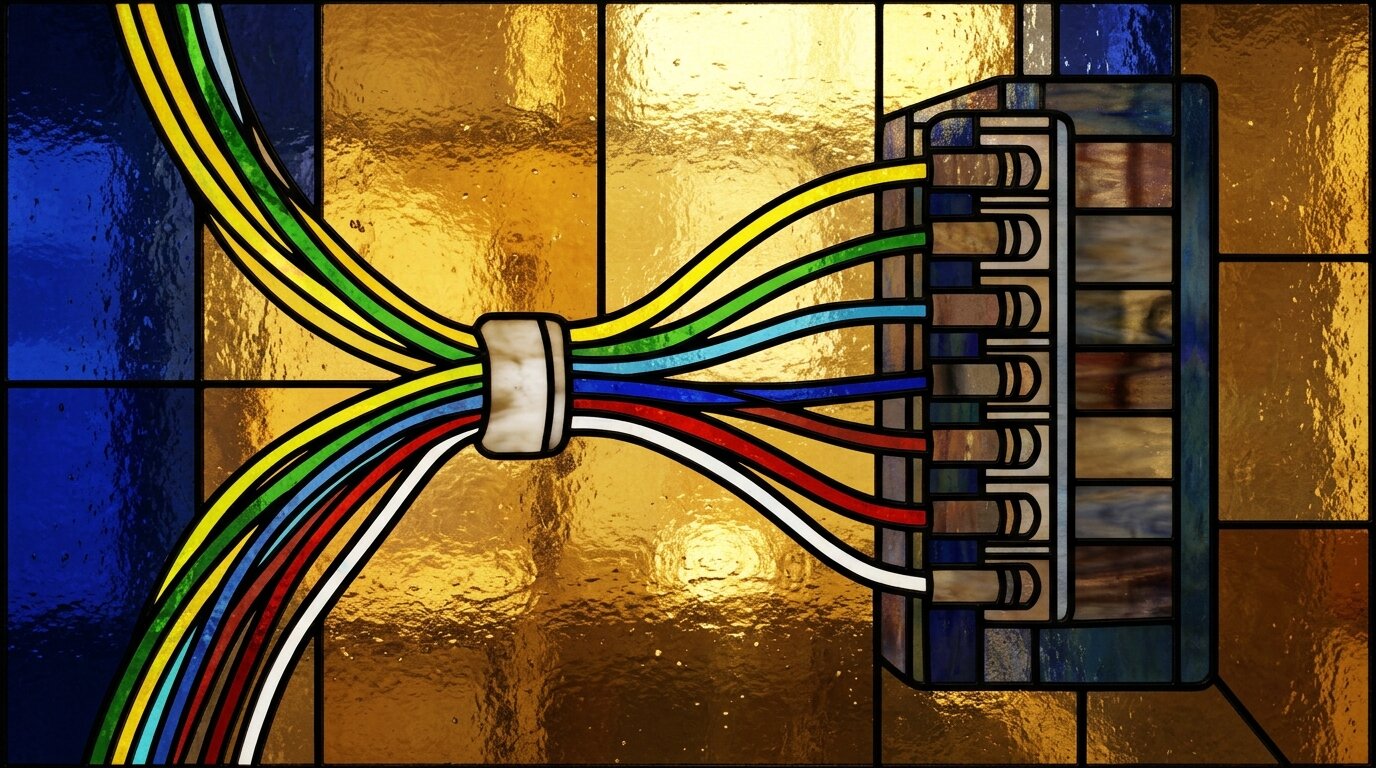
Citation capsule: ANSI and IEC thermocouple color codes use opposite conventions for the negative lead - red under ANSI, white under IEC. Type K appears as a yellow jacket under ANSI and a green jacket under IEC, per HT-Heater (2026). Connector bodies almost always follow ANSI colors regardless of the wire standard inside. Checking the lead insulation itself, not the connector shell, is the only reliable way to confirm polarity before wiring in.
Why Does Type K Drift - and What Is Green Rot?
Type K is cheap and everywhere, but it drifts. In reducing or sulphurous atmospheres its chromel leg oxidizes unevenly, a failure mode known as "green rot." Cycling around 300-500 C adds a separate short-range-ordering drift. Type N was engineered to resist both, per HT-Heater and NPL (2026).
Green rot gets its name from the visible discoloration on the chromel leg where selective oxidation has occurred. In an oxygen-starved or sulphur-bearing atmosphere, chromium in the alloy oxidizes preferentially. That changes the alloy's composition right at the junction and shifts its thermoelectric output - showing up as a slow, hard-to-diagnose reading drift rather than an outright failure. The sensor keeps working; it stops telling the truth.
Short-range-ordering drift is a different mechanism, tied to how the Chromel/Alumel crystal structure rearranges when a junction spends a lot of time cycling through the 300-500 C band. It's less dramatic than green rot but adds up over months of thermal cycling in the same way.
The upgrade path is usually straightforward. If a process runs Type K in a reducing atmosphere, cycles repeatedly through the mid-range, or needs to hold calibration longer between checks, swapping to Type N resolves both drift mechanisms for a modest cost increase. Given the drift risk, it's a trade worth making on any new installation running above a few hundred degrees in anything but a clean, oxidizing atmosphere. Either way, tracking the actual drift rate - rather than assuming a fixed interval - is what sensor calibration and drift covers in more depth.
How Do You Choose a Thermocouple Type?
Choosing a thermocouple type comes down to four questions, answered in order: how hot does it need to read, what atmosphere will it sit in, how accurate does the reading need to be, and how much can the job afford. Type K only wins that comparison by default, not by being the best fit.
Choose by, in order:
- Maximum temperature - rule out any type whose range doesn't comfortably cover your process, with margin for excursions.
- Atmosphere - oxidizing, reducing, vacuum, or corrosive service can eliminate Type K in favor of Type N or a noble metal even when the temperature alone would allow K.
- Accuracy needed - if the process tolerance is tight, check the IEC 60584-1 class, not just the type name; Type T or a noble R/S may be required.
- Cost - noble metals run 10-20x base-metal pricing, so only pay for platinum-rhodium once temperature or atmosphere demands it.
Quick rules of thumb: Type K for general-purpose, dry, oxidizing service; Type J for cheap moderate-temperature work in dry conditions; Type T for cryogenic and food applications where accuracy matters; Type E where you need maximum sensitivity; Type N for stable high-temperature service that would otherwise drift on Type K; and R, S, or B when the process temperature exceeds what any base metal can survive.
If the answer keeps pointing toward tighter accuracy at moderate temperatures rather than extreme range, it's worth revisiting whether a thermocouple is even the right sensor family - see RTD vs thermocouple for when resistance thermometry outperforms any thermocouple class. Once the sensor is chosen, most industrial installations pair it with a transmitter that converts the millivolt signal to a standard loop; see 4-20mA signals for how that conversion typically works. The same how-hot/what-atmosphere/how-accurate framework carries over to other sensor families too - see pressure sensor types and how to select a sensor for the same decision order applied elsewhere.
Frequently Asked Questions
What are the main types of thermocouples?
The common base-metal types are J, K, T, E, and N, covering roughly -270 C to 1372 C between them. Above that, noble-metal types R, S, and B (platinum-rhodium) reach up to about 1820 C, per IEC 60584-1 and ITS-90 reference tables (2026).
How do you tell a Type K from a Type J thermocouple?
Check the color code first: Type K is ANSI yellow, Type J is ANSI black. In the field, the iron leg of a Type J is magnetic - a small magnet sticks to one lead - while neither Type K leg is, per Fabrico (2026).
What is the difference between ANSI and IEC thermocouple color codes?
In ANSI wiring, the negative lead is always red. In IEC wiring, the negative lead is always white - the opposite convention, per HT-Heater (2026). Mixing the two standards on one job is the most common cause of a backwards temperature reading.
Why does a Type K thermocouple drift over time (green rot)?
In reducing or sulphurous atmospheres, the chromel leg of a Type K oxidizes unevenly, producing "green rot" and a downward reading drift; cycling around 300-500 C adds short-range-ordering drift, per HT-Heater and NPL (2026). Type N was engineered to resist both.
Which thermocouple type is the most accurate?
Type T is the most accurate base-metal thermocouple, with an IEC 60584-1 Class 1 tolerance of about +/-0.5 C. Among noble metals, R and S reach Class 1 tolerance of about +/-1.0 C up to 1100 C; Type B has no Class 1 grade at all (2026).
Conclusion
The "type" of a thermocouple is just the alloy pair, and every downstream property - range, sensitivity, atmosphere tolerance, accuracy, cost - falls out of that choice. Type K is the default because it's cheap and works almost everywhere, not because it's the best fit for any job.
Choose by temperature first, then atmosphere, then accuracy, then cost. Reach for Type T when cryogenic accuracy matters, Type E when you need maximum sensitivity, Type N when Type K would drift, and R, S, or B when the process runs hotter than any base metal survives. Keep the Seebeck effect and cold-junction compensation in mind, and never trust a red wire without checking whether the job is wired ANSI or IEC.
For the broader sensor-selection picture, read the industrial sensors guide, and for the other dominant temperature-sensing technology, see RTD vs thermocouple. If resistance thermometry turns out to be the better fit, PT100 vs PT1000 RTDs covers which platinum element to specify.
What are the main types of thermocouples?
The common base-metal types are J, K, T, E, and N, covering roughly -270 C to 1372 C between them. Above that, noble-metal types R, S, and B (platinum-rhodium) reach up to about 1820 C, per IEC 60584-1 and ITS-90 reference tables (2026).
How do you tell a Type K from a Type J thermocouple?
Check the color code first: Type K is ANSI yellow, Type J is ANSI black. In the field, the iron leg of a Type J is magnetic - a small magnet sticks to one lead - while neither Type K leg is, per Fabrico (2026).
What is the difference between ANSI and IEC thermocouple color codes?
In ANSI wiring, the negative lead is always red. In IEC wiring, the negative lead is always white - the opposite convention, per HT-Heater (2026). Mixing the two standards on one job is the most common cause of a backwards temperature reading.
Why does a Type K thermocouple drift over time (green rot)?
In reducing or sulphurous atmospheres, the chromel leg of a Type K oxidizes unevenly, producing "green rot" and a downward reading drift; cycling around 300-500 C adds short-range-ordering drift, per HT-Heater and NPL (2026). Type N was engineered to resist both.
Which thermocouple type is the most accurate?
Type T is the most accurate base-metal thermocouple, with an IEC 60584-1 Class 1 tolerance of about +/-0.5 C. Among noble metals, R and S reach Class 1 tolerance of about +/-1.0 C up to 1100 C; Type B has no Class 1 grade at all (2026).
Related Articles

